
 English
 Español
 中文
中文 हिन्दी
 Français
Government and Politics
Government and Politics of Falkland Islands
Government structure, leadership, capital, military, and national symbols of Falkland Islands.
Government Structure
Constitutional foundations, branches, parties, and leadership.
- Government Type
- NA
- Administrative Divisions
- none (overseas territory of the UK; also claimed by Argentina)
- Legal System
- English common law
- Suffrage
- 18 years of age; universal
- Citizenship
- See United Kingdom
- Executive Branch
- chief of state: King CHARLES III (since 8 September 2022); represented locally by Governor Alison BLAKE (since March 2022) head of government: Governor Alison BLAKE (since March 2022); Chief Executive Andy KEELING (since 2021); Director of Finance Patrick DOYLE (since NA) cabinet: Executive Council; three members elected by the Legislative Assembly, two ex officio members (chief executive and the director of finance), and the governor elections: none; the monarchy is hereditary; governor appointed by the monarch
- Legislative Branch
- Unicameral Legislative Assembly (11 seats — three ex officio members and eight elected by popular vote; members serve four-year terms); presided over by the governor. Elections: Last held on 4 November 2021 (next to be held in November 2025). Election results: Percent of vote — NA; seats — independents 8.
- Judicial Branch
- Supreme Court (chief justice is a nonresident); Magistrates Court (senior magistrate presides over civil and criminal divisions); Court of Summary Jurisdiction
- Political Parties
- none; all independents
- Head of State
- King CHARLES III
- Head of Government
- Governor Alison BLAKE (since March 2022)
- Cabinet
- Executive Council; three members elected by the Legislative Council, two ex officio members (chief executive and the financial secretary), and the governor
- Elections
- Last held on 4 November 2021 (next to be held in November 2025).
- Election Results
- Percent of vote — NA; seats by party — all 8 seats held by independent candidates, with no formal political parties represented in the Legislative Assembly.
- Constitution
- 3 October 1985; amended 1997 and 1998
- Independence
- none (overseas territory of the UK; also claimed by Argentina)
- National Holiday
- Liberation Day, 14 June (1982)
- International Organization Participation
- ICFTU
- Diplomatic Representation in the U.S.
- none (overseas territory of the UK; also claimed by Argentina)
- U.S. Diplomatic Representation
- none (overseas territory of the UK; also claimed by Argentina)
Capital City
Seat of government and political history.
- Capital City
- Stanley
- Location
- 51 42 S, 57 51 W
- Time Difference
- UTC-4 (1 hour ahead of Washington, DC, during Standard Time)
- History
- Named after Edward SMITH-STANLEY (1799-1869), the 14th Earl of Derby, a British statesman and three-time prime minister of the UK who never visited the islands
Military
Branches, service obligations, expenditures, and manpower.
- Military Branches
- No regular military forces
National Symbols
Flag, anthem, and other symbols of national identity.
National Flag
- Flag Symbolism
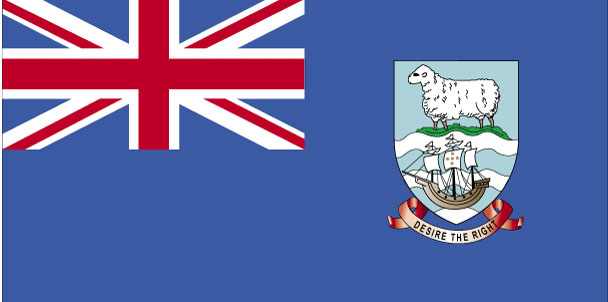
- blue with the flag of the UK in the upper hoist-side quadrant and the Falkland Island coat of arms centered on the outer half of the flag; the coat of arms contains a white ram (sheep raising is the major economic activity) above the sailing ship Desire (whose crew discovered the islands) with a scroll at the bottom bearing the motto DESIRE THE RIGHT
- Flag History
- The badge in the center of the fly portion of the British blue ensign contains the arms granted on Sept. 29, 1948. The ram, standing on tussock grass, denotes that wool is the principal product of the islands. The ship is Desire which was commanded by Captain John Davis in 1592 when he discovered the Falklands. The five stars on its sail allude to the Southern Cross constellation.
- Date of Adoption
- 27 September 1948
National Anthem
- Anthem History
- Falkland Islands are a UK territory