
 English
 Español
 中文
中文 हिन्दी
 Français
Government and Politics
Government and Politics of Denmark
Government structure, leadership, capital, military, and national symbols of Denmark.
Government Structure
Constitutional foundations, branches, parties, and leadership.
- Government Type
- constitutional monarchy
- Administrative Divisions
- metropolitan Denmark - 14 counties (amter, singular - amt) and 2 boroughs* (amtskommuner, singular - amtskomunes); Arhus, Bornholm, Fredericksberg*, Frederiksborg, Fyn, Kobenhavn, Kobenhavns*, Nordjylland, Ribe, Ringkobing, Roskilde, Sonderjylland, Storstrom, Vejle, Vestsjalland, Viborg
- Legal System
- civil law system; judicial review of legislative acts; accepts compulsory ICJ jurisdiction, with reservations
- Suffrage
- 18 years of age; universal
- Citizenship
- citizenship by birth: no citizenship by descent only: at least one parent must be a citizen of Denmark dual citizenship recognized: yes residency requirement for naturalization: 7 years
- Executive Branch
- chief of state: King FREDERIK X (since 14 January 2024); Heir Apparent Crown Prince CHRISTIAN, elder son of the monarch (born 15 October 2005) head of government: Prime Minister Mette FREDERIKSEN (since 27 June 2019) cabinet: Council of State appointed by the monarch elections: none; the monarch is hereditary; following legislative elections, the leader of the majority party or the leader of the majority coalition is usually appointed prime minister by the monarch
- Legislative Branch
- Unicameral People's Assembly or Folketinget (179 seats, including 2 from Greenland and 2 from the Faroe Islands; members are elected by popular vote on the basis of proportional representation to serve four-year terms) Elections: last held on 1 November 2022 (next to be held by November 2026) Election results: percent of vote by party - Social Democrats 27.5%, Liberal Party 13.3%, Denmark Democrats 8.1%, Socialist People's Party 8.3%, Moderates 9.3%, Conservative People's Party 5.5%, Red-Green Alliance 5.1%, Social Liberal Party 4.6%, Danish People's Party 2.6%, Liberal Alliance 7.9%, Alternative 3.3%; seats by party - Social Democrats 50, Liberal Party 23, Denmark Democrats 14, Socialist People's Party 15, Moderates 16, Conservative People's Party 10, Red-Green Alliance 9, Social Liberal Party 7, Danish People's Party 0, Liberal Alliance 14, Alternative 6; note - does not include the 2 seats from Greenland and the 2 seats from the Faroe Islands
- Judicial Branch
- Supreme Court (judges are appointed by the monarch for life)
- Political Parties
- Christian Democrats (was Christian People's Party) [Bodil KORNBEK]; Conservative Party (sometimes known as Conservative People's Party) [Bendt BENDTSEN]; Danish People's Party [Pia KJAERSGAARD]; Liberal Party [Anders Fogh RASMUSSEN]; Red-Green Unity List (bloc includes Left Socialist Party, Communist Party of Denmark, Socialist Workers' Party) [collective leadership]; Social Democratic Party [Helle THORNING-SCHMIDT]; Social Liberal Party (sometimes called the Radical Left) [Marianne JELVED, leader; Soren BALD, chairman]; Socialist People's Party [Villy SOEVNDAL]
- Head of State
- King FREDERIK X
- Head of Government
- Prime Minister Mette FREDERIKSEN
- Cabinet
- Council of State appointed by the monarch
- Elections
- last held on 1 November 2022 (next to be held by November 2026)
- Election Results
- Percent of vote by party - Social Democrats 27.5%, Liberal Party 13.3%, Denmark Democrats 8.1%, Socialist People's Party 8.3%, Moderates 9.3%, Conservative People's Party 5.5%, Red-Green Alliance 5.1%, Social Liberal Party 4.6%, Danish People's Party 2.6%, Liberal Alliance 7.9%, Alternative 3.3%; seats by party - Social Democrats 50, Liberal Party 23, Denmark Democrats 14, Socialist People's Party 15, Moderates 16, Conservative People's Party 10, Red-Green Alliance 9, Social Liberal Party 7, Danish People's Party 0, Liberal Alliance 14, Alternative 6; note - these figures reflect results from the November 2022 general election and do not include the 2 seats from Greenland and the 2 seats from the Faroe Islands, which together bring the total membership of the Folketing to 179 seats.
- Constitution
- 1849 was the original constitution; there was a major overhaul 5 June 1953, allowing for a unicameral legislature and a female chief of state
- Independence
- first organized as a unified state in 10th century; in 1849 became a constitutional monarchy
- National Holiday
- none designated; Constitution Day, 5 June is generally viewed as the National Day
- International Organization Participation
- AfDB, AsDB, Australia Group, BIS, CBSS, CE, CERN, EAPC, EBRD, EIB, ESA, EU, FAO, G- 9, IADB, IAEA, IBRD, ICAO, ICC, ICCt, ICFTU, ICRM, IDA, IEA, IFAD, IFC, IFRCS, IHO, ILO, IMF, IMO, Interpol, IOC, IOM, ISO, ITU, MONUC, NATO, NC, NEA, NIB, NSG, OAS (observer), OECD, OPCW, OSCE, Paris Club, PCA, UN, UNAMSIL, UNCTAD, UNESCO, UNHCR, UNIDO, UNMEE, UNMIK, UNMIL, UNMISET, UNMOGIP, UNOMIG, UNTSO, UPU, WCO, WEU (observer), WHO, WIPO, WMO, WTrO, ZC
- Diplomatic Representation in the U.S.
- chief of mission: Ambassador Friis PETERSEN chancery: 3200 Whitehaven Street NW, Washington, DC 20008 telephone: [1] (202) 234-4300 FAX: [1] (202) 328-1470 consulate(s) general: Chicago, New York
- U.S. Diplomatic Representation
- chief of mission: Ambassador James P. CAIN embassy: Dag Hammarskjolds Alle 24, 2100 Copenhagen mailing address: PSC 73, APO AE 09716 telephone: [45] 33 41 71 00 FAX: [45] 35 43 02 23
Capital City
Seat of government and political history.
- Capital City
- Copenhagen
- Location
- 55 40 N, 12 35 E
- Time Difference
- UTC+1 (6 hours ahead of Washington, DC, during Standard Time)
- History
- name derives from the city's Danish appellation Kobenhavn, meaning "Merchant's Harbor"
Embassy and Diplomatic Representation
Embassy location and contact details.
United States Embassy in Denmark Dag Hammarskjölds Allé 24 2100 Copenhagen Telephone: 45 3341 7100 Emergency after-hours telephone: 45 3341 7400 Fax: 45 3538 9616
Military
Branches, service obligations, expenditures, and manpower.
- Military Branches
- Defense Command: Army Operational Command, Admiral Danish Fleet, Arctic Command, Tactical Air Command, Home Guard
- Service Age and Obligation
- 18 years of age for compulsory and voluntary military service; conscripts serve an initial training period that varies from 4 to 12 months according to specialization; reservists are assigned to mobilization units following completion of their conscript service; women eligible to volunteer for military service
National Symbols
Flag, anthem, and other symbols of national identity.
National Flag
- Flag Symbolism
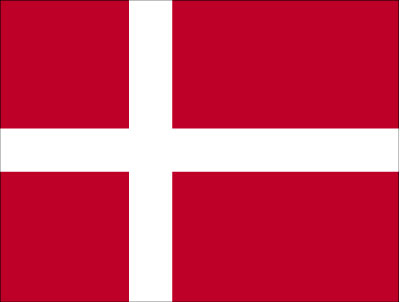
- The flag of Denmark red with a white cross that extends to the edges of the flag; the vertical part of the cross is shifted to the hoist side, and that design element of the Dannebrog (Danish flag) was subsequently adopted by the other Nordic countries of Finland, Iceland, Norway, and Sweden
- Flag History
- According to legend, the Danish national flag (the “Dannebrog”) fell from heaven during a battle in Estonia on 15 June 1219. Public authorities and private people set the flag on special flagflying days, including religious holidays, some royal family birthdays and all national holidays, such as Constitution Day (5 June). Danes also use the national flag on many unofficial occasions. For example, many people put a flag on the table on birthdays and anniversaries. Many Christmas trees are decorated with small paper flags, and flags are also used in Christmas decorations in streets and shops. The extensive use of the flag is an old tradition and not an indication that the Danes are especially nationalistic. Probably the oldest national flag in the world.
- Date of Adoption
- 1625
National Anthem
- Anthem Lyrics
- Der er et yndigt land orig. tekst af Adam Oehlenschläger oversat til engelsk af Peter Ravn Rasmussen Der er et yndigt land, Det står med brede bøge Nær salten østerstrand; Det bugter sig i bakke, dal, Det hedder gamle Danmark, Og det er Frejas sal. Der sad i fordums tid De harniskklædte kæmper, Udhvilede fra strid; Så drog de frem til fjenders mén, Nu hvile deres bene Bag højens bavtasten. Det land endnu er skønt, Thi blå sig søen bælter, Og løvet står så grønt; Og ædle kvinder, skønne mø'r, Og mænd or raske svende Bebo de danskes øer. Hil drot og fædreland! Hil hver en danneborger, Som virker, hvad han kan! Vort gamle Danmark skal bestå, Så længe bøgen spejler Sin top i bølgen blå.
- Anthem Lyrics (English)
- A lovely land is ours A lovely land is ours With beeches green about her Encircled by the sea Her hills and vales are manifold Her name, of old, is Denmark And she is Freya's home In days of long-ago This land was home to heroes From war they rested here Then forth they went, to smite the foe Now to their graves they've gone Among the barrow-stones This land is yet so fair Her waters yet so blue And green are still her leaves And noble ladies, maidens fair, And men and able lads Still dwell on Danish soil Hail Sovereign, hail Home! Hail every Dane who labours To do his very best Our ancient Denmark shall abide, While yet the waves reflect The beeches in their blue Translation: Copyright 1996 Peter Ravn Rasmussen "Permission granted to copy this document for non-commercial or personal use"
Other National Symbols
National Flower
Red Clover
National Bird
The Mute Swan (Knopsvane)
National Tree
Beech
National Tree
beech
Seal
coat of arms
There are two versions of the Danish coat of arms, the small one now called the National Coat of Arms and the large one now called the Royal Coat of Arms. The two coats of arms are used by the royal house and state authorities as a national symbol denoting sovereignty. The National Arms are in principle the coat of arms known from the time of the Valdemars, three lions surrounded by hearts. The Royal Arms with quarterings in one shield held by savages in a pavilion and surrounded by collars of orders of chivalry, has been altered on various occasions, most recently by a royal decree in 1972. In 1959 it was decided that the Royal Arms are used by the monarch, the royal house and the court, and by the Life Guards, while other authorities are to use the National Arms. The Danish coat of arms are ensigned by a crown which was originally open, but since 1624 has been reproduced with arches and an orb with a cross above. The crown symbolises both the royal and national authority. With reproductions of the national arms in seals and on coins, and in connection with the exercise of authority, rights of succession are asserted and sovereignty of the monarch and the state as well. The national arms and the crown are legally protected against misuse. When the designation is indicated, a purveyor to the Royal Court is allowed to use the crown and a Royal Court purveyor the royal coat of arms or the crown alone.
Seal
coat of arms
There are two versions of the Danish coat of arms, the small one now called the National Coat of Arms and the large one now called the Royal Coat of Arms. The two coats of arms are used by the royal house and state authorities as a national symbol denoting sovereignty. The National Arms are in principle the coat of arms known from the time of the Valdemars, three lions surrounded by hearts. The Royal Arms with quarterings in one shield held by savages in a pavilion and surrounded by collars of orders of chivalry, has been altered on various occasions, most recently by a royal decree in 1972. In 1959 it was decided that the Royal Arms are used by the monarch, the royal house and the court, and by the Life Guards, while other authorities are to use the National Arms. The Danish coat of arms are ensigned by a crown which was originally open, but since 1624 has been reproduced with arches and an orb with a cross above. The crown symbolises both the royal and national authority. With reproductions of the national arms in seals and on coins, and in connection with the exercise of authority, rights of succession are asserted and sovereignty of the monarch and the state as well. The national arms and the crown are legally protected against misuse. When the designation is indicated, a purveyor to the Royal Court is allowed to use the crown and a Royal Court purveyor the royal coat of arms or the crown alone.