
 English
 Español
 中文
中文 हिन्दी
 Français
Luxembourg
Luxembourg
Declare Your Relationship to Luxembourg
CountryReports Community
- Studying8
- From Luxembourg1
- Luxembourg heritage2
- Visited1
- Want to visit5
Customs and Culture
Customs and Culture
Cultural Attributes
Luxembourg has a highly developed welfare system that allows people to put food on the table weather they are working or not. Work provides status and self esteem. Education is also provided for by the welfare system, allowing all the ability to obtain an education regardless of your financial situation.
Wealth is best defined by monthly wages, real property, luxury goods, and expensive cars.
When a person dies just prior to death, religious people receive the "last oiling", before the body is transferred to a morgue.

Fortress of Prosperity
Social Customs & Etiquette
Greetings
Men shake hands, even with non-peers, men/women give women three kisses on the cheeks (peer/non-peer, but usually only same age) Younger people often use the expression "salut" (like the French) to say hi, older generations use "Moien" or "Bonjour" (French words are often used to speak in a more "distinguished" way. To greet someone one would generally say "Moien" in the morning, "Metteg" during the day and , "n'Owend" in the evening, n'Owend is the short form of gudden Owend or good evening. "Salut" is widely used by younger generations (age 30 or less).
To get someone's attention on would call their name, shout, whistle, or wave hand sign. Typically their is no public display of affection however, kisses are becoming more accepted.
In school, students not only learn Luxembourgish their native language but they start German classes at age 4, French at age 6, English at 12, and a 5th language at age 15 (either Portuguese, Italian or Spanish)
Visiting
Typical ways people socialize in public include restaurants, bars, or meals among neighbors (especially barbecues in the summer)
If one visits impromptu, they can be turned away in a polite way. If you visit a home, you are not expected to bring gifts. Luxembourgers usually bring a gift for special occasions (birthday, wedding, or dinner) bottle of champagne or wine or flowers are often used as gifts. Upon visiting a home, a person does not usually remove their shoes.
When guests leave, shaking hands and, hugging (relatives) is common.
Personal Appearance
Most people take their fashion ideas from Europe, and the clothing in Luxembourg is very similar to the French, Germans, or Belgians. Usually jeans, shirt, sweater, and coat. Traditional clothes are very rarely used.
Diet
Hearty appetites and large portions are standard for meals. Luxembourg is known for its delicious pastries. Quetsch a plum tart is a seasonal favorite in September. Les penseés brouillées is traditionally eaten on Shrove or Fat Tuesday (the day before lent begins). Favorite dishes include fleeschtaart (meat pies with minced pork filling), civet de lièvre (rabbit served in a thick sauce) and liver dumplings.

Family
National law requires adults to take care of their aging parents. Family size is usually one or two children.
Dating Customs
Dating customs in Luxembourg reflect the country's blend of Western European influences, shaped by its proximity to France, Germany, and Belgium. Social interactions between romantic partners tend to be relatively relaxed and progressive, with young Luxembourgers typically meeting through social circles, university settings, workplaces, or increasingly through dating apps and online platforms.
Luxembourg has one of the higher median ages at first marriage in Europe. In recent years, the average age at which men first marry has hovered around 32 to 34 years, while women tend to marry for the first time between the ages of 30 and 33. This reflects a broader European trend toward prioritizing education, career establishment, and financial stability before committing to marriage.
Cohabitation before marriage is widely accepted and common across all age groups. Many couples live together for several years before deciding to formalize their relationship legally. Luxembourg's legal framework acknowledges this reality through the PACS (Pacte Civil de Solidarité), a civil partnership arrangement borrowed from neighboring France, which offers legal recognition and certain rights to couples who are not married.
Same-sex marriage has been legal in Luxembourg since January 1, 2015, making it one of the earlier adopters of marriage equality in continental Europe. Same-sex couples enjoy the same legal rights as heterosexual married couples, including adoption rights.
The overall marriage rate in Luxembourg has declined gradually over recent decades, consistent with trends seen across the European Union. Divorce is legally accessible and relatively straightforward, requiring the process to go through the civil courts. The divorce rate has increased in step with broader liberalization of family law.
Wedding ceremonies in Luxembourg can be civil, religious, or both. A civil ceremony at the local registry office (commune) is legally required for a marriage to be officially recognized. Religious ceremonies, which are optional and held separately, remain popular particularly among Catholic families, though church attendance and religious observance have declined among younger generations.
Luxembourg's multicultural population, with nearly half of its residents being foreign nationals, also means that cross-cultural relationships and international marriages are quite common throughout the country.
Recreation
The national sport is soccer, like most other European nations. Luxembourg's appearances on the international sports scene although are predominantly due to talents in different single sports as (by order of importance) cycling, tennis, billiards, European bowling, darts, martial arts, athletics.
Children start playing soccer and basketball usually through a school or the community. For adults popular pastimes are soccer, basketball, and cycling.
Holidays
National Day
6/23Birthday
Birthday of Grand Duchess Charlotte
Christmas
12/25Christmas
How do people greet each other in Luxembourg?
Men shake hands, even with non-peers, while women typically receive three kisses on the cheeks (usually among people of the same age). Greetings vary by time of day and generation.
Do
- Say "Moien" in the morning, "Metteg" during the day, and "n'Owend" (short for gudden Owend) in the evening
- Use "Salut" if speaking with younger people (age 30 or less)
- Get someone's attention by calling their name, shouting, whistling, or waving
Don’t
- Don't expect public displays of affection, though kisses are becoming more accepted
Good to know
- Older generations often use "Moien" or "Bonjour," with French words used to sound more distinguished
- Many locals are multilingual, learning Luxembourgish, German, French, English, and a fifth language
What are the dining customs in Luxembourg?
Hearty appetites and large portions are standard, and Luxembourg is especially known for its delicious pastries.
Good to know
- Try seasonal favorites like Quetsch, a plum tart popular in September
- Les pensées brouillées is traditionally eaten on Shrove (Fat) Tuesday
- Sample favorite dishes such as fleeschtaart (minced pork meat pies), civet de lièvre (rabbit in thick sauce), and liver dumplings
What should I know about visiting a home in Luxembourg?
You are not expected to bring gifts on ordinary visits, but gifts are customary for special occasions. Impromptu visitors may be politely turned away.
Do
- Bring a bottle of champagne, wine, or flowers for special occasions like birthdays, weddings, or dinners
- Shake hands when leaving, and hug relatives
Don’t
- Don't feel obligated to remove your shoes when entering a home
- Don't drop by unannounced, as you may be politely turned away
Good to know
- People commonly socialize at restaurants, bars, or neighborhood meals, especially summer barbecues
How should I dress in Luxembourg?
Clothing is very similar to French, German, or Belgian styles, with most people drawing fashion ideas from Europe.
Good to know
- Everyday wear typically includes jeans, a shirt, sweater, and coat
- Traditional clothes are very rarely worn
What is family life like in Luxembourg?
Families are usually small, with one or two children, and caring for aging parents is a legal obligation.
Good to know
- National law requires adults to take care of their aging parents
What do people do for recreation in Luxembourg?
Soccer is the national sport, and popular adult pastimes include soccer, basketball, and cycling.
Good to know
- Children usually start playing soccer and basketball through school or the community
- Luxembourg's international sporting reputation comes mainly from individual sports like cycling, tennis, billiards, European bowling, darts, martial arts, and athletics
Last updated: 2026-07-12 · Sources: CountryReports
Photos of Luxembourg
Photos of Luxembourg


Travel and Tourism
Travel and Tourism
- Travel Alert Status
- Level 1: Exercise Normal Precautions
- Currency
- euro (EUR)
- Time Difference
- UTC+1 (6 hours ahead of Washington, DC, during Standard Time)
- Airports
- 2
Read the full travel guide — health, safety, vaccinations, disease risk, sanitation, and transit details.
View full travel guideRecipes
Recipes
Quetscheflued (Plum Tart)
Dessert
Main Dish
Tripe - Kuddelfleck
Main Dish
F'rell am Rèisleck (Trout in Riesling Sauce)
Main Dish
Judd Mat Gaardebou'nen (Smoked Collar of Pork with Broad Beans)
Main Dish
Trèipen (Black Pudding)
Side Dish
Bou'neschlupp (Green Bean Soup)
Dessert
Quetscheflued (Plum Tart)
History
History
Historical Eras
Medieval County
963 – 1443
Siegfried of the Ardennes acquired the rock fortress of Lucilinburhuc in 963, founding the County of Luxembourg. The territory grew into a significant feudal power in the Holy Roman Empire, briefly elevated to a duchy in 1354. The era ended when Philip the Good of Burgundy acquired Luxembourg through purchase and conquest, beginning four centuries of foreign domination.
Foreign Domination
1443 – 1815
Luxembourg passed successively under Burgundian, Habsburg, Spanish, French, and Austrian rule, serving primarily as a strategic fortress in the heart of Europe. The territory was repeatedly besieged and occupied, earning Vauban's description of Luxembourg as the 'Gibraltar of the North.' French Revolutionary forces annexed it outright in 1795, dissolving its distinct feudal status until the Napoleonic order collapsed.
Grand Duchy Era
1815 – 1867
The Congress of Vienna elevated Luxembourg to a Grand Duchy in 1815, placing it in personal union with the Kingdom of the Netherlands under King William I. The Treaty of London in 1839 severed the French-speaking western half of the territory to Belgium, reducing Luxembourg to roughly its present size but granting genuine political autonomy. Luxembourg joined the German Confederation and maintained a Prussian garrison in its fortress.
Independence & Neutrality
1867 – 1914
The second Treaty of London in 1867 recognized Luxembourg as a fully independent, perpetually neutral state, dissolved the German Confederation garrison, and ordered the dismantling of the great fortress. In 1890, the personal union with the Netherlands ended upon the accession of Grand Duke Adolphe of the Nassau-Weilburg line, establishing an entirely separate dynasty. The country developed its steel industry in the Minette region, laying foundations for future prosperity.
World Wars Period
1914 – 1948
German forces violated Luxembourg's neutrality in both 1914 and 1940, occupying the Grand Duchy throughout each conflict. During World War II, the Nazi regime annexed Luxembourg outright, conscripting Luxembourgers into the Wehrmacht and suppressing the national language. Liberation by Allied forces in 1944 was followed by the Battle of the Bulge scarring the country's Ardennes region; these twin occupations permanently discredited neutrality as a policy.
European Integration
1948 – present
Luxembourg abandoned neutrality in 1948 by joining the Benelux Customs Union and became a founding member of NATO in 1949. It was among the six original signatories of the 1951 Treaty of Paris establishing the European Coal and Steel Community, and later a founding member of the European Economic Community in 1957. Luxembourg City became a key seat of EU institutions, and the country adopted the euro in 2002, cementing its identity as a hub of European integration and international finance.
Overview
The present sovereign, Grand Duke Henri, succeeded his father, Grand Duke Jean, on October 7, 2000. Grand Duke Jean announced his decision to abdicate in December 1999, after a 35-year reign.
The national language of Luxembourg is Luxembourgish, a blend of Dutch, old German, and Frankish elements. The official language of the civil service, law, and parliament is French, although criminal and legal debates are conducted partly in Luxembourgish and police case files are recorded in German. German is the primary language of the press. French and German are taught in the schools, with German spoken mainly at the primary level and French at the secondary level.
Timeline of Key Events
1867
Luxembourg gained independence.
Luxembourg gained independence.
1890
Grand Duchy of Luxembourg separated from the Netherlands.
Grand Duchy of Luxembourg separated from the Netherlands.
1914 – 1918
Outbreak of World War I. Luxembourg is occupied by Germany until 1918.
Outbreak of World War I. Luxembourg is occupied by Germany until 1918.
1920
Luxembourg joins the League of Nations.
Luxembourg joins the League of Nations.
1921
Luxembourg enters economic union with Belgium.
Luxembourg enters economic union with Belgium. The use of the Belgian currency in Luxembourg is permitted.
1940
Luxembourg is again occupied by Germany.
Luxembourg is again occupied by Germany. The occupation lasts for most of World War II, until 1944.
1948
Luxembourg abandons its neutrality.
Luxembourg abandons its neutrality. Forms an economic union with Belgium and the Netherlands.
Read the full history profile — narrative overview, defining eras, and the complete timeline in one place.
View expanded historyInteresting Facts
Interesting Facts
Luxembourg has the world's highest GNP per capita at $45,100 per year.
See every fact — trivia, oddities, and curious tidbits gathered from across the country.
View all interesting factsGeography and Environment
Geography and Environment
- Terrain
- mostly gently rolling uplands with broad, shallow valleys; uplands to slightly mountainous in the north; steep slope down to Moselle flood plain in the southeast
- Climate
- Temperatures range from 5°F (-15°C) to 90°F (32°C), with an annual mean temperature of 49°F (9°C). Summer temperatures average 60°F (15°C) and winters are mild with an average low of 29°F (-1.7°C). July and August are the warmest months; May and June are the sunniest; and January and February are the coldest months. Luxembourg has a climate much like that of the U.S. Pacific Northwest-cool, temperate, and rainy. The northwesterly winds that traverse the western, lower portion of the Belgian Ardennes cause abundant clouds, fog, and rain. Average annual rainfall is 30 inches; some rain falls 50% of the year.
- Natural Hazards
- NA
- Current Environmental Issues
- air and water pollution in urban areas, soil pollution of farmland
Read the full geography and environment profile — terrain, climate, natural resources, hazards, land use, and international agreements.
View full geographyPeople & Demographics
People & Demographics
Religion
Languages Spoken
Luxembourgish (national language), German (administrative language), French
- French
- German
- Luxembourgish
Population
- Population
- 660,809
- Population in Major Urban Areas
- LUXEMBOURG (capital) 94,000
- Nationality Noun
- Luxembourger(s)
- Ethnic Groups
- Celtic base (with French and German blend), Portuguese, Italian, Slavs (from Montenegro, Albania, and Kosovo) and European (guest and resident workers)
Education
- Literacy Definition
- age 15 and over can read and write
Life Expectancy
- Life Expectancy at Birth
- Luxembourg consistently ranks among the top countries in the world for life expectancy, reflecting its high standard of living, well-funded public healthcare system, and strong economic prosperity. As of the most recent available data, life expectancy at birth in Luxembourg stands at approximately 82 to 83 years overall, with women typically living longer than men. Women in Luxembourg can expect to live to around 84 to 85 years, while men have an average life expectancy of approximately 80 to 81 years. These figures place Luxembourg well above the global average and on par with other leading European nations such as Switzerland, Spain, and Iceland. The country's universal healthcare system, known for its comprehensive coverage and accessibility, plays a central role in supporting long, healthy lives for residents. Luxembourg's healthcare expenditure per capita is among the highest in the European Union, enabling access to advanced medical treatments, preventive care, and specialist services. Several factors contribute to Luxembourg's strong life expectancy outcomes. The country maintains low rates of extreme poverty, high levels of education, and robust environmental regulations that help ensure clean air and water. Luxembourg has also made significant investments in public health infrastructure, including mental health services and programs targeting chronic disease prevention. The aging population is a notable demographic trend in Luxembourg, as it is across much of Europe. The government has responded with policies aimed at sustainable pension funding and long-term care planning to accommodate a growing share of elderly residents. Immigration also plays a meaningful role in shaping demographic statistics, as Luxembourg has one of the highest proportions of foreign-born residents of any country in the world, accounting for nearly half the total population. This concentration of working-age immigrants can influence national health averages in complex ways, generally skewing figures in a favorable direction. Overall, the combination of economic stability, quality healthcare, strong social safety nets, and a high standard of living makes Luxembourg one of the most favorable environments in the world for longevity.
- Infant Mortality Rate
- Luxembourg maintains one of the lowest infant mortality rates in the world, reflecting the country's exceptional healthcare infrastructure, high standard of living, and robust social support systems. As of the most recent available data, Luxembourg's infant mortality rate stands at approximately 3 to 4 deaths per 1,000 live births, placing it consistently among the top-performing nations globally on this critical public health measure. This achievement is the result of decades of sustained investment in prenatal and postnatal care, a highly trained medical workforce, and universal access to healthcare services. Expectant mothers in Luxembourg receive comprehensive prenatal monitoring, and childbirth almost universally takes place in modern, well-equipped hospital facilities. The country's national health insurance system, known as the Caisse Nationale de Santé, ensures that virtually all residents — including non-citizens, who make up a significant portion of the population — have access to medical care without prohibitive out-of-pocket costs. Luxembourg also benefits from strong social policies that support families, including generous parental leave, subsidized childcare, and programs targeting maternal nutrition and infant health. These structural advantages significantly reduce risk factors associated with infant mortality, such as low birth weight, preterm birth complications, and lack of access to neonatal care. Regional comparisons further highlight Luxembourg's performance. The country's infant mortality rate is on par with or lower than many of its European neighbors, including Germany, France, and Belgium, and compares favorably to the European Union average of roughly 3 to 5 deaths per 1,000 live births in recent years. While Luxembourg's rate is impressively low, public health authorities continue to monitor disparities among different socioeconomic and immigrant communities within the country, recognizing that equitable health outcomes require ongoing attention. Nevertheless, Luxembourg's infant mortality statistics stand as a testament to the effectiveness of integrated healthcare and social welfare systems in protecting the lives of newborns and supporting healthy early childhood development.
Read the full people and society profile — demographics, health, education, religion, languages, and notable people.
View full people and societyGovernment & Politics
Government & Politics
Country Identity
- Country Name
- Luxembourg
- Full Country Name
- Grand Duchy of Luxembourg
- Local - Long
- Grand Duche de Luxembourg
- Local - Short
- Luxembourg
Government Structure
- Government Type
- constitutional monarchy
- Legal System
- based on civil law system; accepts compulsory ICJ jurisdiction
- Executive Branch
- chief of state: Grand Duke HENRI (since 7 October 2000); Heir Apparent Prince GUILLAUME (son of the monarch, born 11 November 1981) head of government: Prime Minister Luc FRIEDEN (since 17 November 2023); Deputy Prime Minister Xavier BETTEL (since 17 November 2023) cabinet: Council of Ministers recommended by the prime minister and appointed by the monarch elections: none; the monarch is hereditary; following popular elections to the Chamber of Deputies, the leader of the majority party or the leader of the majority coalition is usually appointed prime minister by the monarch; the deputy prime minister is appointed by the monarch; they are responsible to the Chamber of Deputies note: government coalition - CSV and DP
- Legislative Branch
- Unicameral Chamber of Deputies or Chambre des Députés (60 seats; members are elected by direct popular vote to serve five-year terms) Elections: last held on 8 October 2023 (next to be held in October 2028) Election results: percent of vote by party - CSV 28.1%, LSAP 18.0%, DP 14.3%, Green Party 8.6%, ADR 9.0%, Pirate Party 6.8%, déi Lénk 5.0%; seats by party - CSV 21, LSAP 11, DP 14, Green Party 4, ADR 5, Pirate Party 6, déi Lénk 2 (approximate distribution based on 2023 results) Note: there is also a Council of State that serves as an advisory body to the Chamber of Deputies; the Council of State has 21 members appointed by the Grand Duke on the advice of the prime minister
- Judicial Branch
- judicial courts and tribunals (3 Justices of the Peace, 2 district courts, and 1 Supreme Court of Appeals); administrative courts and tribunals (State Prosecutor's Office, administrative courts and tribunals, and the Constitutional Court); judges for all courts are appointed for life by the monarch
- Suffrage
- 18 years of age; universal and compulsory
- Constitution
- 17 October 1868, occasional revisions
- Independence
- 1839 (from the Netherlands)
- National Holiday
- National Day (Birthday of Grand Duchess Charlotte) 23 June
Capital City
- Capital Name
- Luxembourg
- Capital - geographic coordinate
- 49 36 N, 6 07 E
- Capital Time Difference
- UTC+1 (6 hours ahead of Washington, DC, during Standard Time)
the name derives from the Celtic lucilem (little) and the German burg (castle or fortress) to produce the meaning of the "little castle"; the name is actually ironic, since for centuries the Fortress of Luxembourg was one of Europe's most formidable fortifications; the name passed to the city that grew around the fortress
Military
Branches: Luxembourg Army (L'Armee Luxembourgeoises)
Embassy / Diplomatic Mission
U.S. Embassy Luxembourg
22, Blvd Emmanuel Servais, L-2535 Luxembourg City
Telephone: (352) 46 01 23 (available 24/7),
Emergency after-hours telephone: (352) 621 547 133 (duty officer)
Facsimile: (352) 46 19 39
Email: luxembourgconsular@state.gov
Read the full government profile — flag symbolism, national anthem, and other national symbols.
View full government detailsEconomy
Economy
Luxembourg boasts a stable, high-income economy characterized by moderate growth, low inflation, and relatively low unemployment. While the industrial sector was historically dominated by steel, it has diversified considerably to include chemicals, automotive components, glass, and aluminum. The financial services sector is now the cornerstone of the economy, accounting for roughly 25-30% of GDP, and Luxembourg ranks as one of the world's leading investment fund centers, second only to the United States. Most banks operating in the country are foreign-owned and maintain extensive international dealings. Agriculture plays a minor role and is based largely on small family-owned farms. The economy is heavily reliant on foreign and cross-border workers, who make up nearly half of the labor force, commuting daily from France, Belgium, and Germany. Despite vulnerabilities tied to global financial conditions and recent inflationary pressures from energy costs, Luxembourg has maintained resilient growth and continues to enjoy one of the highest standards of living and GDP per capita in the world.
Snapshot
- Currency Name and Code
- Euro (EUR)
- GDP — official exchange rate
- $31,760,000,000 (USD)
- GDP Real Growth Rate
- 1.4%
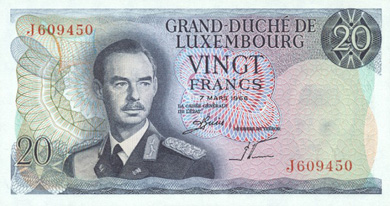
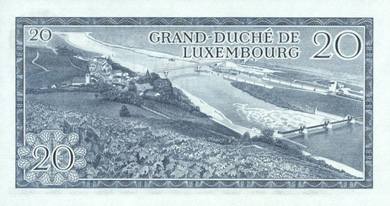
Banknotes
Budget & Public Finance
- Fiscal Year
- calendar year
- Investment (% of GDP)
- 19.7%
- Reserves of Foreign Exchange
- $173,500,000 (USD)
Labor, Industry & Trade
- Labor Force by Occupation
- services 90.1%; industry 8%; agriculture 1.9%
- Industries
- banking, iron and steel, food processing, chemicals, metal products, engineering, tires, glass, aluminum
- Agriculture Products
- barley, oats, potatoes, wheat, fruits, wine grapes; livestock products
- Export Commodities
- machinery and equipment, steel products, chemicals, rubber products, glass
- Export Partners
- Germany 23.9%, France 20.1%, Belgium 10.5%, UK 8.7%, Italy 6.1%, Spain 4.5%, Netherlands 4.4%
- Import Commodities
- minerals, metals, foodstuffs, quality consumer goods
- Import Partners
- Belgium 29.7%, Germany 23%, France 13.2%, Taiwan 7.3%, Netherlands 4.6%
Energy
- Oil Production
- 0 bbl/day
- Oil Consumption
- 52,000 bbl/day
- Oil Reserves
- 0 bbl/day
- Natural Gas Production
- 0 cu m
- Natural Gas Consumption
- 1,312,000,000 cu m
- Natural Gas Imports
- 876,000,000 cu m
- Natural Gas Exports
- 0 cu m
- Natural Gas Reserves
- 0 cu m
Communications
- Telephone System
- general assessment: highly developed, completely automated and efficient system, mainly buried cables domestic: fixed line teledensity over 50 per 100 persons; nationwide mobile-cellular telephone system with market for mobile-cellular phones virtually saturated international: country code - 352
- Internet Country Code
- .lu
News & Weather
News & Weather
Current Weather
Latest News
A Sapphire and Diamond State Visit Tiara for the Grand Duchess of Luxembourg - The Court Jeweller
The Court Jeweller · 13h ago
Luxembourg's Grand Duchess, 42, dons mesmerising shape-shifting tiara to host her first state banquet - Yahoo
Yahoo · 3h ago
Nations League highlights: Luxembourg 0-3 Iceland - UEFA.com
UEFA.com · 2d ago
Spain, Portugal and Luxembourg push for 2040 EU renewable energy target - Reuters
Reuters · 3d ago
The Luxembourg Pavilion Examines Overconsumption of Living Space Through "Excess!" at the 2027 Venice Architecture Biennale - ArchDaily
ArchDaily · 2d ago
Preview: Estonia vs Luxembourg - prediction, team news, lineups - Sports Mole
Sports Mole · 19h ago
Grand Duchess Stephanie hosts her first state banquet since taking the throne – with a shape-shifting tiara - HELLO! Magazine
HELLO! Magazine · 3h ago
Finnish State Visit to Luxembourg - royalwatcherblog.com
royalwatcherblog.com · 2d ago
News via Google News
Frequently Asked Questions
Frequently Asked Questions
What is the population of Luxembourg?
What is the capital of Luxembourg?
Where is Luxembourg located?
What countries border Luxembourg?
What religion is practiced in Luxembourg?
What currency does Luxembourg use?
What languages are spoken in Luxembourg?
What is Luxembourg known for?
Last reviewed 2026