
 English
 Español
 中文
中文 हिन्दी
 Français
Government and Politics
Government and Politics of France
Government structure, leadership, capital, military, and national symbols of France.
Government Structure
Constitutional foundations, branches, parties, and leadership.
- Government Type
- republic
- Administrative Divisions
- 22 regions (regions, singular - region); Alsace, Aquitaine, Auvergne, Basse-Normandie, Bourgogne, Bretagne, Centre, Champagne-Ardenne, Corse, Franche-Comte, Haute-Normandie, Ile-de-France, Languedoc-Roussillon, Limousin, Lorraine, Midi-Pyrenees, Nord-Pas-de-Calais, Pays de la Loire, Picardie, Poitou-Charentes, Provence-Alpes-Cote d'Azur, Rhone-Alpes
- Legal System
- civil law system with indigenous concepts; review of administrative but not legislative acts
- Suffrage
- 18 years of age; universal
- Citizenship
- citizenship by birth: no citizenship by descent only: at least one parent must be a citizen of France dual citizenship recognized: yes residency requirement for naturalization: 5 years
- Executive Branch
- chief of state: President Emmanuel MACRON (since 14 May 2017; reelected for a second five-year term on 24 April 2022) head of government: Prime Minister François BAYROU (since 13 January 2025) cabinet: Council of Ministers appointed by the president on the suggestion of the prime minister elections: president elected by popular vote for a five-year term; election last held 10 April and 24 April 2022 (next to be held in spring 2027); prime minister nominated by the National Assembly majority and appointed by the president election results: Emmanuel MACRON reelected president; percent of vote, second ballot - Emmanuel MACRON (Renaissance) 58.55%, Marine LE PEN (RN) 41.45%
- Legislative Branch
- Bicameral Parliament or Parlement consists of the Senate or Sénat (348 seats; members are indirectly elected by an electoral college composed of local and regional elected officials to serve six-year terms, with one-half of the seats renewed every three years) and the National Assembly or Assemblée Nationale (577 seats; members are elected by popular vote under a two-round single-member majority system to serve five-year terms). Elections: Senate - last held in September 2023 (next to be held in September 2026); National Assembly - last held on 30 June and 7 July 2024 (next to be held no later than July 2029). Election results: Senate - seats by party - Les Républicains (LR) 139, Socialist Party (PS) and allies 64, Rally for the Republic (RDPI/Renaissance and allies) 57, Union Centriste (UC) 56, Rassemblement National (RN) 22, Ecologist and Solidarity Group 17, other and non-attached 13; National Assembly - seats by party - New Popular Front (NFP) coalition 193, Ensemble (centrist alliance) 166, Rassemblement National and allies 143, Les Républicains 39, other and non-attached 36.
- Judicial Branch
- Supreme Court of Appeals or Cour de Cassation (judges are appointed by the president from nominations of the High Council of the Judiciary); Constitutional Council or Conseil Constitutionnel (three members appointed by the president, three appointed by the president of the National Assembly, and three appointed by the president of the Senate); Council of State or Conseil d'Etat
- Political Parties
- Citizen and Republican Movement or MCR [Jean Pierre CHEVENEMENT]; Democratic and European Social Rally or RDSE (mainly Radical Republican and Socialist Parties, and PRG) [Jacques PELLETIER]; French Communist Party or PCF [Marie-George BUFFET]; Greens [Yann WEHRLING, national secretary]; Left Radical Party or PRG (previously Radical Socialist Party or PRS and the Left Radical Movement or MRG) [Jean-Michel BAYLET]; Movement for France or MPF [Philippe DE VILLIERS]; National Front or FN [Jean-Marie LE PEN]; Rally for France or RPF [Charles PASQUA]; Socialist Party or PS [Francois HOLLANDE]; Union for French Democracy or UDF [Francois BAYROU]; Union for a Popular Movement or UMP [Nicolas SARKOZY]
- Head of State
- President Emmanuel MACRON (since 14 May 2017
- Head of Government
- Prime Minister François BAYROU
- Cabinet
- Council of Ministers appointed by the president at the suggestion of the prime minister
- Elections
- Senate - last held in September 2023 (next to be held in September 2026); National Assembly - last held on 30 June and 7 July 2024 (next to be held no later than July 2029).
- Election Results
- Senate - seats by party - Les Républicains (LR) 139, Socialist Party (PS) and allies 64, Rally for the Republic (RDPI/Renaissance and allies) 57, Union Centriste (UC) 56, Rassemblement National (RN) 22, Ecologist and Solidarity Group 17, other and non-attached 13; National Assembly - seats by party - New Popular Front (NFP) coalition 193, Ensemble (centrist alliance) 166, Rassemblement National and allies 143, Les Républicains 39, other and non-attached 36.
- Constitution
- 28 September 1958, amended concerning election of president in 1962, amended to comply with provisions of 1992 EC Maastricht Treaty, 1996 Amsterdam Treaty, 2000 Treaty of Nice; amended to tighten immigration laws in 1993; amended to change the seven-year presidential term to a five-year term in 2000
- Independence
- 486 (unified by Clovis)
- National Holiday
- Bastille Day, 14 July (1789)
- International Organization Participation
- ABEDA, ACCT, AfDB, AsDB, Australia Group, BDEAC, BIS, BSEC (observer), CE, CERN, EAPC, EBRD, EIB, EMU, ESA, EU, FAO, G- 5, G- 7, G- 8, G-10, IADB, IAEA, IBRD, ICAO, ICC, ICCt, ICFTU, ICRM, IDA, IEA, IFAD, IFC, IFRCS, IHO, ILO, IMF, IMO, InOC, Interpol, IOC, IOM, ISO, ITU, MICAH, MINURSO, MONUC, NAM (guest), NATO, NEA, NSG, OAS (observer), OECD, OPCW, OSCE, Paris Club, PCA, UN, UN Security Council, UNCTAD, UNESCO, UNHCR, UNIDO, UNIFIL, UNITAR, UNMEE, UNMIK, UNMIL, UNMOVIC, UNOMIG, UNRWA, UNTSO, UPU, WADB (nonregional), WCL, WCO, WEU, WFTU, WHO, WIPO, WMO, WToO, WTrO, ZC
- Diplomatic Representation in the U.S.
- chief of mission: Ambassador Jean-David LEVITTE chancery: 4101 Reservoir Road NW, Washington, DC 20007 telephone: [1] (202) 944-6000 FAX: [1] (202) 944-6166 consulate(s) general: Atlanta, Boston, Chicago, Houston, Los Angeles, Miami, New Orleans, New York, and San Francisco
- U.S. Diplomatic Representation
- chief of mission: Ambassador Craig R. STAPLETON embassy: 2 Avenue Gabriel, 75382 Paris Cedex 08 mailing address: PSC 116, APO AE 09777 telephone: [33] (1) 43-12-22-22 FAX: [33] (1) 42 66 97 83 consulate(s) general: Marseille, Strasbourg
Capital City
Seat of government and political history.
- Capital City
- Paris
- Location
- 48 52 N, 2 20 E
- Time Difference
- UTC+1 (6 hours ahead of Washington, DC, during Standard Time) time zone note: applies to metropolitan France only; for its overseas regions the time difference is UTC-4 for Guadeloupe and Martinique, UTC-3 for French Guiana, UTC+3 for Mayotte, and UTC+4 for Reunion
- History
- name derives from the Parisii, a Celtic tribe that inhabited the area from the 3rd century B.C., but who were conquered by the Romans in the 1st century B.C.; the Celtic settlement became the Roman town of Lutetia Parisiorum (Lutetia of the Parisii); over subsequent centuries it became Parisium and then just Paris
Embassy and Diplomatic Representation
Embassy location and contact details.
U.S. Embassy Paris 2 Avenue Gabriel 75008 Telephone: 33 (1) 43 12 22 22 Fax: 33 (1) 42 66 97 83 Website: http://france.usembassy.gov/index.html U.S. Consulate General Marseilles Place Varian Fry 13286 Marseille Cedex 6 Telephone: 33 (0) 4 91 54 92 00 Fax: 04 91 55 09 47 Website: http://marseille.usconsulate.gov/about-us.html U.S. Consulate General Strasbourg 15, Avenue d'Alsace 67082 Strasbourg Cedex Telephone: 33 (3) 88 35 31 04 Fax: 33 (3) 88 24 06 95 Website: http://strasbourg.usconsulate.gov/index.html U.S. Consular Agency Nice 7, Avenue Gustave V 3rd floor Tel. 33 (4) 93 88 89 55 Fax 33 (4) 93 87 07 38 Website: http://marseille.usconsulate.gov/nice.html All of our telephone numbers below are written the way you would dial them from the United States. When calling from within France, drop the country code and add a zero. For example: 33 (1) 43 12 22 22 becomes (01) 43 12 22 22.
Military
Branches, service obligations, expenditures, and manpower.
- Military Branches
- Army (Armee de Terre; includes Marines, Foreign Legion, Army Light Aviation), Navy (Marine Nationale), Air Force (Armee de l'Air (AdlA); includes Air Defense)
- Service Age and Obligation
- 18-25 years of age for male and female voluntary military service; no conscription; 1-year service obligation; women serve in noncombat posts
National Symbols
Flag, anthem, and other symbols of national identity.
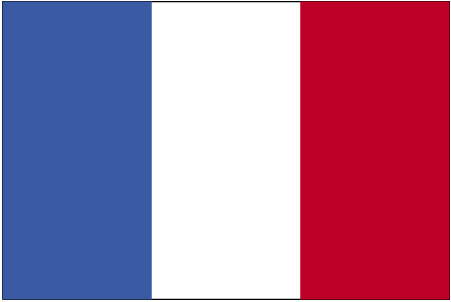
National Flag
- Flag Symbolism
- three equal vertical bands of blue (hoist side), white, and red; known as the French Tricouleur (Tricolor); the design and/or colors are similar to a number of other flags, including those of Belgium, Chad, Ireland, Cote d'Ivoire, Luxembourg, and Netherlands; the official flag for all French dependent areas
- Flag History
- In the early days of the French Revolution, the three colors were initially brought together in the form of a cockade. In July 1789, just before the taking of the Bastille, Paris was in a state of high agitation. A militia was formed; its distinctive sign was a two-color cockade made up of the ancient colors of Paris, blue and red. On July 17, Louis XVI came to Paris to recognize the new National Guard, sporting the blue and red cockade, to which the Commander of the Guard, Lafayette, it appears, had added the royal white. The law of 27 pluviôse, Year II (February 15, 1794), established the "tricolor" as the national flag. At the recommendation of the painter David, the law stipulated that the blue should be flown nearest the flagstaff. Throughout the 19th century, the blue of the legitimist royalists contended with the three colours inherited from the Revolution. The white flag was re-introduced under the Restoration, but Louis-Philippe reinstated the "tricolor," surmounting it with the Gallic rooster. During the Revolution of 1848, the provisional Government adopted the “tricolor,” but the people on the barricades brandished a red flag to signal their revolt. Under the Third Republic, a consensus gradually emerged around the three colours. From 1880 onwards, the presentation of the colors to the armed forces each July 14 came to be a moment of high patriotic fervour. While the Comte de Chambord, pretender to the French throne, never accepted the “tricolor,” the royalists ended up rallying round the national flag at the time of the First World War. The constitutions of 1946 and 1958 (article 2) instituted the "blue, white and red" flag as the national emblem of the Republic. Today, the French flag can be seen on all public buildings. It is flown on the occasion of national commemorations, and it is honored according to a very precisely-defined ceremony. The French flag frequently serves as a backdrop when the French President addresses the public. Depending on the circumstances, it may be accompanied by the European flag or the flag of another country.
- Date of Adoption
- 20 May 1794
National Anthem
- Anthem Lyrics
- La Marseillaise Allons enfants de la patrie, Le jour de gloire est arrivé Contre nous de la tyrannie L'étendard sanglant est levé Entendez vous dans les campagnes, Mugir ces féroces soldats? Ils viennent jusque dans nos bras Egorger nos fils, nos compagnes! Refrain Aux armes, citoyens! Formez vos bataillons! Marchons! Marchons! Qu'un sang impur Abreuve nos sillons! Amour sacré de la patrie, Conduis, soutiens nos bras vengeurs! Liberté, Liberté cherie, Combats avec tes defenseurs! Sous nos drapeaux, que la victoire Accoure à tes males accents! Que tes ennemis expirants Voient ton triomphe et notre gloire! Refrain Nous entrerons dans la carrière Quand nos ainés n'y seront plus; Nous y trouverons leur poussière Et la trace de leurs vertus. Bien moins jaloux de leur survivre Que de partager leur cercueil, Nous aurons le sublime orgueil De les venger ou de les suivre! Refrain
- Anthem Lyrics (English)
- Arise children of the fatherland The day of glory has arrived Against us tyranny's Bloody standard is raised Listen to the sound in the fields The howling of these fearsome soldiers They are coming into our midst To cut the throats of your sons and consorts To arms citizens Form you battalions March, march Let impure blood Water our furrows What do they want this horde of slaves Of traitors and conspiratorial kings? For whom these vile chains These long-prepared irons? Frenchmen, for us, ah! What outrage What methods must be taken? It is we they dare plan To return to the old slavery! What! These foreign cohorts! They would make laws in our courts! What! These mercenary phalanxes Would cut down our warrior sons Good Lord! By chained hands Our brow would yield under the yoke The vile despots would have themselves be The masters of destiny Tremble, tyrants and traitors The shame of all good men Tremble! Your parricidal schemes Will receive their just reward Against you we are all soldiers If they fall, our young heros France will bear new ones Ready to join the fight against you Frenchmen, as magnanimous warriors Bear or hold back your blows Spare these sad victims Who with regret are taking up arms against us But not these bloody despots These accomplices of Bouillé All these tigers who pitilessly Are ripping open their mothers' breasts We shall enter into the pit When our elders will no longer be there There we shall find their ashes And the mark of their virtues We are much less jealous of surviving them Than of sharing their coffins We shall have the sublime pride Of avenging or joining them Sacred Love for the Fatherland Lead and support our avenging arms Liberty, cherished liberty Join the struggle with your defenders Under our flags, let victory hasten to you virile (or manly) force So that in death your enemies See your triumph and our glory!
- Anthem History
- La Marseillaise, the French national anthem, was composed in one night during the French Revolution (April 24, 1792) by Claude-Joseph Rouget de Lisle, a captain of the engineers and amateur musician stationed in Strasbourg in 1792. It was played at a patriotic banquet at Marseilles, and printed copies were given to the revolutionary forces then marching on Paris. They entered Paris singing this song, and to it they marched to the Tuileries on August 10th. Ironically, Rouget de Lisle was himself a royalist and refused to take the oath of allegiance to the new constitution. He was imprisoned and barely escaped the guillotine. Originally entitled Chant de guerre de l'armée du Rhin (War Song of the Army of the Rhine), the anthem became called La Marseillaise because of its popularity with volunteer army units from Marseilles. The Convention accepted it as the French national anthem in a decree passed July 14, 1795. La Marseillaise was banned by Napoléon during the Empire, and by Louis XVIII on the Second Restoration (1815), because of its revolutionary associations. Authorized after the July Revolution of 1830, it was again banned by Napoléon III and not reinstated until 1879.
Other National Symbols
National Flower
lily (Ancien Régime)
The large flowers have three petals along with three petal-like sepals, often fragrant, and come in a range of colours ranging through whites, yellows, oranges, pinks, reds, purples, bronze and even nearly black. Markings include spots, brush strokes and picotees. The plants are summer flowering. Most species are deciduous, but Lilium candidum bears a basal rosette of leaves for much of the year. Flowers are formed at the top of a single erect stem, with leaves being borne at intervals up the stem.
Motto
Liberty, Equality, Fraternity