
 English
 Español
 中文
中文 हिन्दी
 Français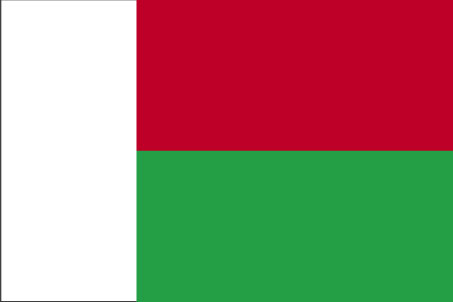
Madagascar
Madagascar
Declare Your Relationship to Madagascar
CountryReports Community
- Studying6
- From Madagascar1
- Madagascar heritage0
- Visited1
- Want to visit0
Customs and Culture
Customs and Culture
About the People
Family is important, with parents and elderly being respected and honored. Close ties between this world and the next influence the Malagasy attitude of vintana or fate ordained by the position of moon, sun, and stars. Fady or Taboos on the use of certain substances, particularly foods, or on the performance, including the timing, of certain acts continue to regulate much of Malagasy life. However, It is important to remember, that customs, particularly dietary prohibitions, vary widely among different ethnic groups, and from village to village
Cultural Attributes
Family is important, with parents and elderly being respected and honored. Close ties between this world and the next influence the Malagasy attitude of vintana or fate ordained by the position of moon, sun, and stars. Fady or Taboos on the use of certain substances, particularly foods, or on the performance, including the timing, of certain acts continue to regulate much of Malagasy life.

The Island Where Ancestors Still Dwell
Greetings, Gestures & Visiting
Saying Manahoana (hello) and a handshake is a proper greeting. Saying Veloma
Diet
Rice is the main staple. Many people if they can afford it eat rice three times a day. At mealtime some families watch TV and discuss the events of the day.

Family
The family system is very important in Madagascar. It is more important to respect people than to "make money". Most kids begin school about six years of age. In some areas men only work for a few months or until they have enough to satisfy their family needs.
Recreation
Soccer, volleyball, tolona (wrestling) and swimming are popular sports. Family activities are also important. Fanorona (pronounced "Fuh-noorn") is a Malagasy board game that
Holidays
Independence Day
6/26Independence Day
Christmas
12/25Christmas
Christmas in Madagscar is a fun and festive summertime occasion. Called Noely, and pronounced ‘know-ly’ in the official Malagasy language, Christmas in this southeastern African coast brings out the best in everybody. Even strangers find themselves wishing each other Arahaba tratry ny noely or Merry Christmas. Since Christmas comes during the summer months, some Malagasy people spend the days before and after Christmas on the beach.
Instead of saying Merry Christmas and a Happy New Year, the more formal Madagscar Christmas greeting is Mirary Krismasy Sambatra sy Taona vaovao tonga lafatra ho anao. The more common greeting friends tell each other in Madagscar, however, is Tratry ny Krismasy’ or ‘be caught by Christmas,’ the response for which is samy ho tratry ny ho avy isika or ‘may we all be caught by the next one.’ This is a Malagasy reflection of how time seems to sneak up on you unexpectedly.
Dadaby Noely (Grandfather Christmas) is the Malagasy name for Santa Clause and they remember him as they exchange small presents. Although Dadaby Noely comes in a traditional red outfit and white beard, he is somewhat thin and brings the children hard candies instead of toys. Just like in the Western traditions, Dadaby Noely is said to arrive on his sleigh on Christmas Eve and brings a lot of hard candy along with some gifts for children who have been good.
Christmas decorations are put up starting the first or the second week of December. No matter how hot it is, the usual decorations include snow, holly and robins. Very few real Christmas pine trees are put up. This is because pine is not endemic to Madagascar and the government discourages its use as deforestation is quite an issue in the locale.
Stores do not over-decorate their shop windows nor put up real Christmas trees. Rather, they resort to simple décor such as cut out snowflakes and sprigs of holly and lined with Christmas lights. In the event that Christmas trees are indeed put up, these are usually made of plastic. Trees are decorated with ornaments such as Christmas balls, dolls, cut out snowflakes and hard candy using the traditional Christmas colors of red and green.
One particular Madagascan Christmas specialty is fresh lychees which many street vendors sell. A true indication that the holiday season has arrived in Madagascar is when Lychee skins line the streets and sidewalks. Christmas flowers or Poinsettias bloom all year round are a popular plant and are usually found in large shrubs outside each home.
Christmas celebrations start on the eve of Christmas, December 24 in their calendar which is January 6 on the calendar of the Western world. There is a Midnight Mass held on Christmas Eve at the church that begins at five in the afternoon and lasts until just after midnight. Families get all dressed up and go to church. In church, children sing traditional Christmas carols in Malagasy and celebrate the birth of Jesus. After midnight, families go home and enjoy Christmas dinner which usually consists of specially prepared pork or chicken and rice. This is followed by a specially made cake before bedtime.
The day after Christmas, children open small presents. Families go back to church for Holy Communion which is held in all the various churches. The celebration of Christmas ends on the December 25 and preparations begin for the even more festive New Year celebrations on January 1. The end of the Christmas season becomes apparent after January 1 when the decorations are once again taken down.
Many families choose Christmas day to hold baptisms. At one point, more than one hundred Madagascan baptisms were held on Christmas. With the Norwegian roots of the Malagasy Lutheran Church, most of the Christmas carols are sung in traditional tunes, albeit in the Malagasy language. Christmas carols are sung in the church and include songs such as Sambasamba Zanahary which is Malagasy for ‘It’s a big opportunity Lord that You sent Your only Son to save us from sin.’ Another Madagascar Christmas Carol which follows the tune of ‘Oh Come All Ye Faithful’ is Avia Ry Mino. Other than the carols sung at church, Madagascar Christmas caroling usually happens in Easter time rather than throughout the Christmas holidays.
Dates of Interest
- December 25th
Christmas in Madagscar is a fun and festive summertime occasion. Called Noely, and pronounced "know-ly" in the official Malagasy language, Christmas in this southeastern African coast brings out the best in everybody. Even strangers find themselves wishing each other Arahaba tratry ny noely or Merry Christmas. Since Christmas comes during the summer months, some Malagasy people spend the days before and after Christmas on the beach. Instead of saying Merry Christmas and a Happy New Year, the more formal Madagscar Christmas greeting is Mirary Krismasy Sambatra sy Taona vaovao tonga lafatra ho anao. The more common greeting friends tell each other in Madagscar, however, is Tratry ny Krismasy’ or "be caught by Christmas," the response for which is samy ho tratry ny ho avy isika or "may we all be caught by the next one." This is a Malagasy reflection of how time seems to sneak up on yo
How do people greet each other in Madagascar?
Say Manahoana (hello) with a handshake, and Veloma (goodbye) with a handshake; kissing on both cheeks is common among friends.
Do
- Shake hands when greeting and saying goodbye
- Kiss on both cheeks with friends
Good to know
- Women and young people usually initiate greetings when meeting elderly people
What are dining customs like in Madagascar?
Rice is the main staple, and many people eat it three times a day if they can afford it. Some families watch TV and discuss the day's events at mealtime.
Good to know
- Rice features at most meals
What etiquette should I know in Madagascar?
Malagasy people are warm and friendly in familiar settings but reserved with strangers, and refusing something offered without explanation is considered rude.
Do
- Give a proper explanation or make up an excuse rather than flatly saying no
- Respect that customs and dietary prohibitions (fady/taboos) vary from village to village
Don’t
- Don't refuse anything offered without an explanation
- Don't expect strangers to start conversations with you
Good to know
- The Malagasy attitude of vintana holds that fate is ordained by the position of the moon, sun, and stars
How should I dress in Madagascar?
Both Western-style and traditional clothing are worn. Traditional items include the lamba, a bright multi-colored cloth reaching the ankles.
Good to know
- In rural areas men wear malabars, cotton shirt-like garments
How important is family in Madagascar?
The family system is very important, and respecting people is valued more than making money, with parents and the elderly especially respected and honored.
Do
- Show respect to parents and the elderly
Good to know
- Most children begin school around age six
- On weekends family and friends gather to catch up on news
What do people do for recreation in Madagascar?
Popular sports include soccer, volleyball, tolona (wrestling), and swimming, and family activities are also important.
Good to know
- Fanorona is a traditional Malagasy board game where each player starts with 22 stones and wins by capturing all the opponent's stones
- Madagascar is known for basket-weaving and painting on silk
Last updated: 2026-07-12 · Sources: CountryReports
Photos of Madagascar
Photos of Madagascar
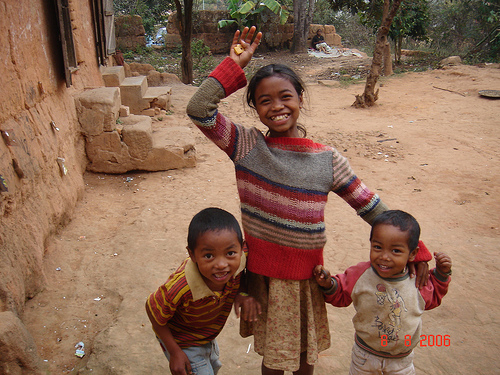
Kids pose for the camera
Tall trees line the roadway in Madagascar
Open marketplace in Madagascar
Local women take a walk.
Local children take goods back home.
A waterfall in Madagascar,
A local boy sales vegatables.
Local children pose for the camera.
Interesting rock formations in Madagascar.
Suspension bridge spans a rock canyon.
Seafood meal in Madagascar.


Travel and Tourism
Travel and Tourism
- Travel Alert Status
- Level 2: Exercise Increased Caution
- Currency
- Malagasy franc (MGF)
- Time Difference
- UTC+3 (8 hours ahead of Washington, DC, during Standard Time)
- Climate
- Madagascar's geography creates many climatic subdivisions. The coastal climate is hot and tropical, with the east coast receiving the most rainfall (more than 160 inches of rain in Maroantsetra.). This is due to the effect of moisture-laden trade winds off the Indian Ocean as they encounter the steep escarpment of the Madagascar coastline. The east coast is also most affected by the cyclones which periodically hit the island, often causing extensive damage. East coast temperatures reach an average high of 85° in the summer and 72° in the winter. On the west coast, precipitation levels drop off from north to south. There are desert areas of the deep south which receive only 2 inches of rain per year. West coast temperatures are generally several degrees warmer than the east coast temperatures. The central highlands, where the capital Antananarivo is located, have a more temperate climate. There are two primary seasons; the rainy summer season, which lasts from approximately November through mid-March; and the dry season, from mid-March through October. In (southern) summer, there are periods of rain almost every day, often in the late afternoon. Cyclones, which can affect the coastal areas, do not reach the highlands, but their influence can cause extended periods of rain. The average daily high temperature in summer is in the mid 80's, with a hot mid-day sun alternating with the periods of rain. Nighttime lows average in the low 60's. The shoulder months of April, May and September, October are very pleasant, with little rain, blue skies, and daytime highs in the 70's. In the (southern) winter months of June-August, the skies are often sunny and daytime highs can reach the mid-to-high 60s. However, there are also chilly days which are overcast and windy with daytime highs in the 50's. Nighttime lows in winter can drop into the 40's in Antananarivo.
- Airports
- 116
Read the full travel guide — health, safety, vaccinations, disease risk, sanitation, and transit details.
View full travel guideRecipes
Recipes
Salady Voankazo - Fruit Compote with Lichee Nuts
Dessert
Main Dish
Varenga — Roasted Shredded Beef
Main Dish
Vary Amin Anana — Rice and Vegetables
Side Dish
Sakay — Hot Red Pepper
Soup
Lasopy — Vegetable Soup
Dessert
Salady Voankazo — Fruit Compote with Lichee Nuts
Dessert
Salady Voankazo - Fruit Compote with Lichee Nuts
History
History
Historical Eras
Early Settlement
500 – 1500
Madagascar was first settled by Austronesian seafarers from the Indonesian archipelago around the 5th century CE, with subsequent waves of Bantu-speaking migrants from mainland Africa. By 1200, the central highlands were increasingly populated and early Malagasy societies were forming distinct cultural identities. This period laid the linguistic and cultural foundations of the Malagasy people, whose language retains strong Austronesian roots.
Merina Kingdom
1500 – 1896
European contact began in 1500 when Portuguese navigator Diogo Dias arrived, though Madagascar resisted colonization for centuries. The Merina kingdom of the central highlands rose to dominance, with King Radama I unifying much of the island in the early 19th century and welcoming British missionaries. Queen Ranavalona I reversed this openness after 1828, persecuting Christians and expelling foreigners, while the Franco-Malagasy War of 1883–1885 foreshadowed the eventual loss of sovereignty.
French Colonial Rule
1896 – 1960
France formally annexed Madagascar as a colony in 1896 following a military invasion two years prior, abolishing the Merina monarchy and exiling Queen Ranavalona III. Resistance persisted, culminating in the devastating 1947 uprising, which French forces suppressed at a cost of up to 80,000 Malagasy lives. During World War II, British troops briefly occupied the island in 1942 before transferring control to Free France, and Madagascar became a French Overseas Territory in 1946.
First Republic
1960 – 1975
Madagascar gained full independence on June 26, 1960, with Philibert Tsiranana becoming the country's first president under a conservative, pro-Western orientation that maintained close ties with France. Tsiranana's government faced growing social unrest, and a series of peasant revolts in 1971–1972 eroded his authority. Military intervention in 1972 effectively ended the First Republic, setting the stage for a dramatic ideological shift.
Socialist Second Republic
1975 – 1993
Lieutenant Commander Didier Ratsiraka assumed power in 1975, reorienting Madagascar toward Marxist socialism, nationalizing key industries, and renaming the country the Democratic Republic of Madagascar. His Arema party maintained single-party rule for nearly two decades, during which economic decline and international isolation severely impoverished the population. Rising political dissent in the early 1990s forced democratic reforms, ending the socialist experiment.
Third Republic
1993 – present
The inauguration of Albert Zafy in March 1993 inaugurated the Third Republic and multiparty democracy following free elections that ended 17 years of single-party rule. Political instability persisted, with Ratsiraka returning to the presidency in 1997 and a deeply contested 2001 election between Ratsiraka and Marc Ravalomanana nearly splitting the country before the High Constitutional Court confirmed Ravalomanana's victory in April 2002. Subsequent decades have been marked by recurring constitutional crises, coups, and efforts at democratic consolidation.
Overview
Figure 2. Madagascar: Administrative Divisions, 1994
Timeline of Key Events
1200
The central highlands of the island are settled
The central highlands of the island are settled.
1500
Diogo Dias becomes first European to land on Madagascar
Portuguese sea captain Diogo Dias becomes first European to land on Madagascar after he is blown off course on the way to India. He named the island St. Lawrence.
1600
Pirates ruled the eastern coast of the island
Pirates ruled the eastern coast of the island from the 1600s through the early 1700s.
1828 – 1861
Queen Ranavalona I ruled over Madagascar
Queen Ranavalona I ruled over Madagascar.
1835
Queen Ranavalona I persecuted and expelled foreigners
Madagascar’s Queen Ranavalona I persecuted and expelled foreigners, including the island’s missionaries and extended her rule all over the island with her 20,000-man army.
1861 – 1863
Radama II ruled from 1861 until his assassination
Radama II (1829-1863), the son of Queen Ranavalona I, succeeded her to rule Madagascar. He ruled from 1861 until his assassination in 1863.
1883 – 1885
Franco-Malagasy War results in December 17, 1885 peace agreement
Franco-Malagasy War results in December 17, 1885 peace agreement that gives France a greater influence in the affairs of Madagascar.
Read the full history profile — narrative overview, defining eras, and the complete timeline in one place.
View expanded historyInteresting Facts
Interesting Facts
Because ancestors are so important, people continue to take care of their family members after they have died. During a ceremony called famadihana, family members open the dead person’s grave and removed the lamba he or she was wearing when buried. Then they wash the body and wrap it in a new silk lamba.
Children go to school at 7am. Classes are taught in French. At 10 am children go home for lundh and a rest. At 3pm they go back to school until 5pm.
They have a set of rules called Fady that explain what people should not do. Ex: Being rude to a stranger is fady. Refusing a stranger’s kindness is fady. Children eating their meals before their elders is fady.
See every fact — trivia, oddities, and curious tidbits gathered from across the country.
View all interesting factsGeography and Environment
Geography and Environment
- Terrain
- narrow coastal plain, high plateau and mountains in center
- Climate
- Madagascar's geography creates many climatic subdivisions. The coastal climate is hot and tropical, with the east coast receiving the most rainfall (more than 160 inches of rain in Maroantsetra.). This is due to the effect of moisture-laden trade winds off the Indian Ocean as they encounter the steep escarpment of the Madagascar coastline. The east coast is also most affected by the cyclones which periodically hit the island, often causing extensive damage. East coast temperatures reach an average high of 85 in the summer and 72 in the winter. On the west coast, precipitation levels drop off from north to south. There are desert areas of the deep south which receive only 2 inches of rain per year. West coast temperatures are generally several degrees warmer than the east coast temperatures. The central highlands, where the capital Antananarivo is located, have a more temperate climate. There are two primary seasons; the rainy summer season, which lasts from approximately November through mid-March; and the dry season, from mid-March through October. In (southern) summer, there are periods of rain almost every day, often in the late afternoon. Cyclones, which can affect the coastal areas, do not reach the highlands, but their influence can cause extended periods of rain. The average daily high temperature in summer is in the mid 80's, with a hot mid-day sun alternating with the periods of rain. Nighttime lows average in the low 60's. The shoulder months of April, May and September, October are very pleasant, with little rain, blue skies, and daytime highs in the 70's. In the (southern) winter months of June-August, the skies are often sunny and daytime highs can reach the mid-to-high 60s. However, there are also chilly days which are overcast and windy with daytime highs in the 50's. Nighttime lows in winter can drop into the 40's in Antananarivo.
- Natural Hazards
- periodic cyclones, drought, and locust infestation
- Current Environmental Issues
- soil erosion results from deforestation and overgrazing; desertification; surface water contaminated with raw sewage and other organic wastes; several species of flora and fauna unique to the island are endangered
Read the full geography and environment profile — terrain, climate, natural resources, hazards, land use, and international agreements.
View full geographyPeople & Demographics
People & Demographics
Religion
Languages Spoken
French (official), Malagasy (official)
- Malagasy
- French
Population
- Population
- 21,281,844
- Population in Major Urban Areas
- ANTANANARIVO (capital) 1.987 million
- Nationality Noun
- Malagasy (singular and plural)
- Ethnic Groups
- Malayo-Indonesian (Merina and related Betsileo), Cotiers (mixed African, Malayo-Indonesian, and Arab ancestry - Betsimisaraka, Tsimihety, Antaisaka, Sakalava), French, Indian, Creole, Comoran
Education
- Literacy Definition
- age 15 and over can read and write
Health Information
- Major Infectious Diseases — degree of risk
- very high
Read the full people and society profile — demographics, health, education, religion, languages, and notable people.
View full people and societyGovernment & Politics
Government & Politics
Country Identity
- Country Name
- Madagascar
- Full Country Name
- Republic of Madagascar
- Local - Long
- Republique de Madagascar
- Local - Short
- Madagascar
- Former Name
- Malagasy Republic
Government Structure
- Government Type
- republic
- Legal System
- based on French civil law system and traditional Malagasy law; has not accepted compulsory ICJ jurisdiction
- Executive Branch
- chief of state: President Marc RAVALOMANANA (since 6 May 2002) head of government: Prime Minister Jacques SYLLA (27 May 2002) cabinet: Council of Ministers appointed by the prime minister elections: president elected by popular vote for a five-year term; election last held 16 December 2001 (next to be held December 2006); prime minister appointed by the president election results: percent of vote - Marc RAVALOMANANA (TIM) 50.5%, Didier RATSIRAKA (AREMA) 37.7%
- Legislative Branch
- bicameral legislature consists of a National Assembly or Assemblee Nationale (160 seats; members are directly elected by popular vote to serve four-year terms) and a Senate or Senat (100 seats; two-thirds of the seats filled by regional assemblies whose members will be elected by popular vote; the remaining one-third of the seats appointed by the president; all members will serve four-year terms) elections: National Assembly - last held 15 December 2002 (next to be held December 2006) election results: National Assembly - percent of vote by party - NA%; seats by party - TIM 103, FP 22, AREMA 3, LEADER/Fanilo 2, RPSD 5, others 3, independents 22
- Judicial Branch
- Supreme Court or Cour Supreme; High Constitutional Court or Haute Cour Constitutionnelle
- Suffrage
- 18 years of age; universal
- Constitution
- 19 August 1992 by national referendum
- Independence
- 26 June 1960 (from France)
- National Holiday
- Independence Day, 26 June (1960)
Capital City
- Capital Name
- Antananarivo
- Capital - geographic coordinate
- 18 55 S, 47 31 E
- Capital Time Difference
- UTC+3 (8 hours ahead of Washington, DC, during Standard Time)
the name, which means "City of the Thousand," was bestowed by 17th century King ADRIANJAKA to honor the soldiers assigned to guard the city
Military
Branches: People's Armed Forces: Intervention Force, Development Force, and Aeronaval Force (navy and air); National Gendarmerie
Embassy / Diplomatic Mission
U.S. Embassy Antananarivo
Lot 207 A, Point Liberty, Andranoro-Antehiroka,
Antananarivo (105), Madagascar
Mailing address: B.P. 5253, Antananarivo (105) Madagascar
Telephone: [261] (20) 23-480-00
Fax: [261] (20) 23-480-35
Read the full government profile — flag symbolism, national anthem, and other national symbols.
View full government detailsEconomy
Economy
Madagascar is a low-income country whose economy remains heavily dependent on agriculture, mining, light manufacturing, and tourism. After abandoning socialist economic policies in the 1990s, the country pursued World Bank and IMF-backed reforms emphasizing privatization and liberalization, but progress has been repeatedly disrupted by political instability, most notably the 2009 coup that toppled President Marc Ravalomanana and triggered international sanctions and the suspension of foreign aid. The return to constitutional rule following the 2013 elections allowed Madagascar to re-engage with international donors and resume a path of modest growth.
Agriculture, including fishing and forestry, continues to employ roughly two-thirds of the workforce and contributes about one-fifth of GDP, with vanilla, cloves, coffee, lychees, and shrimp among the leading exports. Madagascar is the world's largest producer of vanilla, and the sector remains a major source of foreign exchange despite price volatility. The mining sector has grown significantly, with large-scale nickel, cobalt, ilmenite, and graphite operations contributing to exports. The textile and apparel industry also remains important, supported by preferential access to U.S. markets under the African Growth and Opportunity Act.
Persistent challenges include widespread poverty, with around three-quarters of the population living below the international poverty line, weak infrastructure, vulnerability to cyclones and droughts, and severe environmental degradation driven by deforestation, slash-and-burn agriculture, and reliance on charcoal and firewood for energy. The COVID-19 pandemic and subsequent global shocks slowed growth and worsened food insecurity, particularly in the drought-affected south. Government priorities under President Andry Rajoelina center on infrastructure investment, energy expansion, mining development, poverty reduction, and combating corruption, though governance weaknesses and external vulnerabilities continue to constrain progress.
Snapshot
- Currency Name and Code
- Malagasy Franc (MGF)
- GDP — official exchange rate
- $4,719,000,000 (USD)
- GDP Real Growth Rate
- 5.1%
- Gini Index
- 47.5
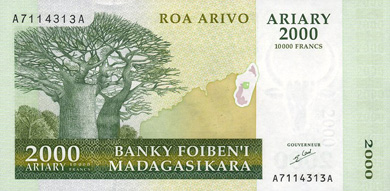
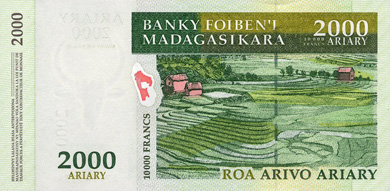
Banknotes
Budget & Public Finance
- Fiscal Year
- calendar year
- Annual Budget
- $853,000,000 (USD)
- External Debt
- $4,600,000,000 (USD)
- Investment (% of GDP)
- 26.8%
- Economic Aid
- $354,000,000 (USD)
- Current Account Balance
- -$292,000,000 (USD)
- Reserves of Foreign Exchange
- $539,000,000 (USD)
Labor, Industry & Trade
- Household Income — highest 10%
- 29%
- Industries
- meat processing, soap, breweries, tanneries, sugar, textiles, glassware, cement, automobile assembly plant, paper, petroleum, tourism
- Agriculture Products
- coffee, vanilla, sugarcane, cloves, cocoa, rice, cassava (tapioca), beans, bananas, peanuts; livestock products
- Export Commodities
- coffee, vanilla, shellfish, sugar; cotton cloth, chromite, petroleum products
- Export Partners
- France 39.2%, US 19.8%, Germany 5.5%, Japan 4.8%, Singapore 4.2%
- Import Commodities
- capital goods, petroleum, consumer goods, food
- Import Partners
- France 37.9%, US 19.1%, Germany 5.3%, Japan 4.7%, Singapore 4.1%
Energy
- Oil Production
- 89 bbl/day
- Oil Consumption
- 15,000 bbl/day
- Oil Reserves
- 0 bbl/day
- Natural Gas Production
- 0 cu m
- Natural Gas Consumption
- 0 cu m
- Natural Gas Imports
- 0 cu m
- Natural Gas Exports
- 0 cu m
- Natural Gas Reserves
- 0 cu m
Communications
- Telephone System
- general assessment: system is above average for the region; Antananarivo's main telephone exchange modernized in the late 1990s, but the rest of the analogue-based telephone system is poorly developed domestic: combined fixed-line and mobile-cellular teledensity about 40 per 100 persons international: country code - 261; landing point for the EASSy, SEACOM, and LION fiber-optic submarine cable systems; satellite earth stations - 2 (1 Intelsat - Indian Ocean, 1 Intersputnik - Atlantic Ocean region)
- Internet Country Code
- .mg
News & Weather
News & Weather
Current Weather
Latest News
Madagascar: IPC Acute Food Insecurity and Malnutrition Snapshot | May 2026 - April 2027 - ReliefWeb
ReliefWeb · 3d ago
Hunger Warning as Madagascar Crisis Deepens - Save the Children US
Save the Children US · 2d ago
TBC student plans to take what he learned home to Madagascar - Baptist Press
Baptist Press · 1d ago
Half a million under-5 children in Madagascar face acute malnutrition, report says - Anadolu Ajansı
Anadolu Ajansı · 1d ago
No Longer Invisible: Unlocking Legal Identity for Millions in Madagascar - World Bank Group
World Bank Group · 17d ago
United States Delivers Life-Saving Health Supplies and equipment to Madagascar - U.S. Embassy in Madagascar (.gov)
U.S. Embassy in Madagascar (.gov) · 6d ago
SADC Executive Secretary Reaffirms Support for Madagascar During Courtesy Meeting with Foreign Affairs Minister - SADC
SADC · 2d ago
This is why lemurs adopt yoga-like poses. And no, it’s not to become more flexible… - BBC Wildlife Magazine
BBC Wildlife Magazine · 16h ago
News via Google News
Climate Overview
Madagascar's geography creates many climatic subdivisions. The coastal climate is hot and tropical, with the east coast receiving the most rainfall (more than 160 inches of rain in Maroantsetra.). This is due to the effect of moisture-laden trade winds off the Indian Ocean as they encounter the steep escarpment of the Madagascar coastline. The east coast is also most affected by the cyclones which periodically hit the island, often causing extensive damage. East coast temperatures reach an average high of 85° in the summer and 72° in the winter.
On the west coast, precipitation levels drop off from north to south. There are desert areas of the deep south which receive only 2 inches of rain per year. West coast temperatures are generally several degrees warmer than the east coast temperatures.
The central highlands, where the capital Antananarivo is located, have a more temperate climate. There are two primary seasons; the rainy summer season, which lasts from approximately November through mid-March; and the dry season, from mid-March through October. In (southern) summer, there are periods of rain almost every day, often in the late afternoon. Cyclones, which can affect the coastal areas, do not reach the highlands, but their influence can cause extended periods of rain. The average daily high temperature in summer is in the mid 80's, with a hot mid-day sun alternating with the periods of rain. Nighttime lows average in the low 60's.
The shoulder months of April, May and September, October are very pleasant, with little rain, blue skies, and daytime highs in the 70's. In the (southern) winter months of June-August, the skies are often sunny and daytime highs can reach the mid-to-high 60s. However, there are also chilly days which are overcast and windy with daytime highs in the 50's. Nighttime lows in winter can drop into the 40's in Antananarivo.
Frequently Asked Questions
Frequently Asked Questions
What is the population of Madagascar?
How do people greet each other in Madagascar?
What are dining customs like in Madagascar?
What etiquette should I know in Madagascar?
How should I dress in Madagascar?
How important is family in Madagascar?
What do people do for recreation in Madagascar?
What is the capital of Madagascar?
Where is Madagascar located?
What are the ocean and sea borders of Madagascar?
What religion is practiced in Madagascar?
What is the currency of Madagascar?
What languages are spoken in Madagascar?
What is the geography and terrain of Madagascar like?
What is Madagascar known for?
Last reviewed 2026