
 English
 Español
 中文
中文 हिन्दी
 Français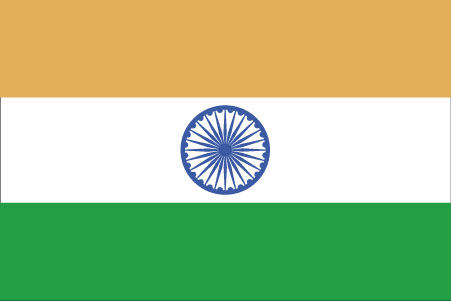
India
Declare Your Relationship to India
CountryReports Community
- Studying5
- From India16
- India heritage3
- Visited2
- Want to visit3
Customs and Culture
Customs and Culture
Cultural Attributes
Physical purity and spiritual refinement are highly valued. Fatalism is widespread in the country, as it is a component of the major religions of India. Indians are proud of a rich heritage that has produced numerous architectural and artistic masterpieces. They are equally proud of being the world’s most populous democracy where free elections have determined leadership since 1947.
Working people work for financial stability, food, clothing, and shelter. Wealth is defined as ownership of land or other real property. The poorest members wish for food, clothing & shelter. Wealth is also defined by the good name you earn in society.

Land of a Thousand Gods and Spices
Get More Customs and Culture
5 more cultural topics for members
Social Customs & Etiquette · Diet · Family · Dating Customs · Recreation
Holidays
Republic Day
1/26Independence
Birthdate - Ravi Shankar
4/7Birthday
Birthdate - Ravi Shankar, Indian sitarist and composer, was born in Varanasi, India.
Birthdate - Rabindranath Tagore
5/7Birthday
Birthdate - Rabindranath Tagore, Indian poet, was born in Calcutta, West Bengal, British India. [now India]
Christmas
12/25Christmas
Dates of Interest
- December 25th
Birthdate - Rabindranath Tagore, an Indian poet, was born in Calcutta, West Bengal, British India. [now India]
How do people greet each other in India?
The traditional greeting is "namaste," said with palms pressed together (fingers pointing up) below the chin; "Hello" and "Hi" are also acceptable in urban areas since English is widely spoken.
Do
- Say "Namaste Bhai" to a man or "Namaste Behan" to a woman
- Add a slight bow to show respect to superiors
- Use titles like Dr, Mr, Shri (men), Shreemati (married women), Kumari (single women), or the suffix Ji with a last name
- Ask permission before taking your leave
Don’t
- Don't shake hands with or touch women; foreign men especially should not initiate a handshake with a woman
- Don't forget: a younger person touches an elder's feet for blessings, while same-age people shake hands casually
Good to know
- In rural North India say "Ram Ram Bhai/Behan" or "Kya haal chaal hai"
- In southern India, "namaskaram" is used
- Use the right hand for the salaam greeting with Muslims
- People often open with questions like "Did you have breakfast/lunch?"
What are the dining customs in India?
Families often eat together and may use the right hand instead of utensils; meals are usually very spicy, with rice a staple in the south and wheat bread (roti) in the north.
Do
- Eat with your right hand if utensils aren't used
- Try betel leaves and nuts after meals to aid digestion
- Make a "namaste" gesture to indicate you've had enough to eat
Don’t
- Don't let your lips touch a communal cup when drinking from it
- Don't offer beef to Hindus (cows are sacred) or pork or alcohol to Muslims
Good to know
- Vegetarianism is widely practiced, often for religious reasons
- Curries of eggs, fish, meat, or vegetables in spicy sauce are popular
- Women may eat after other family members and guests
- Some Hindus object to food handled by members of lower castes
What are the etiquette and hospitality customs in India?
Visiting usually happens in the home, often unannounced among friends and family, and guests are expected to reciprocate hospitality with gifts.
Do
- Bring sweets, flowers, or fruit when invited for a meal
- Remove your shoes before entering the living room or home
- Immediately remove any flower garland you're given and carry it in your hand as a sign of humility
- Say namaste to indicate you are ready to leave
Don’t
- Don't stare at impoverished people, as it is considered humiliating
- Don't show anger—it is the worst way to achieve anything in India
- Don't expect a direct "no"; Indians may say "I'll try" if they cannot attend
Good to know
- In large cities, arrange visits in advance rather than dropping in
- Guests may give specialty foods or gifts for the children
How should you dress in India?
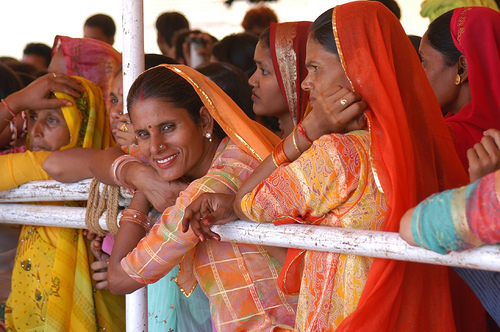
Women may wear a saree, which can reflect social standing or religious affiliation, while men's clothing varies by religion, such as turbans for Sikhs or long shirts with pants for Hindus and Muslims.
Good to know
- Hindu women may wear a Bindi (red dot) on the forehead as a sign of femininity, marital status, or beauty
- A married woman's Bindi with white or vermilion powder signifies her husband is alive; widows do not wear one
- Indian women prefer wearing a large amount of jewelry
- Sikh men wear turbans and items of religious significance
What gestures should travelers know in India?
Certain gestures carry strong meaning: beckon with the palm turned down, point with the chin, and grasp your earlobes to express repentance or sincerity.
Don’t
- Don't whistle—it is very impolite, and women winking or whistling is considered unladylike
- Don't let your feet or shoes touch another person; apologize immediately if they do
- Don't lick postage stamps—use the water provided to moisten them
Good to know
- Cover your head when entering a Sikh shrine
- Remove your footwear before entering a temple
- Fold your hands as in prayer with palms pressed together pointing upward while saying "num-us-tay"
What is family life like in India?
The family takes precedence over the individual, with extended families often living together and the father as the head of the household.
Good to know
- The elderly are respected and cared for by their families
- A middle or upper-class father supports his children financially until they finish education and get a job
- Dating is not common; marriages are still often arranged by parents with the couple's consent
- Weddings are elaborate celebrations that vary by region, often involving garland exchange and circling a fire
- Few women work outside the home, though a growing number of urban women join the workforce
What do people do for recreation in India?
India's national passions are cricket and films, while board games like carom and chess (which originated in India) also have a long history.
Good to know
- Cricket, introduced by the British, is slow-paced and can last five days
- Kho kho and kabaddi are two varieties of team tag popular with both sexes
- Boys favor string tops, marbles, cards, and kites; girls prefer jacks and crafts
- Carom is played by up to four players using black, white, and one pink "queen" coin
Last updated: 2026-07-12 · Sources: CountryReports
Photos of India
Photos of India


Travel and Tourism
Travel and Tourism
- Travel Alert Status
- Level 2: Exercise Increased Caution
- Currency
- 82.28
- Time Difference
- UTC+5.5 (10.5 hours ahead of Washington, DC, during Standard Time)
- Climate
- The climate in India ranges from Arctic-like conditions in the high Himalayas to blast-furnace heat in many parts of the country during the summer, and heavy monsoon downpours during the rainy season. At other times, the weather can be mild and delightfully pleasant. New Delhi has an altitude of 700 feet above sea level in north-central India. The weather in the capital is most pleasant during the temperate months of October-November and February, periods characterized by cool nights and warm days. Although the winter months of December and January are usually fairly temperate, then it can become surprisingly cold at night. From April through mid-July daytime temperatures often top 110F. The nights cool off somewhat but are still hot. From mid-July to September, the occasional monsoon rains combine high humidity with high temperatures. Mumbai (formerly known as Bombay), India's financial capital, is a port on the Arabian Sea in the western state of Maharashtra. On a map, Mumbai appears as a peninsula (actually two islands) off the west coast of India. A great natural harbor provides 75 square miles of sheltered deep water. Mumbai has a tropical climate with three distinct seasons. The heat and high humidity of April, May, and October make life quite uncomfortable. The monsoon season, June to September, brings a welcome relief although the humidity remains high. An average of 77 inches of rain falls during the monsoon. Late November through February is cooler, although the days are still hot and sunny. Calcutta, the capital of the state of West Bengal, is situated on the Hooghly River about 80 miles north of the Bay of Bengal. Because the city is built on near sea-level marshland, Calcutta and its suburbs suffer from poor drainage and periodic flooding - especially during the monsoon, June to October. From November through February, temperatures are pleasant. The heat begins in March, and occasional "nor'westers" bring welcome cool winds and rain from the Himalayas through May. Then the overcast sky of the monsoon brings relief from the glare of the sun, even though the temperature remains high. Chennai (formerly known as Madras), the capital of Tamil Nadu, lies on the shore of the Bay of Bengal, about 900 miles north of the Equator. Chennai has a medium-sized artificial harbor and a wide sandy beach that extends for several hundred miles along the coast. The surrounding countryside is a largely flat, coastal plain devoted to rice cultivation. It is green and fertile during part of the year but dry and dusty during the rainless spring and early summer months. The climate is tropical throughout the year. December and January are relatively cool months. The weather heats up drastically from March through June. Unfortunately, as the temperature rises, so does the humidity. Premonsoon rains bring slight relief in July/August, and the temperatures decrease slowly until the cooler season returns in November. During the hottest months, sea breezes occasionally lessen the discomfort. Chennai averages 48 inches of rain annually, although droughts occur when the monsoon fails. The most rain falls from October through December, but frequent showers can occur from May to September. Occasionally, cyclones strike the coast.
- Airports
- 352
Read the full travel guide — health, safety, vaccinations, disease risk, sanitation, and transit details.
View full travel guideRecipes
Recipes
Bobbatlu Poli
Bread
Main Dish
Maakhidal
Main Dish
Aratikaay a Masala Pulusu (Spiced Raw Banana Curry)
Main Dish
Murg posto (Chicken in poppy seed sauce)
Main Dish
Meen Masala (Fish masala)
Main Dish
Gosht Masala (Lamb masala)
Main Dish
Rishta palak curry (Mincemeat Balls and Spinach Curry)
Main Dish
PremiumCashew Nut Curry with Bengal Gram
Main Dish
PremiumChana Masala (Chana Curry)
Main Dish
PremiumChorchori (Mixed Vegetables)
History
History
Historical Eras
Ancient & Vedic India
2500 BCE – 322 BCE
The Indus Valley civilization flourished at Mohenjo-daro and Harappa from around 2500 BCE, featuring advanced urban planning and trade networks. Around 1500 BCE, Aryan-speaking tribes migrated from the northwest, ushering in the Vedic Age and producing foundational Sanskrit literature including the Rigveda. This era established the caste system, early Hindu religious thought, and the cultural substrata upon which all subsequent Indian civilization was built.
Classical Empires
322 BCE – 550
Chandragupta Maurya founded the Mauryan Empire in 322 BCE, which reached its zenith under Ashoka (269–232 BCE), whose conversion to Buddhism spread the faith across Asia via missionary networks and rock edicts. After the Mauryan collapse, the Gupta Empire (320–550 CE) presided over a golden age of Sanskrit literature, mathematics, astronomy, and Hindu artistic achievement. These centuries defined classical Indian statecraft, philosophy, and cultural identity.
Medieval & Sultanate Era
550 – 1526
Following the fragmentation of Gupta power, regional kingdoms competed across the subcontinent, interrupted by Arab conquests of Sindh in 711 and Mahmud of Ghazni's devastating raids after 997. The Delhi Sultanate (1206–1526), established by Turkish conquerors, introduced Persianate Islamic governance and architecture to northern India while repeatedly contending with Mongol incursions and internal dynastic strife. Timur's sack of Delhi in 1398 temporarily shattered the Sultanate, though successor dynasties including the Sayyids and Lodis maintained its framework.
Mughal Empire
1526 – 1757
Babur's victory at the First Battle of Panipat in 1526 inaugurated the Mughal Empire, which under Akbar the Great achieved remarkable administrative sophistication and a policy of religious syncretism bridging Hindu and Muslim communities. The empire reached its territorial peak under Aurangzeb (1658–1707), whose reversal of Akbar's tolerant policies and costly Deccan campaigns accelerated political fragmentation. Simultaneously, European trading companies—Portuguese, Dutch, and especially British—established coastal footholds that would prove decisive.
British Colonial Period
1757 – 1947
The British East India Company's victory at the Battle of Plassey in 1757 marked the effective beginning of British dominance, formalized as the British Raj following the Rebellion of 1857. Colonial rule integrated India into global trade networks while systematically extracting resources, provoking famines, and suppressing political autonomy. Mohandas Gandhi and Jawaharlal Nehru led a mass nonviolent independence movement that ultimately compelled British withdrawal in 1947, though Partition simultaneously created Pakistan and triggered catastrophic communal violence displacing millions.
Independent Republic
1947 – present
India became the world's largest democracy upon adopting its constitution in 1950, with Nehru steering a policy of nonalignment, democratic socialism, and industrialization through successive Five-Year Plans. Wars with Pakistan in 1947, 1965, and 1971—the last resulting in the creation of Bangladesh—and a border conflict with China in 1962 shaped a contentious regional posture. Economic liberalization beginning in 1991 transformed India into a major global economy, though persistent challenges including poverty, communal tensions, and the unresolved Kashmir dispute continue to define its political landscape.
Overview
THOSE "WHO WEAR COTTON CLOTHES, use the decimal system, enjoy the taste of [curried] chicken, play chess, or roll dice, and seek peace of mind or tranquility through meditation," writes historian Stanley Wolpert, "are indebted to India." India’s deep-rooted civilization may appear exotic or even inscrutable to casual foreign observers, but a perceptive individual can see its evolution, shaped by a wide range of factors: extreme climatic conditions, a bewildering diversity of people, a host of competing political overlords (both…
Timeline of Key Events
2500 BCE – 1600 BCE
Indus Valley culture.
Indus Valley culture.
1500 BCE – 500
Migrations of Aryan-speaking tribes; the Vedic Age.
Migrations of Aryan-speaking tribes; the Vedic Age.
1000 BCE
Settlement of Bengal by Dravidian-speaking peoples.
Settlement of Bengal by Dravidian-speaking peoples.
326 BCE – 184 BCE
Mauryan Empire; reign of Ashoka (269-232 B.C.); spread of Buddhism.
Mauryan Empire; reign of Ashoka (269-232 B.C.); spread of Buddhism.
180 BCE – 150 BCE
Shaka dynasties in Indus Valley.
Shaka dynasties in Indus Valley.
320 – 550
Gupta Empire; classical age in North India.
Gupta Empire; classical age in North India.
606 – 647
North Indian empire of Harsha.
North Indian empire of Harsha.
Read the full history profile — narrative overview, defining eras, and the complete timeline in one place.
View expanded historyInteresting Facts
Interesting Facts
They throw their tooth on the roof and ask the sparrow to bring them a new one.
Many people in India believe the Ganges River has the power to heal the sick. Millions of people live along its banks and bathe in it.
The Taj Mahal was built by Emperor Shah Jahan in the memory of his queen Mumtaz Mahal at Agra, India. Taj Mahal was constructed over a period of twenty-two years, employing twenty thousand workers. It stands on a raised, square platform (186 x 186 feet) with its four corners truncated, forming an unequal octagon. As soon as construction work began in early 1630, sculptors, masons, craftsmen, and calligraphers were called from Persia, Ottoman Empire and Europe to work on construction of the Taj Mahal .
India has the world's biggest Hindu Temple, the Srirangam Temple in Tiruchirappalli, Tamil Nadu.
See every fact — trivia, oddities, and curious tidbits gathered from across the country.
View all interesting factsGeography and Environment
Geography and Environment
- Terrain
- upland plain (Deccan Plateau) in south, flat to rolling plain along the Ganges, deserts in west, Himalayas in north
- Climate
- The climate in India ranges from Arctic-like conditions in the high Himalayas, to blast furnace heat in many parts of the country during the summer, and heavy monsoon downpours during the rainy season. At other times, the weather can be mild and delightfully pleasant. New Delhi has an altitude of 700 feet above sea level in north central India. The weather in the capital is most pleasant during the temperate months of October-November and February, periods characterized by cool nights and warm days. Although the winter months of December and January are usually fairly temperate, the it can become surprisingly cold at night. From April through mid-July daytime temperatures often top 110°F. The nights cool off somewhat, but are still hot. From mid-July to September, the occasional monsoon rains combine high humidity with high temperatures. Mumbai (formerly known as Bombay), India's financial capital, is a port on the Arabian Sea in the western state of Maharashtra. On a map, Mumbai appears as a peninsula (actually two islands) off the west coast of India. A great natural harbor provides 75 square miles of sheltered deep water. Mumbai has a tropical climate with three distinct seasons. The heat and high humidity of April, May, and October make life quite uncomfortable. The monsoon season, June to September, brings a welcome relief although the humidity remains high. An average of 77 inches of rain falls during the monsoon. Late November through February is cooler, although the days are still hot and sunny. Calcutta, the capital of the state of West Bengal, is situated on the Hooghly River about 80 miles north of the Bay of Bengal. Because the city is built on near sea-level marshland, Calcutta and its suburbs suffer from poor drainage and periodic flooding—especially during the monsoon, June to October. From November through February, temperatures are pleasant. The heat begins in March, and occasional "nor'westers" bring welcome cool winds and rain from the Himalayas through May. Then the overcast sky of the monsoon brings relief from the glare of the sun, even though the temperature remains high. Chennai (formerly known as Madras), the capital of Tamil Nadu, lies on the shore of the Bay of Bengal, about 900 miles north of the Equator. Chennai has a medium-sized artificial harbor and a wide sandy beach that extends for several hundred miles along the coast. The surrounding countryside is a largely flat, coastal plain devoted to rice cultivation. It is green and fertile during part of the year but dry and dusty during the rainless spring and early summer months. The climate is tropical throughout the year. December and January are relatively cool months. The weather heats up drastically from March through June. Unfortunately, as the temperature rises, so does the humidity. Premonsoon rains bring slight relief in July/August, and the temperatures decrease slowly until the cooler season returns in November. During the hottest months, sea breezes occasionally lessen the discomfort. Chennai averages 48 inches of rain annually, although droughts occur when the monsoon fails. Most rain falls from October through December, but frequent showers can occur from May to September. Occasionally, cyclones strike the coast.
- Natural Hazards
- droughts; flash floods, as well as widespread and destructive flooding from monsoonal rains; severe thunderstorms; earthquakes
- Current Environmental Issues
- deforestation; soil erosion; overgrazing; desertification; air pollution from industrial effluents and vehicle emissions; water pollution from raw sewage and runoff of agricultural pesticides; tap water is not potable throughout the country; huge and growing population is overstraining natural resources
Read the full geography and environment profile — terrain, climate, natural resources, hazards, land use, and international agreements.
View full geographyPeople & Demographics
People & Demographics
Religion
Languages Spoken
Hindi 41%, Bengali 8.1%, Telugu 7.2%, Marathi 7%, Tamil 5.9%, Urdu 5%, Gujarati 4.5%, Kannada 3.7%, Malayalam 3.2%, Oriya 3.2%, Punjabi 2.8%, Assamese 1.3%, Maithili 1.2%, other 5.9%
Note: English enjoys the status of a subsidiary official language but is the most important language for national, political, and commercial communication; Hindi is the most widely spoken language and primary tongue of 41% of the people; there are 14 other official languages: Bengali, Telugu, Marathi, Tamil, Urdu, Gujarati, Malayalam, Kannada, Oriya, Punjabi, Assamese, Kashmiri, Sindhi, and Sanskrit; Hindustani is a popular variant of Hindi/Urdu spoken widely throughout northern India but is not an official language
- Bangla
- Bengali
- Gujarati
- Hindi
- Kannada
- Kashmiri
- Punjabi
- Tamil
- Telugu
- Urdu
Population
- Population
- 1,428,627,663
- Population: Male/Female
- male: 725,784,825 female: 683,343,471
- Population Distribution
- with the notable exception of the deserts in the northwest, including the Thar Desert, and the mountain fringe in the north, a very high population density exists throughout most of the country; the core of the population is in the north along the banks of the Ganges, with other river valleys and southern coastal areas also having large population concentrations
- Urban Population
- urban population: 36.4% of total population rate of urbanization: 2.33% annual rate of change
- Population in Major Urban Areas
- 32.941 million NEW DELHI (capital), 21.297 million Mumbai, 15.333 million Kolkata, 13.608 million Bangalore, 11.776 million Chennai, 10.801 million Hyderabad
- Nationality Noun
- noun: Indian(s) adjective: Indian
- Ethnic Groups
- Indo-Aryan 72%, Dravidian 25%, and other 3%
- Language Note
- Hindi 43.6%, Bengali 8%, Marathi 6.9%, Telugu 6.7%, Tamil 5.7%, Gujarati 4.6%, Urdu 4.2%, Kannada 3.6%, Odia 3.1%, Malayalam 2.9%, Punjabi 2.7%, Assamese 1.3%, Maithili 1.1%, other 5.6%; note - English enjoys the status of subsidiary official language but is the most important language for national, political, and commercial communication; there are 22 other officially recognized languages: Assamese, Bengali, Bodo, Dogri, Gujarati, Hindi, Kannada, Kashmiri, Konkani, Maithili, Malayalam, Manipuri, Marathi, Nepali, Odia, Punjabi, Sanskrit, Santali, Sindhi, Tamil, Telugu, Urdu; Hindustani is a popular variant of Hindi/Urdu spoken widely throughout northern India but is not an official language
Education
- Literacy Definition
- age 15 and over can read and write
Health Information
- Life Expectancy at Birth
- Total population: 69.9 years Male: 68.7 years Female: 71.4 years
- Major Infectious Diseases — degree of risk
- degree of risk: very high food or waterborne diseases: bacterial diarrhea, hepatitis A and E, and typhoid fever vectorborne diseases: dengue fever, Crimean-Congo hemorrhagic fever, Japanese encephalitis, and malaria water contact diseases: leptospirosis animal contact diseases: rabies
- Alcohol consumption per capita
- total: 3.09 liters of pure alcohol beer: 0.23 liters of pure alcohol wine: 0 liters of pure alcohol spirits: 2.85 liters of pure alcohol other alcohols: 0 liters of pure alcohol
- Tobacco Use
- total: 27.2% male: 41.3% female: 13%
- Child Marriage
- women married by age 15: 4.8% women married by age 18: 23.3% men married by age 18: 2.6%
- Infant Mortality Rate
- total: 27.4 deaths/1,000 live births male: 27.9 deaths/1,000 live births female: 26.8 deaths/1,000 live births
Life Expectancy
- Life Expectancy at Birth
- Total population: 69.9 years Male: 68.7 years Female: 71.4 years
- Median Age
- total: 29.8 years male: 29.1 years female: 30.5 years
- Age Structure
- 0-14 years: 24.5% (male 181,115,052/female 163,647,028) 15-64 years: 68.7% (male 500,568,593/female 467,593,781) 65 years and over: 6.8% (male 44,101,180/female 52,102,662)
- Infant Mortality Rate
- total: 27.4 deaths/1,000 live births male: 27.9 deaths/1,000 live births female: 26.8 deaths/1,000 live births
Read the full people and society profile — demographics, health, education, religion, languages, and notable people.
View full people and societyGovernment & Politics
Government & Politics
Country Identity
- Country Name
- India
- Full Country Name
- Republic of India
Government Structure
- Government Type
- federal republic
- Legal System
- based on English common law; limited judicial review of legislative acts; accepts compulsory ICJ jurisdiction, with reservations
- Executive Branch
- chief of state: President Droupadi MURMU (since 25 July 2022); Vice President Jagdeep DHANKHAR (since 11 August 2022) head of government: Prime Minister Narendra MODI (since 26 May 2014; reappointed 9 June 2024 following general elections) cabinet: Council of Ministers appointed by the president on the recommendation of the prime minister elections: president elected by an electoral college consisting of elected members of both houses of Parliament and the legislatures of the states and union territories for a five-year term; election last held 18 July 2022 (next to be held in July 2027); vice president elected by both houses of Parliament for a five-year term; election last held 6 August 2022 (next to be held in August 2027); prime minister chosen by parliamentary members of the majority party or coalition following legislative elections; election last held 19 April – 1 June 2024 (next to be held in 2029) election results: Droupadi MURMU elected president; percent of electoral college vote – approximately 64.0%; Jagdeep DHANKHAR elected vice president; percent of Parliament vote – approximately 74.4%; Narendra MODI's Bharatiya Janata Party-led National Democratic Alliance secured a majority in the Lok Sabha, enabling his appointment as prime minister for a third consecutive term
- Legislative Branch
- bicameral Parliament or Sansad consists of the Council of States or Rajya Sabha (a body of not more than 250 members, up to 12 of whom are appointed by the president, the remainder are chosen by the elected members of the state and territorial assemblies; members serve six-year terms, with one-third retiring every two years) and the People's Assembly or Lok Sabha (543 seats, all elected by popular vote; members serve five-year terms) elections: People's Assembly - last held 19 April through 1 June 2024 (next to be held in 2029) election results: People's Assembly - percent of vote by party - NA; seats by party - BJP 240, INC 99, SP 37, AITC 29, DMK 22, TDP 16, JDU 12, Shiv Sena (Shinde faction) 7, LJPRV 5, NCP (Ajit Pawar faction) 1, CPI(M) 4, YSRCP 4, RJD 4, AAP 3, independents and others 64
- Judicial Branch
- Supreme Court (one chief justice and 25 associate justices are appointed by the president and remain in office until they reach the age of 65 or are removed for “proved misbehavior”)
- Suffrage
- 18 years of age; universal
- Constitution
- 26-Jan-50
- Independence
- 15 August 1947 (from UK)
- National Holiday
- Republic Day, 26 January (1950)
Capital City
- Capital Name
- New Delhi
- Capital - geographic coordinate
- 28 36 N, 77 12 E
- Capital Time Difference
- UTC+5.5 (10.5 hours ahead of Washington, DC, during Standard Time)
the city's name is associated with various myths and legends; the original name for the city may have been Dhilli or Dhillika; alternatively, the name could be a corruption of the Hindustani words "dehleez" or "dehali" - both terms meaning "threshold" or "gateway" - and indicative of the city as a gateway to the Gangetic Plain; after the British decided to move the capital of their Indian Empire from Calcutta to Delhi in 1911, they created a new governmental district south of the latter designated as New Delhi; the new capital was not formally inaugurated until 1931.
Military
Branches: Army; Navy (includes naval air arm); Air Force; Coast Guard
Embassy / Diplomatic Mission
The U.S. Embassy in New Delhi is located at Shanti Path, Chanakya Puri 110021; telephone 91-11-2419-8000; fax 91-11-2419-8407. In case of an emergency involving a U.S. citizen, please call the 24-hour operator at (91-11) 2419-8000 and ask for American Citizen Services.
The U.S. Consulate General in Mumbai (Bombay) is located at C-49, G-Block, Bandra Kurla Complex, Bandra East, Mumbai 400051, telephone 91-22-2672-4000. In case of an emergency involving a U.S. citizen, please call the 24-hour operator at (91-22) 2672-4000 and ask for American Citizens Services.
The U.S. Consulate General in Kolkata (Calcutta) is located at 5/1 Ho Chi Minh Sarani, 700071; telephone 91-33-3984-2400; fax 91-33-2282-2335. If you are a U.S. citizen with an after-hours emergency (arrest, death, or loss of passport), please call our primary hotline cell phone at (91) 99030 42956. If unable to reach the cell phone, please call (91) (33) 3984-2400 and dial "0" and ask for Duty Officer.
The U.S. Consulate General in Chennai (Madras) is located at 220 Anna Salai, Gemini Circle, 600006; telephone 91-44-2857-4000; fax 91-44-2857-4344. In case of an emergency involving a U.S. citizen, please call the 24-hour operator at (91-44) 2857-4000 and ask for American Citizen Services.
The U.S. Consulate General in Hyderabad is located at Paigah Palace, 1-8-323 Chiran Fort Lane, Begumpet, Secunderabad, Andhra Pradesh, 500003; telephone 91-40-4033-8300; fax 91-40-4033-8301. In case of an emergency involving a U.S. citizen, please call the 24-hour operator at (91-40) 4033-8300 and ask for American Citizen Services.
Read the full government profile — flag symbolism, national anthem, and other national symbols.
View full government detailsEconomy
Economy
India's economy is one of the largest and fastest-growing in the world, encompassing traditional village farming, modern agriculture, handicrafts, a vast range of industries, and a rapidly expanding services sector.
Snapshot
- Currency Name and Code
- Indian Rupee (INR)
- GDP — official exchange rate
- $719,800,000,000 (USD)
- GDP Real Growth Rate
- 6.4%
- Gini Index
- 32.5
News & Weather
News & Weather
Current Weather
Latest News
The 72-hour crisis that could upend Meta’s business in India as firm risks losing legal protection - CNBC
CNBC · 18h ago
Supreme Court on walking: India is a nation of walkers - but its cities forgot them - BBC
BBC · 23h ago
Google’s $15 billion India data centre project battles water, wildlife concerns - Reuters
Reuters · 1d ago
After centuries in India, the last Cochin Jews try to keep their history alive - AP News
AP News · 6h ago
‘India’s Top Gun’ Is Netflix’s Most Ambitious Local Production - Bloomberg.com
Bloomberg.com · 1d ago
Why Narendra Modi’s economic model is not working for India’s youth - Financial Times
Financial Times · 20h ago
"US Regulates Flow Of Foreign Funds Too": India On US Lawmaker's Criticism - NDTV
NDTV · 10h ago
'Our internal matter': India hits back at US lawmaker's criticism of FCRA bill, says Washington also regulates foreign funds - Deccan Herald
Deccan Herald · 8h ago
News via Google News
Climate Overview
The climate in India ranges from Arctic-like conditions in the high Himalayas to blast-furnace heat in many parts of the country during the summer, and heavy monsoon downpours during the rainy season. At other times, the weather can be mild and delightfully pleasant.
New Delhi has an altitude of 700 feet above sea level in north-central India. The weather in the capital is most pleasant during the temperate months of October-November and February, periods characterized by cool nights and warm days. Although the winter months of December and January are usually fairly temperate, then it can become surprisingly cold at night. From April through mid-July daytime temperatures often top 110F. The nights cool off somewhat but are still hot. From mid-July to September, the occasional monsoon rains combine high humidity with high temperatures.
Mumbai (formerly known as Bombay), India's financial capital, is a port on the Arabian Sea in the western state of Maharashtra. On a map, Mumbai appears as a peninsula (actually two islands) off the west coast of India. A great natural harbor provides 75 square miles of sheltered deep water.
Mumbai has a tropical climate with three distinct seasons. The heat and high humidity of April, May, and October make life quite uncomfortable. The monsoon season, June to September, brings a welcome relief although the humidity remains high. An average of 77 inches of rain falls during the monsoon. Late November through February is cooler, although the days are still hot and sunny.
Calcutta, the capital of the state of West Bengal, is situated on the Hooghly River about 80 miles north of the Bay of Bengal. Because the city is built on near sea-level marshland, Calcutta and its suburbs suffer from poor drainage and periodic flooding - especially during the monsoon, June to October. From November through February, temperatures are pleasant. The heat begins in March, and occasional "nor'westers" bring welcome cool winds and rain from the Himalayas through May. Then the overcast sky of the monsoon brings relief from the glare of the sun, even though the temperature remains high.
Chennai (formerly known as Madras), the capital of Tamil Nadu, lies on the shore of the Bay of Bengal, about 900 miles north of the Equator. Chennai has a medium-sized artificial harbor and a wide sandy beach that extends for several hundred miles along the coast. The surrounding countryside is a largely flat, coastal plain devoted to rice cultivation. It is green and fertile during part of the year but dry and dusty during the rainless spring and early summer months.
The climate is tropical throughout the year. December and January are relatively cool months. The weather heats up drastically from March through June. Unfortunately, as the temperature rises, so does the humidity. Premonsoon rains bring slight relief in July/August, and the temperatures decrease slowly until the cooler season returns in November. During the hottest months, sea breezes occasionally lessen the discomfort.
Chennai averages 48 inches of rain annually, although droughts occur when the monsoon fails. The most rain falls from October through December, but frequent showers can occur from May to September. Occasionally, cyclones strike the coast.
Videos
Videos
2 curated YouTube videos.
Source: YouTube
Source: YouTube
Frequently Asked Questions
Frequently Asked Questions
What is the population of India?
How do people greet each other in India?
What are the dining customs in India?
What are the etiquette and hospitality customs in India?
How should you dress in India?
What gestures should travelers know in India?
What is family life like in India?
What do people do for recreation in India?
What is the capital of India?
Where is India located?
What countries border India?
What is the primary religion of India?
What is the currency of India?
What languages are spoken in India?
What is the geography of India like?
What is India known for?
Last reviewed 2026