
 English
 Español
 中文
中文 हिन्दी
 Français
Iceland
Island
Declare Your Relationship to Iceland
CountryReports Community
- Studying5
- From Iceland1
- Iceland heritage0
- Visited0
- Want to visit0
Customs and Culture
Customs and Culture
Cultural Attributes
Icelanders wait impatiently for the first sign of spring. Newspapers run front-page stories about the first sightings of the golden plover bird, a popular symbol of spring. Many villages celebrate the return of the sun in March with "sunshine coffee" parties. The changing weather may be a frequent topic of conversation and jokes among Icelanders. In summer Icelanders stay up late and spend as much time outside as they can. Visitors often say that Icelanders remind them of Hibernating bears because they sleep a lot in the winter, then stay up late and play all summer. No matter what the weather, Icelanders always manage to make do with a smile.Iceland was formed by volcanic eruptions, because of all this underground heat, Icelanders have an unending supply of hot water.
In the 1930s they began using the geothermal water to heat their homes and swimming pools. Nearly every community has its own outdoor geothermal swimming pool and more than 50 percent of the homes are heated geothermally. Iceland is a close-knit society due to the smallness of Iceland's population. A result of this small and close-knit society is that Icelanders usually have a personal stake in the news because there is a reasonable possibility that you will know personally anyone who is in the news. This also gives a sense of a caring society. It can also give a sense of subtle control since it is almost impossible to do anything without the deed being found out and discussed by one's peers. In Iceland literally everyone is on first name terms. There are only two exceptions where titles are used: the president and the bishop of Iceland.
Icelanders have a very strong work ethic. Children as young as 12 begin working during the summer. Icelanders have a strong sense of self-sufficiency due long winters and remote location of their island. Most Icelanders love children. Many children are born out of wedlock but most young couples get married after having their first child. Childrearing duties usually fall on the mothers because the fathers generally work long hours. Icelanders are exceptionally well educated. Many Icelanders are also fluent in Danish and English. Iceland has the highest concentration or bookstores per capita in the world. Iceland has a great health care system and the infant mortality rate is one of the lowest in the world.
Certain minimum guarantees for public welfare are provided for in the Constitution of Iceland. Articles 70 and 71 read: "Whoever is unable to provide for himself or his dependents shall, subject to duties prescribed by law, be entitled to support from public funds, unless his maintenance rests upon others .... If parents cannot afford to educate their children, of if the children are orphaned or destitute, their education and maintenance must be defrayed from public funds.

Fire and Ice, Land of the Midnight Sun
Get More Customs and Culture
6 more cultural topics for members
Social Customs & Etiquette · Diet · Family · Dating Customs · Recreation · Student Life
Holidays
Independence Day
6/17Independence Day
Christmas
12/25Christmas
Christmas traditions are a blend of Christianity and those of the winter festival Jól (Yule) honoring the return of the sun at the winter solstice. Children enjoy a two to three week vacation from school which begins after “Little Christmas”, a day at school where children light candles, sing carols and read holiday stories. Families prepare for Christmas by cleaning their homes and baking spiced cookies for guests. Christmas trees are imported and are decorate them on December 23rd, a day which commemorates the death of a native saint Thorlakur Thorhallson, bishop of Skalhotd in the 11th century. Tree decorations include miniature Icelandic Flags and a star or crown for a tree topper. Families do not light the Christmas tree until 6 p.m. on Adfangadagur (Christmas Eve). At that time the national broadcast of the ringing of the bells at the Lutheran Cathedral in Reykjavik official heralds Christmas. Putting candles on the graves of ancestors on Christmas Eve is also a common tradition.
The Christmas Eve meal consists of smoked lamb, pork, beef, chicken, grouse, porridge and rice pudding containing one almond in the batch. The person who receives this almond in their serving will have a successful year. Fish and liquor are absent from this meal. Afterwards, children open their gifts brought by the 12 jólasveinarnir (Christmas Lads). A new article of clothing remains a traditional gift as is a book or some other useful item.
Jóladagur (Christmas Day) and Annar Jóladagur (Second Day of Christmas) are spent in feasting and enjoying family time. The New Year is greeted with fireworks and parties. Drinking is also acceptable on New Year’s Eve.
Dates of Interest
- December 31st
Thorrablot recalls Icelandersâ?? Viking history with naturally preserved winter foods and drink. ThorrablÃ?t is a time to celebrate the fact that a family had enough food to last until spring.
How do people greet each other in Iceland?
Icelanders greet with phrases like "Good Morning," "Good day," or "Halló" (hello), typically accompanied by a handshake.
Do
- Use a handshake when greeting
- Address people by their first name
Good to know
- Icelanders are very proud of their language, which descends from the ancient Vikings
- Everyone is on first-name terms, with the only titled exceptions being the president and the bishop of Iceland
What is the food and dining culture like in Iceland?
Fish is very popular, and Icelandic cuisine also features dishes like skyr (a yogurt-like dish) and delicate pancakes called pönnukökur, while most produce is imported or greenhouse-grown due to the short growing season.
Good to know
- Try skyr, made from skim milk and a bacteria culture, which can be eaten at any meal
- Pönnukökur are thin pancakes dusted with brown sugar or jam, or folded with whipped cream
- During the Þorrablót festival (first Friday after January 19th), traditional Viking-era preserved foods are served, such as hákarl (petrified shark meat), blóðmör (blood pudding), pickled ram's testicles, jellied sheep's head, and smoked lamb
- Broiled puffin, whale blubber, whale steaks, and seal meat are available from time to time
What social etiquette should I know in Iceland?
Icelanders are casual in their visiting, rarely send formal invitations, and tend to socialize late—especially on weekends.
Do
- Expect casual, informal socializing
- Gather at someone's home before heading downtown
Don’t
- Don't turn up downtown before midnight—it's considered unfashionable
- Don't expect strict punctuality, as Icelanders' busy lifestyles often make them late for appointments
Good to know
- On Friday nights, friends congregate at a home around 9 PM before going downtown around midnight; bars close at 3 AM
- In winter, most socializing is done in the home due to the cold
- In this small, close-knit society, deeds are easily found out and discussed among peers
How should I dress in Iceland?
Icelanders consider themselves stylish and favor clothing from the US, the UK, and Europe, but warm clothing is required for most of the year due to the cold.
Do
- Bring warm clothing for most of the year
- Dress up for special occasions
Good to know
- Teens usually wear baggy jeans and comfortable shirts, dressing up only for special occasions
- Beauty pageants and modeling contests are extremely popular
What is family life like in Iceland?
Icelanders rate family as more important than social life, possessions, or work, and use a patronymic naming system based on the father's (or sometimes mother's) first name.
Good to know
- Surnames are formed by adding -son (son) or -dóttir (daughter) to a parent's first name, e.g., Pétursdóttir
- Because there are hardly any family names, people call each other by their first name
- Many couples live together and may have their first child before marrying, often waiting until they can afford their own home
- Weddings usually take place in a church, and children may act as flower-bearers or assistants
What do people do for recreation in Iceland?
Handball and soccer are the two most popular sports, and Icelanders also enjoy hiking, horseback riding, chess, bridge, and swimming in geothermally heated pools.
Good to know
- Try glíma, a traditional Icelandic wrestling similar to sumo, where wrestlers grab harnesses on the thighs and hips
- Hiking is a favorite way to see the scenery, with cross-country skiing as a winter alternative
- Nearly every community has its own outdoor geothermally heated swimming pool
- Boxing is banned in Iceland
- Fishing for trout and salmon is popular, though licenses can be expensive; the Akureyri Golf Club hosts the Arctic Open in late June
Last updated: 2026-07-12 · Sources: CountryReports
Photos of Iceland
Photos of Iceland
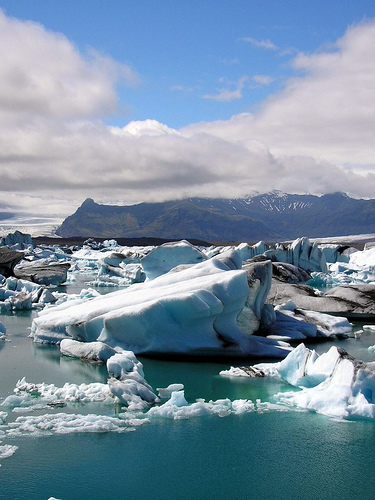
Jokulsarlon V ice flow, Iceland
River in Iceland, September 2003
Waterfall in rural Iceland
Typical Iceland landscape
Rainbow in Iceland, September 2003
Gulfoss, waterfall in Iceland
Iceland house with grass on top.
Blue lagoon with hot gyser water, September
Iceland house
Airliner at the Reykjavik airport.
Church in Reykjavik, Iceland
Blue lagoon geothermal spa, Reykjavik


Travel and Tourism
Travel and Tourism
- Travel Alert Status
- Level 1: Exercise Normal Precautions
- Currency
- Icelandic krona (ISK)
- Time Difference
- UTC 0 (5 hours ahead of Washington, DC, during Standard Time)
- Climate
- Despite its location close to the Arctic Circle, Reykjavik's climate is similar to that of the northwestern U.S., although cooler and windier. The Gulf Stream helps keep the annual mean temperature at 40°F. Changes between summer and winter are not extreme. It is rarely very cold in winter or warm in summer. Winter temperatures below 20°F are unusual, as are summer temperatures above 60°F. The wind blows year round, however, and a wind chill factor between -15°F and 10°F is common in winter. Cooler weather lasts from October through April. Snow may fall in Reykjavik as early as September and as late as June, but the normal season is between October or November and March or April. Even in midwinter, rain is as likely as snow. A large accumulation of snow is rare. Average annual rainfall is 31 inches in Reykjavik. During winter and spring, winds in the capital can reach hurricane force. Iceland is so far north that the amount of daylight varies considerably throughout the year. An average daily gain of 6 minutes of daylight follows the winter solstice on December 21, and a daily loss of 6 minutes follows the summer solstice on June 21. December and January days have only about 4 hours of daylight; in February the days rapidly begin to lengthen; and by April they are as long as at midsummer in the U.S. From late May to late July, there is no darkness at all-20 hours of sun (or clouds) and 4 hours of twilight. Following this period of "white nights," the sun slowly retreats, and by October the days begin to shorten as rapidly as they lengthened in the spring. Earthquakes are common in Iceland, but are rarely felt in Reykjavik. Volcanic activity is infrequent but rather spectacular when an eruption does occur. The underwater volcano that created the new island of Surtsey in the Westmann Islands off the south coast began erupting in November 1963 and remained active through mid-1967. In January 1973, a volcanic eruption on Heimaey Island in the Westmann Islands forced the evacuation of all 5,000 residents and destroyed more than 300 homes and buildings. In the Krafla area, near Lake Myvatn, an eruption took place in December 1975, lasting several days; this area subsequently has seen seven lesser eruptions, and further volcanic activity is expected there. The most famous of Iceland's volcanoes, Mt. Hekla, which had been expected to remain dormant for a 100 years or so after its spectacular 1947 eruption, produced eruptions in August 1980, April 1981, and January 1991. A volcano under the Glacier Vatnajokull erupted in November 1996, melting tons of ice and creating destructive flooding.
- Airports
- 100
Read the full travel guide — health, safety, vaccinations, disease risk, sanitation, and transit details.
View full travel guideRecipes
Recipes
Potatoes Browned in Sugar
Side Dish
Appetizer
Shrimp Salad
Main Dish
Haddock, Vegetables and Cheese Bake
Main Dish
Sunnudagssteikin (Roasted Leg of Lamb)
Main Dish
Kjötsúpa (Meat Soup)
Main Dish
Whole Salmon with Apples and Beets
Side Dish
Cooked Red Cabbage
Side Dish
PremiumPotatoes Browned in Sugar
Soup
PremiumCauliflower Soup
Bread
PremiumIceland Snowflake Breads (Laufabraud)
History
History
Historical Eras
Settlement & Commonwealth
870 – 1262
Norwegian and Celtic settlers, led by figures such as Ingólfur Árnarson, colonized Iceland between 870 and 930, after which the Althing — the world's oldest functioning parliament — was established at Þingvellir in 930. Christianity was peacefully adopted in 1000, and the 12th and 13th centuries became a golden age of literature, producing the sagas and eddas compiled by poet-historian Snorri Sturluson. Icelanders also led the European discovery of Greenland and North America during this era.
Norwegian & Danish Rule
1262 – 1874
Internal civil strife forced Iceland to submit to the Norwegian crown in 1262–64; when Norway joined the Kalmar Union in 1397, Iceland passed to Danish sovereignty. Danish rule brought the Reformation in 1551, a suffocating trade monopoly, absolute monarchy in 1662, and the dissolution of the Althing in 1800, reducing Iceland to a wholly administered colony. The Black Death of 1402–04 and catastrophic volcanic eruptions in 1783 further devastated the population and economy.
Reform & Home Rule
1874 – 1918
A rising nationalist movement secured the reinstatement of the Althing as a consultative assembly in 1843, and Iceland received its first constitution along with control over domestic finances from the Danish crown in 1874. Full home rule followed in 1904, and women gained the right to vote in national elections in 1917. The Act of Union of 1918 granted Iceland sovereignty as a separate kingdom in personal union with Denmark under the Danish crown.
Occupation & Republic
1918 – 1944
Though nominally sovereign after 1918, Iceland remained tied to Denmark until the German occupation of Denmark in 1940 prompted British forces to occupy Iceland preemptively, safeguarding the strategically vital North Atlantic island. American troops replaced the British in 1941 under a bilateral agreement. On 17 June 1944, Icelanders formally dissolved the union with Denmark and proclaimed the independent Republic of Iceland at Þingvellir.
Modern Republic
1944 – present
As a founding member of NATO in 1949 and a participant in the Marshall Plan, Iceland aligned firmly with the Western bloc and hosted a strategically important U.S. air base at Keflavík until 2006. The economy modernized rapidly around fishing, geothermal energy, and — briefly and disastrously — international banking, which collapsed spectacularly in the 2008 financial crisis. Iceland today ranks among the world's leaders in literacy, longevity, gender equality, and human development.
Overview
The first people known to have inhabitated Iceland were Irish monks or hermits who came in the eighth century, but left with the arrival of the pagan Norsemen, who systematically settled Iceland in the period 870 - 930 A.D. Ingolfur Arnason fled from Norway, and his followers settled in Iceland about A.D. 870. He was a chieftain from Norway, arriving in Iceland with his family and dependents in 874.
Timeline of Key Events
874
The Scandinavian Vikings established settlements in Iceland
The Scandinavian Vikings established settlements in Iceland.
930
The Althing established
An annual parliament,the Althing, established, to make laws and solve disputes.
986
Erik the Red established his 1st settlement on Greenland.
Erik the Red takes settlers from Iceland and established his 1st settlement on Greenland.
1000
Iceland adopts Christianity.
Iceland adopts Christianity.
1262
Icelanders recognize the King of Norway as their monarch.
After a long and bloody conflict between the various families and clans, Icelanders recognize the King of Norway as their monarch.
1380
Norway and Iceland come under Denmark’s control.
Norway and Iceland come under Denmark’s control.
1402 – 1404
The Black Death plague devastates Iceland.
The Black Death plague devastates Iceland.
Read the full history profile — narrative overview, defining eras, and the complete timeline in one place.
View expanded historyInteresting Facts
Interesting Facts
When a child loses a tooth they put their tooth under their pillow at night and wait for the tooth fairy to come.
In 1996 a volcanic eruption beneath Vatnajokull caused a glacier outburst flood (jokulhlaup).
The last name of Icelanders is derived from their father's first name.
See every fact — trivia, oddities, and curious tidbits gathered from across the country.
View all interesting factsGeography and Environment
Geography and Environment
- Terrain
- mostly plateau interspersed with mountain peaks, icefields; coast deeply indented by bays and fiords
- Climate
- Despite its location close to the Arctic Circle, Reykjavik's climate is similar to that of the northwestern U.S., although cooler and windier. The Gulf Stream helps keep the annual mean temperature at 40°F. Changes between summer and winter are not extreme. It is rarely very cold in winter or warm in summer. Winter temperatures below 20°F are unusual, as are summer temperatures above 60°F. The wind blows year round, however, and a wind chill factor between -15°F and 10°F is common in winter. Cooler weather lasts from October through April. Snow may fall in Reykjavik as early as September and as late as June, but the normal season is between October or November and March or April. Even in midwinter, rain is as likely as snow. A large accumulation of snow is rare. Average annual rainfall is 31 inches in Reykjavik. During winter and spring, winds in the capital can reach hurricane force. Iceland is so far north that the amount of daylight varies considerably throughout the year. An average daily gain of 6 minutes of daylight follows the winter solstice on December 21, and a daily loss of 6 minutes follows the summer solstice on June 21. December and January days have only about 4 hours of daylight; in February the days rapidly begin to lengthen; and by April they are as long as at midsummer in the U.S. From late May to late July, there is no darkness at all-20 hours of sun (or clouds) and 4 hours of twilight. Following this period of "white nights," the sun slowly retreats, and by October the days begin to shorten as rapidly as they lengthened in the spring. Earthquakes are common in Iceland, but are rarely felt in Reykjavik. Volcanic activity is infrequent but rather spectacular when an eruption does occur. The underwater volcano that created the new island of Surtsey in the Westmann Islands off the south coast began erupting in November 1963 and remained active through mid-1967. In January 1973, a volcanic eruption on Heimaey Island in the Westmann Islands forced the evacuation of all 5,000 residents and destroyed more than 300 homes and buildings. In the Krafla area, near Lake Myvatn, an eruption took place in December 1975, lasting several days; this area subsequently has seen seven lesser eruptions, and further volcanic activity is expected there. The most famous of Iceland's volcanoes, Mt. Hekla, which had been expected to remain dormant for a 100 years or so after its spectacular 1947 eruption, produced eruptions in August 1980, April 1981, and January 1991. A volcano under the Glacier Vatnajokull erupted in November 1996, melting tons of ice and creating destructive flooding.
- Natural Hazards
- earthquakes and volcanic activity
- Current Environmental Issues
- water pollution from fertilizer runoff; inadequate wastewater treatment
Read the full geography and environment profile — terrain, climate, natural resources, hazards, land use, and international agreements.
View full geographyPeople & Demographics
People & Demographics
Religion
Languages Spoken
Icelandic, English, Nordic languages, German widely spoken
- German
- Icelandic
Population
- Population
- 376,248
- Population in Major Urban Areas
- REYKJAVIK (capital) 206,000
- Nationality Noun
- Icelander(s)
- Ethnic Groups
- homogeneous mixture of descendants of Norse and Celts 94%, population of foreign origin 6%
- Language Note
- Icelandic is part of the North Germanic branches of languages, and so is most closely related to Norwegian, Swedish, Danish and Faroese Icelandic is based on the Latin alphabet, with the addition of Þ, ð, æ, and the diacritics á, é, í, ó, ú and ö Icelandic developed into a distinct Scandinavian language around the 12th century.
Education
- Literacy Definition
- age 15 and over can read and write
Health Information
- Life Expectancy at Birth
- Iceland consistently ranks among the world's leaders in life expectancy, reflecting the country's high standard of living, universal healthcare access, and healthy lifestyle habits. As of the most recent data, the average life expectancy at birth in Iceland is approximately 83 to 84 years, with women typically living longer than men. Icelandic women have an average life expectancy of around 85 to 86 years, while men average approximately 81 to 82 years. Several factors contribute to Iceland's exceptional longevity. The country benefits from a robust universal healthcare system that provides comprehensive medical services to all residents, emphasizing preventive care and early intervention. Iceland also maintains relatively low rates of obesity compared to many other developed nations, and its population enjoys a diet traditionally rich in fish and seafood, which supports cardiovascular health. Environmental quality plays a meaningful role as well. Iceland's air is among the cleanest in the world, largely due to the country's reliance on geothermal and hydroelectric energy rather than fossil fuels. Pollution-related health burdens that affect life expectancy in many industrialized nations are significantly reduced in Iceland as a result. Social stability and economic equality are additional contributors. Iceland consistently scores highly on measures of income equality and social cohesion, both of which are strongly associated with positive population health outcomes. The country also invests heavily in education and public health infrastructure, reinforcing long-term improvements in quality of life. Iceland's infant mortality rate is extremely low, at roughly 1 to 2 deaths per 1,000 live births, which also bolsters overall life expectancy at birth figures. The country has maintained its position among the top-performing nations globally for decades, and the trend has remained stable or has continued to improve over time. When compared globally, Iceland frequently places among the top five to ten countries worldwide for life expectancy, alongside nations such as Japan, Switzerland, and Australia. This consistent performance underscores the effectiveness of Iceland's public health model and the broader social conditions that support a long and healthy life for its citizens.
- Infant Mortality Rate
- Iceland consistently ranks among the countries with the lowest infant mortality rates in the world, reflecting its exceptional healthcare infrastructure, high standard of living, and strong public health policies. The infant mortality rate measures the number of deaths of children under one year of age per 1,000 live births, and Iceland's figures in this category are among the most impressive globally. In recent years, Iceland's infant mortality rate has hovered around 1 to 2 deaths per 1,000 live births, placing it in the same tier as other Nordic nations such as Finland, Norway, and Sweden, all of which are recognized global leaders in child health outcomes. For context, the global average infant mortality rate is approximately 27 to 28 deaths per 1,000 live births, making Iceland's rate dramatically lower than the worldwide norm. Several factors contribute to this achievement. Iceland provides universal access to prenatal and postnatal healthcare, ensuring that expectant mothers receive comprehensive medical attention throughout pregnancy and after birth. The country has a highly trained medical workforce, well-equipped hospitals, and robust systems for monitoring maternal and neonatal health. Breastfeeding support programs, newborn screening initiatives, and vaccination coverage rates that consistently approach 100% all contribute to keeping infant mortality exceptionally low. Iceland's small population — roughly 370,000 to 380,000 people — means that even a handful of infant deaths in a given year can cause slight statistical fluctuation in the annual rate. In some years, the country has recorded rates approaching zero, though demographers typically note that small population sizes can make year-to-year comparisons less statistically stable than in larger nations. Socioeconomic conditions also play a significant role. Iceland has low levels of poverty, high educational attainment among women, generous parental leave policies, and strong social safety nets — all of which are closely correlated with positive infant health outcomes internationally. Overall, Iceland's infant mortality statistics serve as a benchmark for what is achievable when universal healthcare access, social equality, and investment in maternal and child health are sustained national priorities.
Life Expectancy
- Life Expectancy at Birth
- Iceland consistently ranks among the world's leaders in life expectancy, reflecting the country's high standard of living, universal healthcare access, and healthy lifestyle habits. As of the most recent data, the average life expectancy at birth in Iceland is approximately 83 to 84 years, with women typically living longer than men. Icelandic women have an average life expectancy of around 85 to 86 years, while men average approximately 81 to 82 years. Several factors contribute to Iceland's exceptional longevity. The country benefits from a robust universal healthcare system that provides comprehensive medical services to all residents, emphasizing preventive care and early intervention. Iceland also maintains relatively low rates of obesity compared to many other developed nations, and its population enjoys a diet traditionally rich in fish and seafood, which supports cardiovascular health. Environmental quality plays a meaningful role as well. Iceland's air is among the cleanest in the world, largely due to the country's reliance on geothermal and hydroelectric energy rather than fossil fuels. Pollution-related health burdens that affect life expectancy in many industrialized nations are significantly reduced in Iceland as a result. Social stability and economic equality are additional contributors. Iceland consistently scores highly on measures of income equality and social cohesion, both of which are strongly associated with positive population health outcomes. The country also invests heavily in education and public health infrastructure, reinforcing long-term improvements in quality of life. Iceland's infant mortality rate is extremely low, at roughly 1 to 2 deaths per 1,000 live births, which also bolsters overall life expectancy at birth figures. The country has maintained its position among the top-performing nations globally for decades, and the trend has remained stable or has continued to improve over time. When compared globally, Iceland frequently places among the top five to ten countries worldwide for life expectancy, alongside nations such as Japan, Switzerland, and Australia. This consistent performance underscores the effectiveness of Iceland's public health model and the broader social conditions that support a long and healthy life for its citizens.
- Infant Mortality Rate
- Iceland consistently ranks among the countries with the lowest infant mortality rates in the world, reflecting its exceptional healthcare infrastructure, high standard of living, and strong public health policies. The infant mortality rate measures the number of deaths of children under one year of age per 1,000 live births, and Iceland's figures in this category are among the most impressive globally. In recent years, Iceland's infant mortality rate has hovered around 1 to 2 deaths per 1,000 live births, placing it in the same tier as other Nordic nations such as Finland, Norway, and Sweden, all of which are recognized global leaders in child health outcomes. For context, the global average infant mortality rate is approximately 27 to 28 deaths per 1,000 live births, making Iceland's rate dramatically lower than the worldwide norm. Several factors contribute to this achievement. Iceland provides universal access to prenatal and postnatal healthcare, ensuring that expectant mothers receive comprehensive medical attention throughout pregnancy and after birth. The country has a highly trained medical workforce, well-equipped hospitals, and robust systems for monitoring maternal and neonatal health. Breastfeeding support programs, newborn screening initiatives, and vaccination coverage rates that consistently approach 100% all contribute to keeping infant mortality exceptionally low. Iceland's small population — roughly 370,000 to 380,000 people — means that even a handful of infant deaths in a given year can cause slight statistical fluctuation in the annual rate. In some years, the country has recorded rates approaching zero, though demographers typically note that small population sizes can make year-to-year comparisons less statistically stable than in larger nations. Socioeconomic conditions also play a significant role. Iceland has low levels of poverty, high educational attainment among women, generous parental leave policies, and strong social safety nets — all of which are closely correlated with positive infant health outcomes internationally. Overall, Iceland's infant mortality statistics serve as a benchmark for what is achievable when universal healthcare access, social equality, and investment in maternal and child health are sustained national priorities.
Read the full people and society profile — demographics, health, education, religion, languages, and notable people.
View full people and societyGovernment & Politics
Government & Politics
Country Identity
- Country Name
- Iceland
- Full Country Name
- Republic of Iceland
- Local - Long
- Lydhveldidh Island
- Local - Short
- Island
Government Structure
- Government Type
- constitutional republic
- Legal System
- civil law system based on Danish law; has not accepted compulsory ICJ jurisdiction
- Executive Branch
- chief of state: President Gudni Th. JOHANNESSON (since 1 August 2016) head of government: Prime Minister Bjarni BENEDIKTSSON (since 9 April 2024) cabinet: Cabinet appointed by the prime minister elections: president, largely a ceremonial post, is elected by popular vote for a four-year term; election last held 1 June 2024 (next to be held June 2028); following legislative elections, the leader of the majority party or the leader of the majority coalition is usually the prime minister election results: Gudni Th. JOHANNESSON reelected president in 2020, running unopposed; Bjarni BENEDIKTSSON appointed prime minister following the collapse of the previous coalition government led by Katrin JAKOBSDOTTIR
- Legislative Branch
- Unicameral Parliament or Althing (63 seats; members are elected by popular vote to serve four-year terms) Elections: Last held on 25 September 2021 (next to be held by 2025) Election results: Percent of vote by party - Left-Green Movement 12.6%, Independence Party 24.4%, Progressive Party 17.3%, Pirate Party 9.9%, People's Party 8.9%, Reform Party 8.3%, Centre Party 5.4%, Social Democratic Alliance 9.9%; seats by party - Independence Party 16, Progressive Party 13, Left-Green Movement 8, Social Democratic Alliance 7, Pirate Party 6, People's Party 6, Reform Party 5, Centre Party 2
- Judicial Branch
- Supreme Court or Haestirettur (justices are appointed for life by the Minister of Justice); eight district courts (justices are appointed for life by the Minister of Justice)
- Suffrage
- 18 years of age; universal
- Constitution
- 16 June 1944, effective 17 June 1944
- Independence
- 1 December 1918 (became a sovereign state under the Danish Crown); 17 June 1944 (from Denmark)
- National Holiday
- Independence Day, 17 June (1944)
Capital City
- Capital Name
- Reykjavik
- Capital - geographic coordinate
- 64 09 N, 21 57 W
- Capital Time Difference
- UTC 0 (5 hours ahead of Washington, DC, during Standard Time)
The name means "smoky bay" in Icelandic and refers to the steamy, smoke-like vapors discharged by hot springs in the area
Military
Branches: no regular military forces; Icelandic National Police; Icelandic Coast Guard
Embassy / Diplomatic Mission
U.S. Embassy Reykjavik
Laufasvegur 21
101 Reykjavik
Telephone: 354-562-9100
Emergency After-Hours Telephone: 011-354-595-2248
Fax: 354-562-9110
Read the full government profile — flag symbolism, national anthem, and other national symbols.
View full government detailsEconomy
Economy
Iceland has a Nordic-style mixed economy that combines free-market capitalism with an extensive welfare system, universal healthcare, strong labor protections, and a relatively even distribution of income.
Snapshot
- Currency Name and Code
- Euro (EUR)
- GDP — official exchange rate
- $13,050,000,000 (USD)
- GDP Real Growth Rate
- 4.1%
News & Weather
News & Weather
Current Weather
Latest News
EXCLUSIVE: Iceland asks Brussels to stay out of EU referendum - euractiv.com
euractiv.com · 2d ago
This Country’s Most Famous Dish Might Be a Gas Station Hot Dog - Food & Wine
Food & Wine · 1d ago
Fish over Trump: Economy will determine Iceland's vote on the EU - Euronews
Euronews · 32d ago
Iceland’s EU vote: A nation divided over Europe - dw.com
dw.com · 2d ago
Donald Trump’s Arctic threats are pushing Iceland towards Europe - The Economist
The Economist · 3d ago
Iceland, ‘Land of Fire and Ice’ prepares to see dazzling total solar eclipse - Yahoo
Yahoo · 3h ago
Kormakur Jack - Iceland - Player Profile - FIBA U16 EuroBasket 2026, Division B - FIBA
FIBA · 2d ago
We took my husband's 75-year-old grandmother to Iceland. We still talk about that trip 9 years later. - Business Insider
Business Insider · 3d ago
News via Google News
Climate Overview
Despite its location close to the Arctic Circle, Reykjavik's climate is similar to that of the northwestern U.S., although cooler and windier. The Gulf Stream helps keep the annual mean temperature at 40°F. Changes between summer and winter are not extreme. It is rarely very cold in winter or warm in summer. Winter temperatures below 20°F are unusual, as are summer temperatures above 60°F. The wind blows year round, however, and a wind chill factor between -15°F and 10°F is common in winter.
Cooler weather lasts from October through April. Snow may fall in Reykjavik as early as September and as late as June, but the normal season is between October or November and March or April. Even in midwinter, rain is as likely as snow. A large accumulation of snow is rare. Average annual rainfall is 31 inches in Reykjavik. During winter and spring, winds in the capital can reach hurricane force.
Iceland is so far north that the amount of daylight varies considerably throughout the year. An average daily gain of 6 minutes of daylight follows the winter solstice on December 21, and a daily loss of 6 minutes follows the summer solstice on June 21. December and January days have only about 4 hours of daylight; in February the days rapidly begin to lengthen; and by April they are as long as at midsummer in the U.S. From late May to late July, there is no darkness at all-20 hours of sun (or clouds) and 4 hours of twilight. Following this period of "white nights," the sun slowly retreats, and by October the days begin to shorten as rapidly as they lengthened in the spring.
Earthquakes are common in Iceland, but are rarely felt in Reykjavik. Volcanic activity is infrequent but rather spectacular when an eruption does occur. The underwater volcano that created the new island of Surtsey in the Westmann Islands off the south coast began erupting in November 1963 and remained active through mid-1967. In January 1973, a volcanic eruption on Heimaey Island in the Westmann Islands forced the evacuation of all 5,000 residents and destroyed more than 300 homes and buildings. In the Krafla area, near Lake Myvatn, an eruption took place in December 1975, lasting several days; this area subsequently has seen seven lesser eruptions, and further volcanic activity is expected there. The most famous of Iceland's volcanoes, Mt. Hekla, which had been expected to remain dormant for a 100 years or so after its spectacular 1947 eruption, produced eruptions in August 1980, April 1981, and January 1991. A volcano under the Glacier Vatnajokull erupted in November 1996, melting tons of ice and creating destructive flooding.
Videos
Videos
2 curated YouTube videos.
Source: YouTube
Source: YouTube
Frequently Asked Questions
Frequently Asked Questions
What is the population of Iceland?
How do people greet each other in Iceland?
What is the food and dining culture like in Iceland?
What social etiquette should I know in Iceland?
How should I dress in Iceland?
What is family life like in Iceland?
What do people do for recreation in Iceland?
What is the capital of Iceland?
Where is Iceland located?
What are Iceland's ocean and sea borders?
What religion is practiced in Iceland?
What is the currency of Iceland?
What language is spoken in Iceland?
What is the geography of Iceland like?
What is Iceland known for?
Last reviewed 2026