
 English
 Español
 中文
中文 हिन्दी
 Français
Holy See
Santa Sede
Declare Your Relationship to Holy See
CountryReports Community
- Studying7
- From Holy See5
- Holy See heritage4
- Visited4
- Want to visit3
Customs and Culture
Customs and Culture
Cultural Attributes
The Holy See represents one of the most distinctive cultural entities in the world, functioning simultaneously as the governing body of the Roman Catholic Church and as a sovereign state recognized under international law. Its cultural identity is inseparable from the Catholic faith, which shapes every dimension of life within Vatican City — from its art and architecture to its daily rhythms and social customs. Latin remains the official language of the Holy See for formal documents, liturgical texts, and official communications, making it one of the very few institutions in the world where Latin retains an active administrative role. Italian is widely spoken in everyday interactions among residents and staff. The cultural heritage of the Holy See is expressed most visibly through its extraordinary collection of art and architecture. St. Peter's Basilica, the Sistine Chapel with Michelangelo's celebrated ceiling frescoes, and the Vatican Museums — which house over 20,000 works of art — represent some of the most significant cultural treasures in human history. The Vatican Apostolic Library, founded in 1475, contains approximately 1.1 million printed books and 75,000 manuscripts, serving as one of the oldest and most important research libraries in the world. The liturgical calendar governs the cultural life of the Holy See, with major feasts such as Christmas, Easter, and the feast days of patron saints marking significant communal celebrations. Papal audiences and liturgical ceremonies held in St. Peter's Square draw pilgrims and visitors from across the globe, reinforcing the Holy See's role as a center of universal Catholic culture. The Swiss Guard, established in 1506, remains an enduring cultural symbol — their Renaissance-era uniforms and ceremonial duties reflect a living connection to the institution's deep historical roots. The Pontifical academies, covering fields such as theology, science, and the arts, further demonstrate the Holy See's commitment to intellectual and cultural engagement across disciplines. Despite its remarkably small geographic size of approximately 44 hectares, the cultural influence of the Holy See extends to an estimated 1.3 billion Catholics worldwide, making it a uniquely global cultural force.

The Seat of Christendom
Get More Customs and Culture
2 more cultural topics for members
Social Customs & Etiquette · Dating Customs
Every country, every topic, all activities & recipes
✓ Instant access on this device · ✓ No subscription
Holidays
Coronation Day of Pope JOHN PAUL II
10/22Religious
Christmas
12/25Christmas
Dates of Interest
- December 25th
What languages and customs shape daily life in the Holy See?
Life in the Holy See is inseparable from the Catholic faith, which shapes its art, architecture, daily rhythms, and social customs. Latin is the official language for formal documents, liturgy, and official communications, while Italian is widely spoken in everyday interactions.
Do
- Expect Italian in everyday conversations with residents and staff
- Be aware the liturgical calendar governs cultural life, with major feasts like Christmas, Easter, and patron saint days
Good to know
- Latin retains an active administrative role here, unlike almost anywhere else
- The Swiss Guard, established in 1506, is a living cultural symbol in their Renaissance-era uniforms
What can visitors see and do in the Holy See?
The Holy See holds some of the world's most significant cultural treasures, including St. Peter's Basilica, the Sistine Chapel with Michelangelo's ceiling frescoes, and the Vatican Museums with over 20,000 works of art.
Good to know
- Visit the Vatican Apostolic Library, founded in 1475, holding about 1.1 million printed books and 75,000 manuscripts
- Papal audiences and liturgical ceremonies in St. Peter's Square draw pilgrims and visitors from around the world
Last updated: 2026-07-12 · Sources: CountryReports
Photos of Holy See
Photos of Holy See
Vatican
Holy Water at the Vatican
Vatican
Vatican City , Italy
Vatican Museum
St Peter’s Basillica
Staues at the top of the St Peters Basillica
View from inside St Peters Basillica in the Vatican City
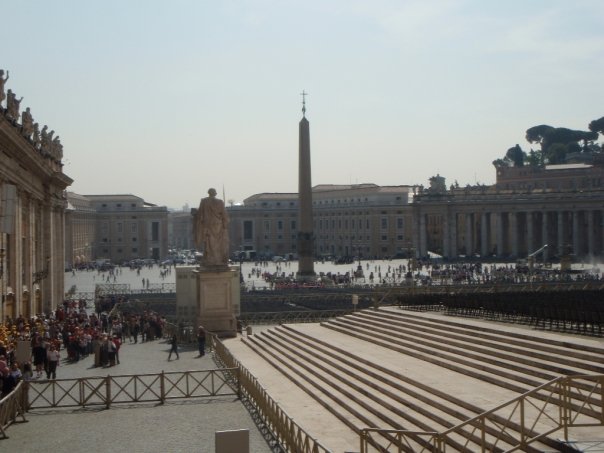
This statue sits just outside the St Peters Basillica
St Peter’s Basillica , Rome
St Peter’s Basilica - Vatican City


Travel and Tourism
Travel and Tourism
- Time Difference
- UTC+1 (6 hours ahead of Washington, DC, during Standard Time)
Read the full travel guide — health, safety, vaccinations, disease risk, sanitation, and transit details.
View full travel guideHistory
History
Historical Eras
Early Papal Foundations
326 – 756
Following Constantine's legalization of Christianity, the first basilica was erected over Saint Peter's traditional tomb in 326, anchoring Rome as the spiritual center of Christendom. The papacy developed its theological authority and diplomatic reach across the crumbling Western Roman Empire. This era established the institutional foundations of the Holy See as both a religious and emerging political force in Europe.
Papal States Era
756 – 1054
The Donation of Pepin granted the papacy temporal control over central Italian territories, formally establishing the Papal States as a sovereign political entity. Popes navigated complex relationships with Frankish and later Holy Roman emperors, asserting spiritual supremacy while defending territorial holdings. The era culminated in the Great Schism of 1054, which permanently divided the Roman and Eastern Orthodox churches.
Medieval & Crusade Period
1054 – 1417
Pope Urban II launched the Crusades in 1095, projecting papal authority into the Holy Land and cementing the papacy's role as director of Western Christendom. The period witnessed intense conflicts with Holy Roman emperors, the sack of Rome by Henry IV in 1083, and the founding of military orders such as the Knights Templar. Papal prestige peaked with Innocent III before declining sharply during the Avignon papacy and the Western Schism.
Renaissance Papacy
1417 – 1648
Restored to Rome after the Western Schism, the papacy became one of the great Renaissance patrons, commissioning Michelangelo's Sistine Chapel ceiling, Raphael's Vatican frescoes, and the rebuilding of St. Peter's Basilica, consecrated in 1626. The Protestant Reformation challenged papal authority across northern Europe, prompting the Counter-Reformation and the Council of Trent. This era defined Catholic identity and artistic heritage that endures to the present day.
Loss of Temporal Power
1648 – 1929
The gradual erosion of papal secular authority accelerated dramatically when Victor Emmanuel's forces seized the Papal States in 1860 and captured Rome in 1870, declaring it the capital of unified Italy. Popes Pius IX and his successors refused to recognize the Italian state, confining themselves as self-declared prisoners within the Vatican. The standoff ended with the 1929 Lateran Treaties, which recognized Vatican City as an independent sovereign state and compensated the Holy See for its territorial losses.
Vatican City State
1929 – present
The Lateran Treaties of 1929 created the modern State of Vatican City, the world's smallest sovereign state, resolving sixty years of dispute with Italy. A revised concordat in 1984 further adjusted church-state relations, removing Catholicism's status as Italy's official state religion. The Holy See has since expanded its global diplomatic presence, engaging with issues of religious freedom, international development, interfaith dialogue, and the moral dimensions of globalization under a succession of influential pontiffs.
Overview
Almost all of Vatican City’s citizens live inside the Vatican’s walls. The Vatican includes high dignitaries, priests, nuns, and guards as well as about 3,000 lay workers who comprise the majority of the work force.
Every country, every topic, all activities & recipes
✓ Instant access on this device · ✓ No subscription
Timeline of Key Events
326
First church built on the site of Vatican City, traditional place of Saint Peter’s tomb.
First church built on the site of Vatican City, traditional place of Saint Peter’s tomb.
1054
The Roman and Orthodox Churches split decisively.
The Roman and Orthodox Churches split decisively. The Orthodox Church did not accept the papal authority from Rome. Christians in southern Albania were left under the ecumenical patriarch of Constantinople and those in the north under the pope in Rome.
1083
Henry IV of Germany stormed Rome capturing St. Peter’s Basilica.
Henry IV of Germany stormed Rome capturing St. Peter’s Basilica.
1095
Pope Urban urged the faithful to wrest the Holy Land from the Muslims, heralding start of Crusades.
Pope Urban urged the faithful to wrest the Holy Land from the Muslims, heralding start of Crusades.
1119
The Knights Templar were founded to protect pilgrims in the Holy Land during the second Crusade.
The Knights Templar were founded to protect pilgrims in the Holy Land during the second Crusade.
1148
The Second Crusade.
The Second Crusade.
1477 – 1480
Pope Sixtus IV (1471-1492) started building a great chapel, named "Sistina" .
Pope Sixtus IV (1471-1492) started building a great chapel, named "Sistina" after him, decorated with frescoes painted by the major Italian painters of the time.
Read the full history profile — narrative overview, defining eras, and the complete timeline in one place.
View expanded historyInteresting Facts
Interesting Facts
On April 19, German cardinal Joseph Ratzinger was named the new pope. Pope Benedict XVI is known as an accomplished scholar of theology and is considered an archconservative in his religious views.
The term Vatican was used in ancient times to identify the marshy area on the right bank of the Tiber River, between the Milvio Bridge and the present Sixtus Bridge.
During the monarchy and the republican age, this geographic area was known as Ager Vaticanus.
See every fact — trivia, oddities, and curious tidbits gathered from across the country.
View all interesting factsGeography and Environment
Geography and Environment
- Climate
- Rome’s climate is mild and the area is noted for its frequent sunny days. Summers are hot (and sometimes humid) and winters are cold (overcoats necessary).
Read the full geography and environment profile — terrain, climate, natural resources, hazards, land use, and international agreements.
View full geographyPeople & Demographics
People & Demographics
Religion
Languages Spoken
Italian, Latin, French, various other languages
- Italian
- Latin
Population
- Population
- 800
- Nationality Noun
- None
Life Expectancy
- Life Expectancy at Birth
- Life expectancy at birth is a key demographic indicator, yet for the Holy See — the sovereign entity governing the Catholic Church and headquartered within Vatican City — this metric carries unusual complexity. The Holy See is among the smallest and most unique sovereign entities in the world, with a permanent population estimated at only around 800 to 1,000 people. This population consists almost entirely of clergy, members of religious orders, and a small number of lay workers and Swiss Guard personnel, making standard demographic statistics difficult to calculate in the same way they are for typical nation-states. Because of this extraordinarily small and highly selective population, the Holy See does not report conventional life expectancy figures to international bodies such as the World Bank or the World Health Organization in the same manner as other countries. The resident population skews heavily male and is largely composed of adults who have already passed through childhood, which would naturally affect any raw calculation of life expectancy at birth. If measured informally against the broader Italian population — from which many Vatican residents originate or with whom they share healthcare access — life expectancy would be broadly comparable to Italy's figures, which rank among the highest in the world. Italy's life expectancy at birth is approximately 83 to 84 years, reflecting high-quality healthcare, Mediterranean dietary habits, and strong social support systems. Vatican residents generally have access to the same advanced Italian and European medical infrastructure, including the renowned hospital networks of Rome. It is worth noting that the Holy See does not maintain its own hospitals or maternity wards. No births are recorded as occurring within Vatican City itself in modern times, which further renders the concept of "life expectancy at birth" as a statistical category largely inapplicable in the traditional sense. For travelers and students researching the Holy See, these demographic peculiarities are a reflection of its singular status as a non-traditional sovereign entity defined by religious mission rather than conventional statehood.
- Infant Mortality Rate
- The Holy See, the sovereign entity governing the Catholic Church and headquartered within Vatican City, presents a highly unusual case when it comes to infant mortality statistics. As the smallest internationally recognized sovereign state in the world by both area and population, the Holy See does not have a permanent residential civilian population in the traditional sense. Its inhabitants are primarily clergy, members of the Pontifical Swiss Guard, and a small number of lay employees — a population that does not include infants or families in any statistically meaningful number. Because of this unique demographic reality, no reliable or regularly updated infant mortality rate is calculated or reported for the Holy See by international health organizations such as the World Health Organization or UNICEF. Standard demographic indicators, including birth rates and infant mortality rates, simply do not apply in the conventional sense. There are no maternity wards, no recorded births occurring within Vatican City's borders in normal circumstances, and no pediatric health infrastructure designed to serve a resident population of newborns. In the rare event that a medical emergency involving a birth or infant care were to arise, the individuals involved would most likely be transferred to or treated within the Italian healthcare system, which surrounds Vatican City entirely. Italy itself maintains a strong healthcare infrastructure and records an infant mortality rate of approximately 2.5 to 3 deaths per 1,000 live births, reflecting the broader regional context in which the Holy See is geographically embedded. For researchers, students, or travelers seeking infant mortality data relevant to this location, it is more practical to reference Italian national health statistics, as Vatican City relies heavily on Italian medical services for any healthcare needs that may arise among its small working population.
Read the full people and society profile — demographics, health, education, religion, languages, and notable people.
View full people and societyGovernment & Politics
Government & Politics
Country Identity
- Country Name
- HolySee
- Full Country Name
- The Holy See
- Local - Short
- Santa Sede
Government Structure
- Executive Branch
- chief of state: Pope FRANCIS (since 13 March 2013) head of government: Secretary of State Cardinal Pietro PAROLIN (since 15 October 2013) cabinet: Pontifical Commission for Vatican City State, appointed by the pope elections: Pope elected for life by the College of Cardinals; election last held 13 March 2013 (next to be held following the death or resignation of the incumbent pope); Secretary of State appointed by the pope election results: Jorge Mario BERGOGLIO elected Pope FRANCIS
- Legislative Branch
- Unicameral Pontifical Commission for Vatican City State; the Commission consists of 7 cardinals appointed by the Pope for 5-year terms and is responsible for the legislative governance of Vatican City State, distinct from the broader governing structures of the Holy See itself.
- Judicial Branch
- there are three tribunals responsible for civil and criminal matters within Vatican City; three other tribunals rule on issues pertaining to the Holy See note: judicial duties were established by the Motu Proprio of Pope PIUS XII on 1 May 1946
Capital City
- Capital Name
- Vatican City
- Capital - geographic coordinate
- 41 54 N, 12 27 E
- Capital Time Difference
- UTC+1 (6 hours ahead of Washington, DC, during Standard Time)
The term "Vatican" derives from the hill Mons Vaticanus on which the Vatican is located and which comes from the Latin "vaticinari" (to prophesy), referring to the fortune tellers and soothsayers who frequented the area in Roman times
Military
Branches: Pontifical Swiss Guard Corps (Corpo della Guardia Svizzera Pontificia)
Read the full government profile — flag symbolism, national anthem, and other national symbols.
View full government detailsEconomy
Economy
The Holy See operates a unique, non-commercial economy that is fundamentally different from those of sovereign states.
Snapshot
- Currency Name and Code
- Euro (EUR)
Every country, every topic, all activities & recipes
✓ Instant access on this device · ✓ No subscription
News & Weather
News & Weather
Current Weather
Latest News
New Holy See Permanent Observer to UN: Hate speech is not freedom of expression - Vatican News
Vatican News · 2d ago
Vatican: Peter's Pence Balanced in 2025 - FSSPX Actualités
FSSPX Actualités · 1d ago
The quiet power of papal diplomacy - GIS Reports
GIS Reports · 2d ago
On AI, top Vatican cardinal is worried about states ‘going it alone’ - Crux | Taking the Catholic Pulse
Crux | Taking the Catholic Pulse · 2d ago
Hate speech violates command to love one's neighbor, says Vatican's UN diplomat - National Catholic Reporter
National Catholic Reporter · 1d ago
Cardinal Parolin says nations should work together to face the threats of AI - EWTN News
EWTN News · 2d ago
Pope Leo's visit to France to focus on faith, culture, Europe - Vatican News
Vatican News · 4h ago
Uruguayan Bishops visit Rome ahead of Pope Leo’s November visit - Vatican News
Vatican News · 2d ago
News via Google News
Videos
Videos
1 curated YouTube videos.
Source: YouTube
Frequently Asked Questions
Frequently Asked Questions
What is the population of Holy See?
What is the capital of the Holy See?
Where is the Holy See located?
What countries border the Holy See?
What religion is practiced in the Holy See?
What currency does the Holy See use?
What languages are spoken in the Holy See?
What is the Holy See known for?
Last reviewed 2026