
 English
 Español
 中文
中文 हिन्दी
 Français
Government and Politics
Government and Politics of Argentina
Government structure, leadership, capital, military, and national symbols of Argentina.
Government Structure
Constitutional foundations, branches, parties, and leadership.
- Government Type
- republic
- Administrative Divisions
- 23 provinces (provincias, singular - provincia), and 1 autonomous city* (distrito federal); Buenos Aires, Buenos Aires Capital Federal*, Catamarca, Chaco, Chubut, Cordoba, Corrientes, Entre Rios, Formosa, Jujuy, La Pampa, La Rioja, Mendoza, Misiones, Neuquen, Rio Negro, Salta, San Juan, San Luis, Santa Cruz, Santa Fe, Santiago del Estero, Tierra del Fuego - Antartida e Islas del Atlantico Sur, Tucuman
- Legal System
- mixture of US and West European legal systems; has not accepted compulsory ICJ jurisdiction
- Suffrage
- 18 years of age; universal and mandatory
- Citizenship
- citizenship by birth: yes citizenship by descent only: yes dual citizenship recognized: yes residency requirement for naturalization: 2 years
- Executive Branch
- chief of state: President Javier MILEI (since 10 December 2023); Vice President Victoria VILLARRUEL (since 10 December 2023); note - the president is both the chief of state and head of government head of government: President Javier MILEI (since 10 December 2023); Vice President Victoria VILLARRUEL (since 10 December 2023); note - the president is both the chief of state and head of government cabinet: Cabinet appointed by the president elections: president and vice president elected on the same ticket by popular vote for four-year terms; election last held 22 October 2023, with a runoff held on 19 November 2023 (next election to be held in 2027) election results: results of the first-round presidential election of 22 October 2023: Sergio MASSA 36.7%, Javier MILEI 30.0%, Patricia BULLRICH 23.8%, Juan SCHIARETTI 6.8%, Myriam BREGMAN 2.7%; runoff election held 19 November 2023: Javier MILEI 55.7%, Sergio MASSA 44.3%; MILEI elected president
- Legislative Branch
- bicameral National Congress or Congreso Nacional consists of the Senate (72 seats; members are elected by direct vote; one-third of the members elected every two years to a six-year term) and the Chamber of Deputies (257 seats; members are elected by direct vote; one-half of the members elected every two years to a four-year term) elections: Senate - last held 22 October 2023 (next to be held in 2025); Chamber of Deputies - last held 22 October 2023 (next to be held in 2025) election results: Senate - seats by bloc or party following 2023 elections - Unión por la Patria 13, La Libertad Avanza 7, Juntos por el Cambio/PRO 6, other 2; Chamber of Deputies - seats by bloc or party following 2023 elections - Unión por la Patria 99, La Libertad Avanza 38, Juntos por el Cambio/PRO 37, Hacemos Coalición Federal 17, other 66; note - La Libertad Avanza, the political movement of President Javier Milei, emerged as a major force following the 2023 general elections, while the traditional Peronist and center-right blocs retained significant congressional representation
- Judicial Branch
- Supreme Court or Corte Suprema (the nine Supreme Court judges are appointed by the president with approval by the Senate)
- Political Parties
- Alternative for a Republic of Equals or ARI [Elisa CARRIO]; Front for Victory or FV [Nestor KIRCHNER]; Interbloque Federal or IF (a broad coalition of approximately 12 parties including RECREAR) [leader NA]; Justicialist Front or FJ [Eduardo DUHALDE]; Justicialist Party or PJ (Peronist umbrella political organization) [leader NA]; Radical Civic Union or UCR [Roberto IGLESIAS]; Republican Initiative Alliance or PRO (including Federal Recreate Movement or RECREAR [Ricardo LOPEZ MURPHY] and Commitment for Change or CPC [Mauricio MACRI]); Socialist Party or PS [Ruben GIUSTINIANI]; Union For All [Patricia BULLRICH]; several provincial parties
- Head of State
- President Javier MILEI
- Head of Government
- President Javier MILEI
- Cabinet
- Cabinet appointed by the president
- Elections
- Senate - last held 22 October 2023 (next to be held in 2025); Chamber of Deputies - last held 22 October 2023 (next to be held in 2025)
- Election Results
- Senate - seats by bloc or party following 2023 elections - Unión por la Patria 13, La Libertad Avanza 7, Juntos por el Cambio/PRO 6, other 2; Chamber of Deputies - seats by bloc or party following 2023 elections - Unión por la Patria 99, La Libertad Avanza 38, Juntos por el Cambio/PRO 37, Hacemos Coalición Federal 17, other 66; note - La Libertad Avanza, the political movement of President Javier Milei, emerged as a major force following the 2023 general elections, while the traditional Peronist and center-right blocs retained significant congressional representation
- Constitution
- 1 May 1853; revised August 1994
- Independence
- 9 July 1816 (from Spain)
- National Holiday
- Revolution Day, 25 May (1810)
- International Organization Participation
- AfDB, Australia Group, BCIE, BIS, FAO, G-6, G-15, G-24, G-77, IADB, IAEA, IBRD, ICAO, ICC, ICCt, ICFTU, ICRM, IDA, IFAD, IFC, IFRCS, IHO, ILO, IMF, IMO, Interpol, IOC, IOM, ISO, ITU, LAES, LAIA, Mercosur, MICAH, MINURSO, NSG, OAS, OPANAL, OPCW, PCA, RG, UN, UNCTAD, UNESCO, UNFICYP, UNHCR, UNIDO, UNMIK, UNMOVIC, UNTSO, UPU, WCL, WCO, WFTU, WHO, WIPO, WMO, WToO, WTrO, ZC
- Diplomatic Representation in the U.S.
- chief of mission: Ambassador Jose Octavio BORDON chancery: 1600 New Hampshire Avenue NW, Washington, DC 20009 telephone: [1] (202) 238-6400 FAX: [1] (202) 332-3171 consulate(s) general: Atlanta, Chicago, Houston, Los Angeles, Miami, New York
- U.S. Diplomatic Representation
- chief of mission: Ambassador Lino GUTIERREZ embassy: Avenida Colombia 4300, C1425GMN Buenos Aires mailing address: international mail: use street address; APO address: Unit 4334, APO AA 34034 telephone: [54] (11) 5777-4533 FAX: [54] (11) 5777-4240
Capital City
Seat of government and political history.
- Capital City
- Buenos Aires
- Location
- 34 36 S, 58 22 W
- Time Difference
- UTC-3 (2 hours ahead of Washington, DC, during Standard Time)
- History
- the name translates as "fair winds" in Spanish and derives from the original designation of the settlement that would become the present-day city, "Santa Maria del Buen Aire" (Saint Mary of the Fair Winds)
Embassy and Diplomatic Representation
Embassy location and contact details.
U.S. Embassy Buenos Aires, Argentina Avenida Colombia 4300, Palermo Telephone: (54) (11) 5777-4533 Emergency after-hours telephone: (54) (11) 5777-4873 Facsimile: (54) (11) 5777-4250
Military
Branches, service obligations, expenditures, and manpower.
- Military Branches
- Argentine Army (Ejercito Argentino), Navy of the Argentine Republic (Armada Republica; includes naval aviation and naval infantry), Argentine Air Force (Fuerza Aerea Argentina, FAA)
- Service Age and Obligation
- 18-24 years of age for voluntary military service (18-21 requires parental consent); no conscription; if the number of volunteers fails to meet the quota of recruits for a particular year, Congress can authorize the conscription of citizens turning 18 that year for a period not exceeding one year
National Symbols
Flag, anthem, and other symbols of national identity.
National Flag
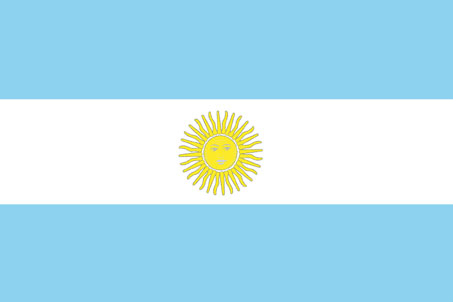
- Flag Symbolism
- has three equal horizontal bands of light blue (top), white, and light blue; centered in the white band is a radiant yellow sun with a human face known as the Sun of May Its width-to-length ratio varies: proportions of 1 to 2 and of 9 to 14 are commonly used on land, while the ratio 2 to 3 is used at sea. This flag was adopted on February 12, 1812, four years after Argentina achieved independence from Spain (1816). The "Sun of May" design was added to the flag in 1818. The blue and white colors were chosen by Manuel Belgrano, the leader of the Argentinian revolution against Spain, and represent the blue sky parting to reveal white clouds, as is said to have happened when the Liberation demonstration began in Buenos Aires, Argentina, on May 25, 1810.
- Date of Adoption
- February 12, 1812
National Anthem
- Anthem Lyrics
- Oid mortales el grito sagrado ¡Libertad! ¡Libertad! ¡Libertad! oid el ruido de rotas cadenas ved el trono en su noble igualdad Ya su trono dignisimo abrieron las provincias unidas del sud y los libres del mundo responden al gran pueblo Argentino ¡salud! al gran pueblo Argentino ¡salud! y los libres del mundo responden al gran pueblo Argentino ¡salud! Sean eternos los laureles que supimos conseguir que supimos conseguir coronados de gloria vivamos ¡oh! juremos con gloria morir ¡oh! juremos con gloria morir ¡oh! juremos con gloria morir
- Anthem History
- During the war of independence with Spain, the anthem underwent many modifications to tone down the militaristic and anti-Spanish nature of the song. However, in a presidential decree in 1900, it was declared that the anthem, as adopted on March 11, 1813, would be the official anthem,
Other National Symbols
Motto
National Motto
Spanish: En Unión y Libertad <br>English: In Union and Liberty
National Flower
Ceibo or Seibo
Erythrina crista-galli is a flowering tree in the family Fabaceae, native to Argentina, Uruguay, Brazil and Paraguay. It is widely planted as a street or garden tree in other countries, most notably in California in the United States. In South America, it is known by several common names: ceibo, seíbo, bucaré. In English it is known as the Cockspur coral tree. The tree's flower is the national flower of Argentina and Uruguay. It is also the official city tree of Los Angeles, California (where it is referred to simply as “the coral tree”). Erythrina crista-galli is a small tree, the girth of its trunk measuring 50 cm. Normally it grows 5–8 meters tall, although some, such as the ceibos in the Argentine provinces of Salta, Jujuy and Tucumán, can grow up to 10 m. The species characteristically grows wild in gallery-forest ecosystems along water courses, as well as in swamps and wetlands. In urban settings, it often is planted in parks for its bright red flowers.