
 English
 Español
 中文
中文 हिन्दी
 Français
Cote d'Ivoire
Cote d'Ivoire
Declare Your Relationship to Cote d'Ivoire
CountryReports Community
- Studying5
- From Cote d'Ivoire2
- Cote d'Ivoire heritage2
- Visited3
- Want to visit3
Customs and Culture
Customs and Culture
Cultural Attributes
Côte d'Ivoire is a culturally rich and ethnically diverse nation, home to more than 60 distinct ethnic groups whose traditions, languages, and artistic expressions collectively shape the country's national identity. The largest ethnic groups include the Akan, Gur, Northern Mandes, Southern Mandes, and Kru peoples, each with unique customs, social structures, and oral traditions passed down through generations. Music and dance hold a central place in Ivorian cultural life.

The World's Cocoa Coast
Greetings, Gestures & Visiting
People wear both traditional and Western style clothing. In cities people wear pants or blue jeans with shirts, with many of the women wearing pagnes or brightly colored dresses. Traditional clothing is most common in rural areas. For men traditional clothing includes shorts or a short piece of cloth wrapped around their bodies with long robes for ceremonial occasions.
Diet
The Ivorians are kind people who enjoy inviting others for dinner they believe those who are blessed enough to prepare a meal should share their good fortune. In many villages people eat together in a common area. Women and girls eat as a group, Men eat as a group and young boys eat as a third group. They eat with their right hand.

Family
Hospitality is a way of life. Men dominate interpersonal relations with the village elders being respected. Women take care of the children and many women have more than five (5) children. Different ethnic groups have their own traditions. A common ritual is initiations rights where participants undergo endurance tests. In rural areas many marriages are arranged, in the urban cities young people choose their own spouse.
Recreation
Football (soccer) is the most important sport. Griots or storytellers and storytelling is a favorite pastime in villages and stories may be told well into the night. Carving decorative objects is also a favorite pastime.
Student Life
The routine of going to school in Cote d’Ivoire, especially the rural parts of the country is considered a recent development and thus has to be accommodated within the normal routines that have gone on for ages. On a normal typical day children and especially girls will have to wake up at about 4:00 a.m. in order to take a long walk to the nearest water pump and fetch water to be used by the family for the day.
Holidays
Independence Day
8/7Independence Day
Dates of Interest
- August 7th
What are the dining customs in Côte d'Ivoire?
Ivorians love to share meals and often invite guests to dinner, eating with the right hand in a communal setting, frequently separated into groups.
Do
- Eat with your right hand
- Leave the meal area if you need to cough
- Thank the elders after the meal
- Leave a little food for the host's children as a polite guest
Don’t
- Don't reach across the table
- Don't cough, sneeze, or talk during the meal
- Don't take more than your fair share of food
Good to know
- In villages, women and girls, men, and young boys often eat in separate groups
- A bowl or calabash of water is passed around to wash hands, in order of seniority
- More honorable guests are served more food in a separate calabash
- Staples include yams, plantains, rice, millet, corn, and peanuts; the national dish is fufu served with kedjenou sauce, with attieke as a common side
How do people dress in Côte d'Ivoire?
People wear both traditional and Western clothing; cities favor jeans and shirts, while traditional dress is more common in rural areas.
Good to know
- In cities, men wear pants or jeans with shirts, and many women wear pagnes or brightly colored dresses
- Traditional men's clothing includes shorts or a wrapped cloth, with long robes for ceremonial occasions
- Hand-woven textiles feature bold geometric patterns reflecting ethnic identity and social status
What is family life like in Côte d'Ivoire?
Hospitality is a way of life and extended family networks are central to social support and decision-making, with elders highly respected.
Good to know
- Men dominate interpersonal relations and village elders are respected
- Women care for the children and many have more than five children
- Rural marriages are often arranged and can occur young; urban youth choose their own spouses
- Among the Akan, all villagers shave their heads when there is a death in the village
What do people do for fun in Côte d'Ivoire?
Football is the most important sport, and storytelling, carving, and dancing are cherished pastimes.
Good to know
- Griots (storytellers) may tell stories well into the night
- Carving decorative objects is a favorite pastime
- Dancing is taken seriously as expression and a way to pass down values; some dance societies are secret and require special ceremonies to join
- Coupé-décalé dance music originated among the Ivorian diaspora; traditional instruments include the djembe, balafon, and kora
What should travelers know before visiting Côte d'Ivoire?
Côte d'Ivoire is ethnically and religiously diverse, with French as the official language and Dioula as a widely spoken trade language.
Good to know
- Over 60 ethnic groups shape the national identity, including the Akan, Gur, Mandes, and Kru peoples
- The population is roughly 42% Muslim and 34% Christian, with both Christian and Muslim holidays observed
- Wooden masks by the Dan, Baoulé, and Senufo carry spiritual significance and are used in rituals
Last updated: 2026-07-12 · Sources: CountryReports
Photos of Cote d'Ivoire
Photos of Cote d'Ivoire


Travel and Tourism
Travel and Tourism
- Travel Alert Status
- Level 3: Reconsider Travel
- Currency
- 604.4
- Time Difference
- UTC 0 (5 hours ahead of Washington, DC, during Standard Time)
- Climate
- In the south, the tropical climate keeps temperatures between 24°C (75°F) and 32°C (90°F). The southern region features two rainy seasons, May to July and September to December. Humidity averages 85%. Over half the average annual precipitation (208 cm or 82 inches in Abidjan) falls in May, June, and July. Even then, however, the sun often shines. Temperatures vary in the north from 24°C to over 37°C (100°F). The northern region's one rainy season, May-October, averages 130 cm (51 inches) annual rainfall with 71% average humidity.
- Airports
- 37
- Recommended Vaccinations
- How important is it to do your research about vaccinations? It might just save your life! Make yourself aware of the different types of vaccinations and which ones you may need to travel to your destination. Schedule an appointment with your doctor at least four to six weeks before you travel to ensure you receive all important shots. Be sure that you and your family are up to date on your routine vaccinations. Which vaccinations you need will depend on a number of factors including your destination, whether you will be spending time in rural areas, the season of the year you are traveling, your age, health status, and previous immunizations.
Read the full travel guide — health, safety, vaccinations, disease risk, sanitation, and transit details.
View full travel guideRecipes
Recipes
History
History
Historical Eras
Pre-Colonial Era
1000 – 1843
The region that became Côte d'Ivoire was home to diverse ethnic groups, including the Mandé, Kru, and Akan peoples. In the 18th century, the Agni and Baoulé, two Akan subgroups, migrated from present-day Ghana and established influential kingdoms in the southeast and central regions. French missionaries made initial contact at Assinie in 1637, but sustained European presence remained limited due to the inhospitable coastline and local resistance.
French Protectorate
1843 – 1893
Admiral Bouet-Williaumez signed protectorate treaties with the kings of Grand Bassam and Assinie in 1843–44, establishing formal French influence along the coast. French explorers, missionaries, and trading companies gradually pushed inland, encountering sustained resistance from local rulers, most notably the Malinke leader Almany Samory Touré. Full pacification of the interior was not achieved until 1915, well after the territory's formal colonial designation.
French Colonial Period
1893 – 1960
Côte d'Ivoire was officially declared a French colony in 1893, with Captain Louis-Gustave Binger appointed as its first governor. From 1904 to 1958, it formed part of the Federation of French West Africa, administered largely from Paris under a philosophy of 'association' that denied Africans full citizenship rights. Post–World War II reforms, including the Brazzaville Conference of 1944 and the Loi Cadre of 1956, progressively expanded African political rights and laid the groundwork for independence.
Houphouët-Boigny Era
1960 – 1993
Côte d'Ivoire gained full independence on August 7, 1960, with Félix Houphouët-Boigny, founder of the Parti Démocratique de la Côte d'Ivoire (PDCI), becoming the country's first and long-serving president. His government maintained close ties with France, promoted cocoa and coffee export economies, and attracted foreign investment, producing the so-called 'Ivorian Miracle' of sustained economic growth through the 1970s. Single-party rule and authoritarian governance characterized the era, though multiparty politics were cautiously reintroduced in 1990.
Political Crisis & Civil War
1993 – 2011
Following Houphouët-Boigny's death in 1993, Côte d'Ivoire descended into deepening instability driven by ethnic tensions, the exclusionary concept of 'Ivoirité,' and disputes over citizenship. A military coup in December 1999 ousted President Henri Konan Bédié, and a failed coup attempt in September 2002 triggered a full civil war that split the country between the government-controlled south and rebel-held north. A decade of fragile peace agreements, a disputed 2010 presidential election, and post-election violence culminated in the capture of incumbent Laurent Gbagbo in April 2011.
Reconstruction & Modern Côte d'Ivoire
2011 – present
Alassane Ouattara assumed the presidency in 2011, overseeing a significant economic recovery that made Côte d'Ivoire one of Africa's fastest-growing economies, driven by cocoa production, infrastructure investment, and restored foreign confidence. The country navigated post-conflict reconciliation challenges, including trials related to post-election violence, while maintaining political tensions that surfaced in elections in 2015 and 2020. Ouattara's contested decision to seek a third term in 2020 renewed political divisions, reflecting ongoing challenges in consolidating democratic governance.
Overview
The early history of Cote d’Ivoire is virtually unknown, although it is
Timeline of Key Events
1842
France imposes protectorate over coastal zone.
France imposes protectorate over coastal zone.
1893
Ivory Coast made into a colony.
Ivory Coast made into a colony.
1958
Ivory Coast becomes a republic within the French Community.
Ivory Coast becomes a republic within the French Community.
1960
France grants independence under President Felix Houphouet-Boigny.
France grants independence under President Felix Houphouet-Boigny. He holds power until he dies in 1993.
2000
Fighting erupts.
Fighting erupts between Gbagbo’s mainly southern Christian supporters and followers of Ouattara, who are mostly Muslims from the north.
2002
Short-lived ceasefire in October.
Short-lived ceasefire in October gives way to further clashes and battle for key cocoa-industry town of Daloa. Previously unknown rebel groups seize towns in west.
2003
President Gbagbo accepts peace deal at talks in Paris.
President Gbagbo accepts peace deal at talks in Paris. Deal proposes power-sharing government.
Read the full history profile — narrative overview, defining eras, and the complete timeline in one place.
View expanded historyInteresting Facts
Interesting Facts
The world's biggest church is the the Basilica of Our Lade of Peace in Uamoussoukro.
See every fact — trivia, oddities, and curious tidbits gathered from across the country.
View all interesting factsGeography and Environment
Geography and Environment
- Terrain
- mostly flat to undulating plains; mountains in northwest
- Climate
- In the south, the tropical climate keeps temperatures between 24°C (75°F) and 32°C (90°F). The southern region features two rainy seasons, May to July and September to December. Humidity averages 85%. Over half the average annual precipitation (208 cm or 82 inches in Abidjan) falls in May, June, and July. Even then, however, the sun often shines. Temperatures vary in the north from 24°C to over 37°C (100°F). The northern region's one rainy season, May-October, averages 130 cm (51 inches) annual rainfall with 71% average humidity.
- Natural Hazards
- coast has heavy surf and no natural harbors; during the rainy season torrential flooding is possible
- Current Environmental Issues
- deforestation (most of the country's forests - once the largest in West Africa - have been heavily logged); water pollution from sewage and industrial and agricultural effluents
Read the full geography and environment profile — terrain, climate, natural resources, hazards, land use, and international agreements.
View full geographyPeople & Demographics
People & Demographics
Religion
Languages Spoken
French (official), 60 native dialects with Dioula the most widely spoken
- French
Population
- Population
- 34
- Population in Major Urban Areas
- ABIDJAN (seat of government) 4.288 million; YAMOUSSOUKRO (capital) 966,000
- Nationality Noun
- Ivoirian(s)
- Ethnic Groups
- Akan 42.1%, Voltaiques or Gur 17.6%, Northern Mandes 16.5%, Krous 11%, Southern Mandes 10%, other 2.8% (includes 130,000 Lebanese and 14,000 French) (1998)
Education
- Literacy Definition
- Age 15 and over can read and write
Health Information
- Major Infectious Diseases — degree of risk
- very high
Read the full people and society profile — demographics, health, education, religion, languages, and notable people.
View full people and societyGovernment & Politics
Government & Politics
Country Identity
- Country Name
- CotedIvoire
- Full Country Name
- Republic of Cote d'Ivoire
- Local - Short
- Cote d'Ivoire
- Former Name
- Ivory Coast
Government Structure
- Government Type
- republic; multiparty presidential regime established 1960
- Legal System
- based on French civil law system and customary law; judicial review in the Constitutional Chamber of the Supreme Court; has not accepted compulsory ICJ jurisdiction
- Executive Branch
- chief of state: President Alassane OUATTARA (since 11 April 2011; reelected 31 October 2020) head of government: Prime Minister Robert MAMBE (since 2024); note: the prime minister is appointed by the president cabinet: Council of Ministers appointed by the president elections: president elected by popular vote for a five-year term; election last held on 31 October 2020 (next to be held in 2025); prime minister appointed by the president election results: Alassane OUATTARA reelected president; percent of vote - Alassane OUATTARA 94.3%, Kouadio Konan BERTIN 1.99%, other 3.71%; note: the main opposition parties boycotted the 2020 election
- Legislative Branch
- Cote d'Ivoire has a bicameral Parliament (Parlement) consisting of two chambers: the Senate (Senat) with 99 seats, of which 66 members are indirectly elected by municipal and regional councils and 33 are appointed by the president, serving five-year terms; and the National Assembly (Assemblee Nationale) with 255 seats, whose members are elected by direct popular vote in single- and multi-district constituencies to serve five-year terms. Elections for the National Assembly were last held on March 6, 2021. Election results: seats by party - RHDP 137, PDCI-RDA 50, EDS 23, UDPCI 8, other 21, independents 16. Senate elections were last held on September 16, 2023, with the RHDP winning the majority of indirectly elected seats. The Senate was formally established and began functioning following the adoption of the 2016 constitution, which restructured the country's legislature into its current bicameral form. The president of the National Assembly serves as second in the line of succession to the presidency, while the president of the Senate serves as first in the line of succession.
- Judicial Branch
- Supreme Court or Cour Supreme consists of four chambers: Judicial Chamber for criminal cases, Audit Chamber for financial cases, Constitutional Chamber for judicial review cases, and Administrative Chamber for civil cases; there is no legal limit to the number of members
- Suffrage
- 18 years of age; universal
- Constitution
- 3 November 1960; has been amended numerous times, most recently 27 July 1998
- Independence
- 7 August 1960 (from France)
- National Holiday
- Independence Day, 7 August (1960)
Capital City
- Capital Name
- Yamoussoukro (legislative capital), Abidjan (administrative capital); note - although Yamoussoukro has been the official capital since 1983, Abidjan remains the administrative capital as well as the officially designated economic capital; the US, like other countries, maintains its Embassy in Abidjan
- Capital - geographic coordinate
- 6 49 N, 5 16 W
- Capital Time Difference
- UTC 0 (5 hours ahead of Washington, DC, during Standard Time)
Yamoussoukro is named after Queen YAMOUSSOU, who ruled in the village of N'Gokro in 1929 at the time of French colonization; the village was renamed Yamoussoukro, the suffix "-kro" meaning "town" in the native Baoule language; Abidjan's name supposedly comes from a misunderstanding; tradition states that an old man carrying branches met a European explorer who asked for the name of the nearest village; the man, not understanding and terrified by this unexpected encounter, fled shouting "min-chan m’bidjan," which in the Ebrie language means: "I return from cutting leaves"; the explorer, thinking that his question had been answered, recorded the name of the locale as Abidjan; a different version has the first colonists asking native women the name of the place and getting a similar response
Military
Branches: Republican Forces of Cote d'Ivoire (Force Republiques de Cote d'Ivoire, FRCI): Army, Navy, Cote d'Ivoire Air Force (Force Aerienne de la Cote d'Ivoire) Note: FRCI is the former Armed Forces of the New Forces (FAFN)
Embassy / Diplomatic Mission
Embassy Abidjan
Address: 01 B.P. 1712
Abidjan 01 Côte d’Ivoire.
Telephone: 225-22-49-40-00
Emergency after-hours telephone: 225-22-49-44-50
Facsimile: 225-22-49-42-02
Email: AbjAmcit@state.gov
Read the full government profile — flag symbolism, national anthem, and other national symbols.
View full government detailsEconomy
Economy
Cote d'Ivoire is among the world's largest producers and exporters of cocoa beans, cashews, coffee, and palm oil, and it is the global leader in cocoa production, accounting for roughly 40% of the world's supply. As a result, the economy remains highly sensitive to fluctuations in international commodity prices and to weather conditions. Despite government efforts to diversify, the economy is still heavily dependent on agriculture and related activities, which engage close to half of the workforce.
After enduring a prolonged political and military crisis between 2002 and 2011, Cote d'Ivoire experienced a remarkable economic rebound, becoming one of the fastest-growing economies in Sub-Saharan Africa. GDP growth averaged around 8% annually between 2012 and 2019, fueled by infrastructure investment, expanded agricultural output, offshore oil and gas production, and a more favorable business climate. Growth slowed in 2020 due to the COVID-19 pandemic but rebounded quickly, with annual GDP growth returning to roughly 6–7% in subsequent years.
The government's National Development Plan aims to transform Cote d'Ivoire into an upper-middle-income economy, with priorities including industrialization, local processing of raw cocoa and cashews, expansion of the energy sector, and improvements in education and healthcare. Recent offshore oil discoveries, notably the Baleine field, are expected to significantly boost hydrocarbon output and export revenues in the coming years.
Challenges persist, however, including high public debt, regional security concerns linked to instability in the Sahel, vulnerability to global commodity price swings, and persistent poverty and inequality, particularly in rural areas. The outlook nonetheless remains positive, supported by strong domestic demand, ongoing reforms, and continued external investment.
Snapshot
- Currency Name and Code
- Communaute Financiere Africaine francs (XOF)
- GDP — official exchange rate
- $16,570,000,000 (USD)
- GDP Real Growth Rate
- 1%
- Gini Index
- 45.2
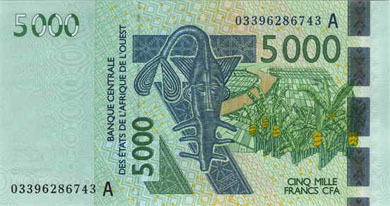
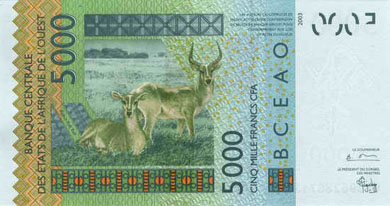
Banknotes
Budget & Public Finance
- Fiscal Year
- calendar year
- Annual Budget
- $2,830,000,000 (USD)
- Public Debt (% of GDP)
- 70.4%
- External Debt
- $13,260,000,000 (USD)
- Investment (% of GDP)
- 8.7%
- Economic Aid
- $1,000,000,000 (USD)
- Current Account Balance
- -$289,000,000 (USD)
- Reserves of Foreign Exchange
- $1,950,000,000 (USD)
Labor, Industry & Trade
- Labor Force by Occupation
- 68% agricultural
- Household Income — highest 10%
- 28.8%
- Industries
- foodstuffs, beverages; wood products, oil refining, truck and bus assembly, textiles, fertilizer, building materials, electricity
- Agriculture Products
- coffee, cocoa beans, bananas, palm kernels, corn, rice, manioc (tapioca), sweet potatoes, sugar, cotton, rubber; timber
- Export Commodities
- cocoa, coffee, timber, petroleum, cotton, bananas, pineapples, palm oil, fish
- Export Partners
- France 13.7%, Netherlands 12.2%, US 7.2%, Germany 5.3%, Mali 4.4%, Belgium 4.2%, Spain 4.1%
- Import Commodities
- fuel, capital equipment, foodstuffs
- Import Partners
- France 22.4%, Nigeria 16.3%, China 7.8%, Italy 4.1%
Energy
- Oil Production
- 32,900 bbl/day
- Oil Consumption
- 20,000 bbl/day
- Oil Reserves
- 220,000,000 bbl/day
- Natural Gas Production
- 1,300,000,000 cu m
- Natural Gas Consumption
- 1,300,000,000 cu m
- Natural Gas Imports
- 0 cu m
- Natural Gas Exports
- 0 cu m
- Natural Gas Reserves
- 29,730,000,000 cu m
Communications
- Telephone System
- General Assessment: Well-developed by African standards; telecommunications sector privatized in the late 1990s and operational fixed-lines have increased since that time with two fixed-line providers operating over open-wire lines, microwave radio relay, and fiber-optics; 90% digitalized Domestic: With multiple mobile-cellular service providers competing in the market, usage has increased sharply to roughly 80 per 100 persons international: country code - 225; landing point for the SAT-3/WASC fiber-optic submarine cable that provides connectivity to Europe and Asia; satellite earth stations - 2 Intelsat (1 Atlantic Ocean and 1 Indian Ocean)
- Internet Country Code
- .ci
News & Weather
News & Weather
Current Weather
Latest News
How a new temple sparked a year of rapid growth in Côte d’Ivoire - LDS Living
LDS Living · 1d ago
How the ‘gathering oasis’ in the Africa West Area is flourishing 1 year later - Church News
Church News · 3d ago
New Lessons from Côte d’Ivoire: Countering Violent Extremism in West Africa’s Borderlands - Small Wars Journal
Small Wars Journal · 3d ago
Watch Côte d'Ivoire vs Norway - tod.tv
tod.tv · 2d ago
Pastors in politics: How evangelicals are crossing the line in Côte d’Ivoire - The Africa Report
The Africa Report · 18h ago
World Bank clears PRIME-GAS project linking Benin, Togo and Côte d'Ivoire around gas - Capmad
Capmad · 19h ago
Saipem’s Santorini heads back to Côte d’Ivoire for Eni - Drilling Contractor
Drilling Contractor · 1d ago
Côte d'Ivoire advances to first FIFA World Cup knockout stage - Philadelphia Union
Philadelphia Union · 28d ago
News via Google News
Climate Overview
In the south, the tropical climate keeps temperatures between 24°C (75°F) and 32°C (90°F). The southern region features two rainy seasons, May to July and September to December. Humidity averages 85%. Over half the average annual precipitation (208 cm or 82 inches in Abidjan) falls in May, June, and July. Even then, however, the sun often shines. Temperatures vary in the north from 24°C to over 37°C (100°F). The northern region's one rainy season, May-October, averages 130 cm (51 inches) annual rainfall with 71% average humidity.
Videos
Videos
1 curated YouTube videos.
Source: YouTube
Frequently Asked Questions
Frequently Asked Questions
What is the population of Cote d'Ivoire?
What are the dining customs in Côte d'Ivoire?
How do people dress in Côte d'Ivoire?
What is family life like in Côte d'Ivoire?
What do people do for fun in Côte d'Ivoire?
What should travelers know before visiting Côte d'Ivoire?
What is the capital of Côte d'Ivoire?
Where is Côte d'Ivoire located?
What countries border Côte d'Ivoire?
What is the predominant religion in Côte d'Ivoire?
What currency is used in Côte d'Ivoire?
What language is spoken in Côte d'Ivoire?
What is Côte d'Ivoire known for?
Last reviewed 2026