
 English
 Español
 中文
中文 हिन्दी
 Français
Sweden
Sverige
Declare Your Relationship to Sweden
CountryReports Community
- Studying20
- From Sweden0
- Sweden heritage4
- Visited3
- Want to visit3
Customs and Culture
Customs and Culture
Cultural Attributes
Life in Sweden is greatly influenced by its geographic location and climate. Much of the country experiences long, dark winters and short vibrant summers. Despite the harshness of winter, Swedes are not a people to hide indoors. Instead, they participate in many winter sports and activities that help winter days pass quickly. Swedes are somewhat reserved, friendships are meaningful but take time to develop.
Swedes are proud of their nation as well as regions and towns.
Swedes can rely on a generous social welfare system to provide health, education, and retirement benefits.
Sweden awards all Nobel prizes (Chemistry, literature, medicine, and physics) except the Nobel Peace Prize.
Being on time is extremely important to adults in Sweden, In fact, Swedes are stereotyped as being obsessive about time. In Swedish schools, tardy slips and hall passes are not used

Kingdom of Winter Lights and Innovation
Get More Customs and Culture
6 more cultural topics for members
Social Customs & Etiquette · Diet · Family · Dating Customs · Recreation · Student Life
Every country, every topic, all activities & recipes
✓ Instant access on this device · ✓ No subscription
Holidays
Flag Day
6/6Independence
Since 1916, 6 June has been celebrated as the Swedish Flag Day. This finally also became Sweden's National Day in 1983. The reasons for the choice of date are twofold: the election of Gustav Vasa as Sweden's king on 6 June 1523 laid the foundation of Sweden as a separate state; and on the same date in 1809, Sweden adopted a new constitution which included the establishment of civil rights and liberties.
Labor Day
5/1Other
A day to honor the nation’s workers
Birth date - Alfred Bernhard Nobel
10/21Birthday
Birth date - Alfred Bernhard Nobel, Swedish inventor of dynamite who established the Nobel Prizes, was born in Stockholm, Sweden on Oct. 21, 1833.
Christmas
12/25Christmas
On December 13th, one of the shortest days of winter, girls dress up as Santa Lucia wearing a white dress and a crown of candles . Boys carry a candle and wear a kind of white pajama. They wear hats that are pointy with golden stars on them. Girls do not wear candles anymore because their hair caught on fire. Today they use modern candles with batteries in them. After lunch most schools close on Santa Lucia day around noon. There are special foods for Lucia’s Day like Lussekatter and spicy gingerbread biscuits. In big cities there are beauty contests where some women dress up as Santa Lucia and the judges and the people vote for the Santa Lucia of the year.
Song for Santa Lucia English Version
The night goes with weighty step round yard and (stove i.e. house, hearth?) round earth. The sun’s departure leaves the woods brooding. There in our dark house, appears with lighted candles Saint Lucia, Saint Lucia. The night goes great and mute. Now one hears its wings in every silent room murmuring as if from wings. Look at our threshold. There she stands white-clad with lights in her hair Saint Lucia, Saint Lucia The darkness shall soon depart from the earth’s valleys thus she speaks a wonderful word to us. The day shall rise anew from the rosy sky. Saint Lucia, Saint Lucia.
Swedish Version
Natten går tunga fjät rund gård och stuva; kring jord, som sol förlät, skuggoma ruva. Då i vårt mörka hus, stiger med tända Uus, Sankta Lucia, Sankta Lucia. Natten går stor och stum nu hörs dess vingar i alla tysta rum sus som av vingar. Se, på vår tröskel står vitklädd med ljus i hår Sankta Lucia, Sankta Lucia. Mörkret ska flyta snart urjordens dalar så hon ett underbart ord till oss talar. Dagen ska åter ny stiga ur rosig sky. Sankta Lucia, Sankta Lucia.
Dates of Interest
- October 4th
Cinnamon Bun Day, celebrated on October 4th, is dedicated to Sweden's beloved pastry, the cinnamon bun. Bakeries and individuals bake and share these sweet treats throughout the day.
How do people greet each other in Sweden?
Swedes shake hands when entering or leaving a social setting, or nod from a distance, and usually address each other by first name.
Do
- Shake hands when arriving or leaving
- Use first names in most situations
- Use titles in formal situations
- Nod from a distance when appropriate
What are the dining customs in Sweden?
Meals reflect a mix of traditional and health-conscious eating, with the main meal ("middag") traditionally eaten at midday and social dinners lasting into the evening.
Do
- Try breakfast staples like fil (yogurt) and knäckebröd (crisp bread) with coffee
- Enjoy open-face sandwiches (smörgåsar)
- Join an August crayfish party with beer and aquavit
- Stay after dinner for coffee and conversation until 11 PM
What etiquette should I know when visiting a Swedish home?
Swedes visit only by prior arrangement, value punctuality highly, and expect guests to be respectful and prompt.
Do
- Arrive on time or a few minutes early
- Remove your shoes when entering a home
- Bring indoor shoes or clogs in bad weather
- Send a thank-you card if you didn't bring a gift
Don’t
- Don't visit without prior arrangements
- Don't be late
Good to know
- Being on time is extremely important to Swedes
- A host usually offers guests something to drink
How should I dress in Sweden?
Swedes wear warm, conservative European fashions suited to the climate.
Good to know
- Traditional folk costumes for women include white blouses, vests, and long dark skirts with aprons
- Men's folk costumes include white shirts, vests, dark knee-length breeches, and white hose
What gestures and customs are unique to Sweden?
Sweden has several distinctive gestures, from the friendly two-finger salute to careful toasting etiquette.
Do
- Make eye contact with each person when toasting before sipping
- Give a slight nod or bow with a handshake in formal settings
- Use the two-finger salute as a friendly greeting or thanks
Good to know
- Swedes knock on wood, usually three times, to ward off bad luck after expressing a hope
What is family and social life like in Sweden?
About 80 percent of Swedes live in urban areas, and a generous welfare system supports families throughout life.
Good to know
- Families receive government money to support each child under 16 and those in secondary school or university
- Every employed person receives at least five weeks of paid vacation each year
- The government provides benefits for unemployment, retirement, and medical care
What do Swedes do for recreation?
Singing in choirs is Sweden's most popular hobby, and Swedes love outdoor activities and sports year-round.
Do
- Try popular sports like soccer (fotboll), skiing, tennis, golf, swimming, and ice hockey
- Use town exercise trails for jogging, walking, or cross-country skiing
- Watch or join the 86-kilometer Vasaloppet cross-country ski race each March
Good to know
- Tennis surged in popularity after Björn Borg won five straight Wimbledon titles
- The Vasaloppet commemorates Gustav Vasa's 1523 flight on skis
Last updated: 2026-07-12 · Sources: CountryReports
Photos of Sweden
Photos of Sweden
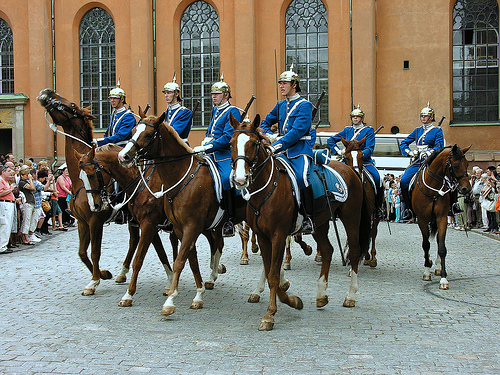
Royal guard change in Stockholm, Sweden
Large shuttle boat heading from Stockholm to Helsinki.
Shopping district in Stockholm, Sweden
Coffee house in Stockholm.
Street in Drottninggatan
Train near Stockholm
Gamla stan, Stockholm
Digerhuvud, beach
Tyska kyrkan, Gamla Stan
Drottningholm Palace
View over Gamla Stan
Liljeholmen train station


Travel and Tourism
Travel and Tourism
- Travel Alert Status
- Level 1: Exercise Normal Precautions
- Currency
- Swedish krona (SEK)
- Time Difference
- UTC+1 (6 hours ahead of Washington, DC, during Standard Time)
- Airports
- 255
Read the full travel guide — health, safety, vaccinations, disease risk, sanitation, and transit details.
View full travel guideRecipes
Recipes
Gravad lax
Main Dish
Main Dish
Iglagd Sill (Salted Herring)
Main Dish
Kåldolmar (Cabbage Rolls)
Main Dish
Köttbullar (Swedish Meatballs)
Main Dish
Julskinka (Christmas Ham)
Main Dish
Gravlax (Salt and Sugar Cured Salmon)
Main Dish
Iglagd Sill (Salted Herring)
Main Dish
PremiumKåldolmar (Cabbage Rolls)
Main Dish
PremiumKöttbullar (Swedish Meatballs)
Main Dish
PremiumJulskinka (Christmas Ham)
History
History
Historical Eras
Viking & Early Kingdom
793 – 1397
Swedish Vikings emerged as formidable merchant-warriors, trading and raiding as far as Constantinople and the Caspian Sea. By the 11th century, Sweden was consolidating into a unified Christian kingdom following the introduction of Christianity by St. Ansgar in 829. The kingdom gradually expanded to include Finland, developing distinct administrative and ecclesiastical structures through the 12th and 13th centuries.
Kalmar Union
1397 – 1523
Queen Margaret of Denmark united Sweden, Denmark, and Norway under the Kalmar Union in 1397, creating a pan-Nordic political entity. Persistent tensions between Swedish nobility and Danish royal authority fueled repeated conflict, culminating in the Stockholm Bloodbath of 1520, in which Danish King Christian II executed scores of Swedish nobles. This atrocity galvanized Swedish resistance under Gustav Vasa, who dissolved the union and established an independent Swedish state.
Vasa Dynasty
1523 – 1611
Gustav Vasa's election as king in 1523 founded the Vasa dynasty and marked the birth of modern Sweden. He broke with Rome, established the Lutheran Reformation, and centralized royal authority over the nobility and church alike. Sweden seized Estonian territory in 1551 and concluded the Peace of Stettin in 1570, securing Danish recognition of its full sovereignty.
Swedish Empire
1611 – 1721
Through successive wars against Denmark, Russia, and Poland, Sweden emerged as the dominant power of northern Europe, ruling Finland, the eastern Baltic coast, and significant portions of northern Germany. Gustav II Adolf's decisive intervention in the Thirty Years' War reshaped the religious and political balance of the continent before his death at Lützen in 1632. The empire collapsed following the Great Northern War, when Karl XII's overextended campaigns against Russia ended in catastrophic defeat and the 1721 Peace of Nystad stripped Sweden of most of its Baltic territories.
Constitutional & Napoleonic Era
1721 – 1814
Defeat in the Great Northern War ushered in the Age of Liberty, a parliamentary era in which the Riksdag assumed dominance over the crown. Sweden suffered further territorial contraction during the Napoleonic Wars, losing Finland to Russia in 1809 in a humiliating peace. French Marshal Jean-Baptiste Bernadotte was elected Crown Prince in 1810, founding the Bernadotte dynasty and steering Sweden toward the allied coalition that defeated Napoleon.
Industrialization & Neutrality
1814 – 1905
The Congress of Vienna compensated Sweden for its German losses with a dynastic union with Norway, which lasted peacefully until Norway's dissolution of the arrangement in 1905. Domestically, Sweden underwent a profound agricultural and industrial transformation, though economic hardship drove approximately 1.5 million Swedes to emigrate to the United States between 1850 and 1930. A tradition of non-alignment in peacetime solidified during this era, laying the groundwork for Swedish neutrality in both World Wars.
Modern Sweden
1905 – present
Sweden maintained armed neutrality through both World Wars, benefiting economically from wartime demand for steel, timber, and industrial goods, and used postwar prosperity to construct one of the world's most comprehensive welfare states under Social Democratic governance. The country joined the European Union in 1995 but declined to adopt the euro, reflecting enduring ambivalence about deeper European integration. In 2022, prompted by Russia's invasion of Ukraine, Sweden abandoned its historic neutrality doctrine and formally applied for NATO membership.
Overview
During the seventh and eighth centuries, the Swedes were merchant seamen well known for their far-reaching trade. In the ninth century, Nordic Vikings raided and ravaged the European Continent as far as the Black and Caspian Seas. During the 11th and 12th centuries, Sweden gradually became a unified Christian kingdom that later included Finland. Queen Margaret of Denmark united all the Nordic lands in the "Kalmar Union" in 1397.
Every country, every topic, all activities & recipes
✓ Instant access on this device · ✓ No subscription
Timeline of Key Events
829
Christianity introduced by St. Ansgar.
Christianity introduced by St. Ansgar.
860
Swedish Vikings attacked Constantinople.
Swedish Vikings attacked Constantinople.
1054
Sweden and Denmark set boundaries.
Sweden and Denmark set boundaries.
1250
King Eriksson died
King Eriksson died; Valdemar crowned King; Birger Jarl declared regent until Valdemar is of age
1266
King Valdemar overthrown by brothers.
King Valdemar overthrown by brothers.
1318
Peasants revolted against King.
Peasants revolted against King.
1323
Sweden and Russia establish border.
Sweden and Russia establish border.
Read the full history profile — narrative overview, defining eras, and the complete timeline in one place.
View expanded historyInteresting Facts
Interesting Facts
They put their tooth in a glass of water. In the morning their tooth will be gone and a coin will be in the glass.
Every year, the Nobel Prizes are awarded in Stockholm, Sweden. Alfred Nobel, who founded the prizes, was a Swedish manufacturer of armaments and explosives.
In July 2000, a bridge linking Sweden and Denmark was opened by Sweden's King Carl Gustav xvi and Denmark's Queen Margrethe II. The 16-kilometre Öresund Link spans the water between Lernacken, near Malmö, and Kastrup, near Copenhagen.
One-seventh of Sweden lies north of the Arctic Circle. This region is called the Land of the Midnight Sun because the sun shines almost 24 hours a day for several weeks in late June and early July. In December and January, the sun barely rises above the horizon.
2 more facts for members
Every country, every topic, all activities & recipes
✓ Instant access on this device · ✓ No subscription
Geography and Environment
Geography and Environment
- Terrain
- mostly flat or gently rolling lowlands; mountains in west
- Climate
- Despite its northern latitude, Sweden’s climate is not excessively cold due to the proximity of the Gulf Stream and the Baltic Sea. The mean annual temperature is 48 degrees F. Stockholm is situated at approximately the same latitude as Juneau, Alaska. During most of December and early January, the sun does not rise before 9 a.m. and sets as early as 2:30 p.m. Snow usually falls in January, February, and March. The average temperature range for January is 27° F to 30° F. Spring comes late, with snow possible even in May. By June, daylight is almost continuous, and the vegetation is luxuriant. In July, the average temperature range is 57° F to 72° F. Many firms close down for the month so that the entire staff can take vacation. The average annual rainfall in Stockholm is 22 inches. It rains an average of 164 days a year.
- Natural Hazards
- ice floes in the surrounding waters, especially in the Gulf of Bothnia, can interfere with maritime traffic
- Current Environmental Issues
- acid rain damage to soils and lakes; pollution of the North Sea and the Baltic Sea
Read the full geography and environment profile — terrain, climate, natural resources, hazards, land use, and international agreements.
View full geographyPeople & Demographics
People & Demographics
Religion
Languages Spoken
Swedish
- Swedish
Population
- Population
- 10,551,707
- Population in Major Urban Areas
- STOCKHOLM (capital) 1.385 million
- Nationality Noun
- Swede(s)
- Ethnic Groups
- indigenous population: Swedes and Finnish and Sami minorities; foreign-born or first-generation immigrants: Finns, Yugoslavs, Danes, Norwegians, Greeks, Turks
- Language Note
- The numbers in Swedish and in English are very similar. If, for example, you want to say 31 you just take the word for 30, "trettio", and the word for 5, "fem", and put them together to make "trettiofem". This works in exactly the same way as it does in English. Sweden uses the Roman alphabet with three extra letters. å ö ä. Some words are the same in English and Swedish for example "man" and "person" are the same.
Education
- Literacy Definition
- age 15 and over can read and write
Life Expectancy
- Life Expectancy at Birth
- Sweden consistently ranks among the top countries in the world for life expectancy, reflecting the nation's robust healthcare system, high standard of living, and deeply ingrained cultural emphasis on wellness and preventive care. As of the most recent available data, the average life expectancy at birth in Sweden is approximately 83 to 84 years overall, with women living to around 85 years and men to approximately 82 years. These figures place Sweden well above the global average life expectancy of roughly 73 years. Several interconnected factors contribute to Sweden's exceptional longevity. The country operates a universal healthcare system funded primarily through taxation, ensuring that all residents have access to medical services regardless of income. Preventive medicine, regular health screenings, and early intervention programs are standard components of Swedish healthcare, helping to detect and manage chronic conditions before they become life-threatening. Lifestyle factors also play a significant role. Sweden has one of the lower rates of tobacco use in Europe, and physical activity is deeply embedded in everyday culture, with cycling, hiking, and outdoor recreation commonly practiced across all age groups. Swedes benefit from a diet that traditionally emphasizes fish, whole grains, and fresh produce, though modern dietary habits have diversified considerably. Social and environmental conditions further support long life. Sweden maintains low levels of air pollution relative to many industrialized nations, strong occupational safety regulations, and a generous social safety net that reduces poverty-related health risks. Low infant mortality rates — among the lowest recorded globally — also contribute positively to overall life expectancy calculations. Sweden's aging population is itself a testament to these conditions, with a significant and growing proportion of citizens aged 65 and older. Currently, roughly 20 percent of Sweden's population is 65 or older, a share projected to increase in the coming decades. The government has responded with substantial investments in elder care and long-term health services to meet this demographic demand. Historically, Sweden has seen steady, long-term gains in life expectancy over the past century, interrupted only briefly by global events such as the 1918 influenza pandemic and, more recently, experiencing modest fluctuations during the COVID-19 pandemic period. Despite these disruptions, Sweden's overall upward trend in longevity has remained intact, underscoring the resilience and effectiveness of its public health infrastructure and its enduring commitment to social welfare as a foundation of national policy.
- Infant Mortality Rate
- Sweden consistently ranks among the countries with the lowest infant mortality rates in the world, reflecting its highly developed healthcare system, strong social welfare infrastructure, and widespread access to prenatal and postnatal care. As of recent data, Sweden's infant mortality rate stands at approximately 2.1 to 2.4 deaths per 1,000 live births. This figure places Sweden well below the global average of roughly 27 deaths per 1,000 live births, and also below the average for high-income countries. The rate has declined steadily over several decades, driven by improvements in neonatal medicine, universal healthcare coverage, and public health education. Several factors contribute to Sweden's exceptional performance in this area. The country provides universal access to maternal healthcare, including comprehensive prenatal screenings, skilled attendance at every birth, and well-equipped neonatal intensive care units. Sweden's parental leave policies also support early infant health, as parents are encouraged and financially supported to remain closely involved in newborn care during the critical first months of life. Sweden maintains a robust network of child healthcare centers, known locally as barnavårdscentraler (BVC), which offer regular developmental checkups and vaccinations for all children from birth through school age. These centers are free of charge and serve virtually the entire population, ensuring that health monitoring is not dependent on family income. Breastfeeding rates in Sweden are also among the highest in Europe, which contributes positively to infant immune health and early development. Public health campaigns and hospital practices actively promote breastfeeding, and most maternity wards follow guidelines supporting immediate skin-to-skin contact and early initiation of breastfeeding. Socioeconomic equity plays an important role as well. Sweden's relatively low levels of poverty and strong social safety nets reduce the health disparities that in many countries drive higher rates of infant death among lower-income populations. While Sweden's infant mortality rate is exceptionally low, public health authorities continue to monitor neonatal outcomes closely, with particular attention to preterm births, which remain the leading cause of infant deaths even in high-income settings.
Read the full people and society profile — demographics, health, education, religion, languages, and notable people.
View full people and societyGovernment & Politics
Government & Politics
Country Identity
- Country Name
- Sweden
- Full Country Name
- Kingdom of Sweden
- Local - Long
- Konungariket Sverige
- Local - Short
- Sverige
Government Structure
- Government Type
- constitutional monarchy
- Legal System
- civil law system influenced by customary law; accepts compulsory ICJ jurisdiction, with reservations
- Executive Branch
- chief of state: King CARL XVI GUSTAF (since 19 September 1973); Heir Apparent Princess VICTORIA Ingrid Alice Desiree, daughter of the monarch (born 14 July 1977) head of government: Prime Minister Ulf KRISTERSSON (since 18 October 2022) cabinet: Cabinet appointed by the prime minister elections: the monarchy is hereditary; following legislative elections, the leader of the majority party or majority coalition is elected prime minister by the parliament election results: Ulf KRISTERSSON elected prime minister following the September 2022 general election, in which his center-right Moderate Party-led coalition secured a narrow parliamentary majority; election held 11 September 2022 (next to be held in September 2026)
- Legislative Branch
- unicameral Parliament or Riksdag (349 seats; members are elected by popular vote on a proportional representation basis to serve four-year terms) elections: last held 11 September 2022 (next to be held in September 2026) election results: percent of vote by party - Social Democrats 30.3%, Sweden Democrats 20.5%, Moderates 19.1%, Left Party 6.7%, Center Party 6.7%, Christian Democrats 5.3%, Liberal Party 4.7%, Greens 5.1%; seats by party - Social Democrats 107, Sweden Democrats 73, Moderates 68, Left Party 24, Center Party 24, Christian Democrats 19, Liberal Party 16, Greens 18
- Judicial Branch
- Supreme Court or Hogsta Domstolen (judges are appointed by the prime minister and the cabinet)
- Suffrage
- 18 years of age; universal
- Constitution
- 1-Jan-75
- Independence
- 6 June 1523 (Gustav VASA elected king)
- National Holiday
- Flag Day, 6 June
Capital City
- Capital Name
- Stockholm
- Capital - geographic coordinate
- 59 20 N, 18 03 E
- Capital Time Difference
- UTC+1 (6 hours ahead of Washington, DC, during Standard Time)
stock and holm literally mean "log" and "islet" in Swedish, but there is no consensus as to what the words refer to
Military
Branches: Swedish Armed Forces (Forsvarsmakten): Army (Armen), Royal Swedish Navy (Marinen), Swedish Air Force (Svenska Flygvapnet)
Embassy / Diplomatic Mission
U.S. Embassy in Stockholm
Dag Hammarskjoldsvag 31
SE-115 89 Stockholm
Telephone: (46) (8) 783-5300
Emergency after-hours telephone: (46) (8) 783-5300
Fax: (46) (8) 783-5480
Read the full government profile — flag symbolism, national anthem, and other national symbols.
View full government detailsEconomy
Economy
Sweden has achieved a high standard of living under a mixed system of advanced capitalism and extensive welfare benefits, supported by more than two centuries of peace and a long tradition of neutrality, though the country joined NATO in March…
Snapshot
- Currency Name and Code
- Swedish Krona (SEK)
- GDP — official exchange rate
- $348,100,000,000 (USD)
- GDP Real Growth Rate
- 0.5%
- Gini Index
- 25
Every country, every topic, all activities & recipes
✓ Instant access on this device · ✓ No subscription
News & Weather
News & Weather
Current Weather
Latest News
‘I have nothing in the UK at all’: British man torn from his Swedish wife and home - The Guardian
The Guardian · 1d ago
Why the far right lost: 11 lessons for Europe from Sweden’s election - politico.eu
politico.eu · 1d ago
Sweden’s Riksbank to Hike Rate in Fourth Quarter of 2026, Survey Finds - Bloomberg.com
Bloomberg.com · 8h ago
Russia May Use Real Estate in Sweden as Bases for Espionage - Мілітарний
Мілітарний · 1d ago
Ukrainian Combat Medics Show Sweden How Drones Save Lives - Kyiv Post
Kyiv Post · 1d ago
EXPLAINED: What needs to happen for Sweden to get a new prime minister? - The Local Sweden
The Local Sweden · 7h ago
Swedish Prosecutors Probe Election Fraud Allegation Casting Shadow Over Vote - U.S. News & World Report
U.S. News & World Report · 4h ago
Sweden imported 3.86 million metric tons of other countries’ waste in 2024 and gets paid to burn it for heat and electricity, but the system still releases fossil CO2 and is not the same as recycling - ECOticias.com 'El Periódico Verde'
ECOticias.com 'El Periódico Verde' · 2d ago
News via Google News
Videos
Videos
2 curated YouTube videos.
Source: YouTube
Source: YouTube
Frequently Asked Questions
Frequently Asked Questions
What is the population of Sweden?
What is the capital of Sweden?
Where is Sweden located?
What countries border Sweden?
What is the main religion practiced in Sweden?
What currency is used in Sweden?
What language is spoken in Sweden?
What is Sweden known for?
What is the geography of Sweden like?
Last reviewed 2026