
 English
 Español
 中文
中文 हिन्दी
 Français
Saudi Arabia
Al Arabiyah as Suudiyah
Declare Your Relationship to Saudi Arabia
CountryReports Community
- Studying13
- From Saudi Arabia2
- Saudi Arabia heritage3
- Visited2
- Want to visit0
Customs and Culture
Customs and Culture
Cultural Attributes
Saudis attempt to maintain traditions even though society is being modernized. The Saudi people are very religious. Islamic customs play a key role in determining cultural practices.
Saudi Arabians prefer to establish trust and confidence before proceeding with business. Personal and family honor is important and can be easily offended.

Keeper of the Sacred Sands
Get More Customs and Culture
5 more cultural topics for members
Social Customs & Etiquette · Diet · Family · Dating Customs · Recreation
Every country, every topic, all activities & recipes
✓ Instant access on this device · ✓ No subscription
Holidays
Unification of the Kingdom
9/23Independence
Christmas
12/25Christmas
This Country is entirely Muslin and public celebrations of Christmas are not tolerated in any form. Foreign visitors may hold private holiday observances according to their country of origin.
Dates of Interest
- July - August
Al-Quds Day, also known as Jerusalem Day, is an annual event observed on the last Friday of Ramadan to express solidarity with the Palestinian people and their struggle for the liberation of Jerusalem. While it is not an official holiday in Saudi Arabia, some individuals participate in demonstrations or rallies to support the Palestinian cause.
How do people greet each other in Saudi Arabia?
A handshake with the right hand is the most common greeting, accompanied by "As-Salaamu Alaykum" (peace be upon you). Greetings between opposite genders are not the norm, so wait for the other person to initiate.
Do
- Shake with the right hand and say "As-Salaamu Alaykum"
- Let the other person initiate when greeting the opposite gender
- Greet the oldest person first when visiting a home
Don’t
- Don't assume you should shake hands with a woman
Good to know
- Men who are close friends or family may exchange cheek kisses
- Women may exchange verbal greetings, cheek kisses, or hugs if close
What are the dining customs in Saudi Arabia?
Food is eaten with the fingers of the right hand only, and the main meal is in mid-afternoon. Coffee or tea is served before meals, and common dishes include Kabsah (rice and lamb).
Do
- Eat with the fingers of your right hand
- Accept coffee or tea served before the meal
- Accept food or drink offered by your host
Don’t
- Don't eat pork or drink alcohol (Muslims abstain)
- Don't eat with the left hand
- Don't refuse offered food or drink, as it may seem impolite
Good to know
- Bread may be torn with the left hand but is eaten with the right
- Kabsah (rice and lamb) is a favorite dish throughout the country
What etiquette should I know when visiting a Saudi home?
Show respect through hospitality customs: bring a small gift, remove your shoes, and defer to elders. Saudi Arabia is known for treating guests with great respect and generosity.
Do
- Bring a small gift such as dates, chocolates, or flowers
- Remove your shoes before entering
- Greet and show deference to the oldest person
- Address elders as "Sheikh" (men) or "Sheikha" (women) with their first name
Don’t
- Don't raise sensitive topics like politics, religion, or personal matters unless the host does
- Don't ignore separate seating areas for men and women
Good to know
- Focus conversation on family, culture, food, and general interests
- Arrive on time, but be prepared for events to start later than scheduled
- Follow your host's lead on seating; you may be offered indoor slippers
How should I dress in Saudi Arabia?
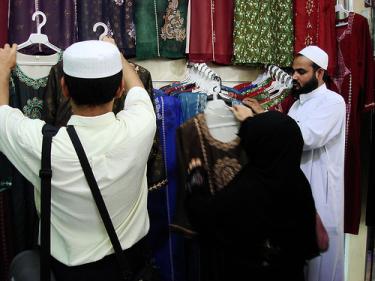
Dress conservatively and modestly, as modesty is of utmost importance even in summer heat. Avoid tight or revealing clothing.
Do
- Men: wear long pants and shirts with sleeves
- Women: cover arms and legs, and wear a headscarf (hijab) if Muslim
- Dress modestly in public and in homes
Don’t
- Don't wear tight or revealing clothing
Good to know
- Saudi women often wear an "abaaya" and veil their faces in public
- Saudi men typically wear a headdress ("ghutua") and a long white "thobe"
Are there gestures to avoid in Saudi Arabia?
Avoid pointing, using the left hand, and showing the sole of your foot, as these are considered rude.
Do
- Use both hands when passing something to someone
Don’t
- Don't point with your finger or signal with your hand
- Don't make gestures or pass items with the left hand alone
- Don't point the bottom of your foot toward another person
What should I know about family and gender customs in Saudi Arabia?
Separation of males and females is the norm, with many customs designed to protect a woman's modesty. Dating is not done, and marriages are usually arranged.
Do
- Respect the separation of men and women in public and social settings
Don’t
- Don't expect men and women to socialize together in public
Good to know
- Women are usually accompanied by a male relative in public
- Weddings are an Islamic ceremony followed by separate parties for men and women
What do people do for recreation in Saudi Arabia?
Popular activities include shopping malls, social gatherings for meals and coffee, outdoor desert activities, sports, cultural events, and religious activities.
Good to know
- Malls offer shops, restaurants, cinemas, and air-conditioned relief from the heat
- Outdoor options include picnics, camping, hiking, desert safaris, sandboarding, and dune bashing
- Football, basketball, volleyball, tennis, and cricket are popular, alongside camel racing and falconry
- Explore sites like Jeddah's Old Town, the Nabatean ruins of Al-Ula, and the Red Sea coastline
Last updated: 2026-07-12 · Sources: CountryReports
Photos of Saudi Arabia
Photos of Saudi Arabia


Travel and Tourism
Travel and Tourism
- Travel Alert Status
- Level 3: Reconsider Travel
- Currency
- Saudi riyal (SAR)
- Time Difference
- UTC+3 (8 hours ahead of Washington, DC, during Standard Time)
- Airports
- 204
Read the full travel guide — health, safety, vaccinations, disease risk, sanitation, and transit details.
View full travel guideRecipes
Recipes
Green Coriander Salad
Main Dish
Main Dish
Kharoof Mahshi - Roast Stuffed Kid
Main Dish
Koazy Al-Macarona - Macaroni Koazy
Main Dish
Aish Bel-Lahm - Bread with Meat
Main Dish
Fakhitha Bel Laban - Leg of Lamb with Yogurt
Main Dish
Dajaj Bel Laban - Chicken with Yogurt
Main Dish
Kebab Bel Laban - Kebab with Yogurt
Main Dish
PremiumKebab Bel Laban - Kebab with Yogurt Al-Motubug - Stuffed Pastry Squares
Main Dish
PremiumGreen Coriander Salad
Side Dish
PremiumAroz Saudi - Saudi Rice
History
History
Historical Eras
Pre-Islamic Arabia
3000 BCE – 622
The Arabian Peninsula was home to ancient trade kingdoms such as the Nabataeans and the Sabaeans, as well as nomadic Bedouin tribal confederations. Mecca emerged as a significant religious and commercial center, housing the Kaaba. The birth of the Prophet Muhammad around 570 CE set the stage for a transformative religious revolution that would reshape the peninsula and the wider world.
Early Islamic Era
622 – 1517
The Hijra of 622 CE marks the founding moment of the Islamic community, followed swiftly by pivotal events such as the Battle of Badr and the conquest of Mecca in 630. The holy cities of Mecca and Medina became the spiritual heart of an expanding empire. After Muhammad's death in 632, the peninsula passed through successive caliphates — Rashidun, Umayyad, and Abbasid — before fragmenting under local dynastic and tribal rule.
Ottoman Suzerainty
1517 – 1744
The Ottoman Empire extended its authority over the Hejaz in 1517, assuming the role of guardian of Mecca and Medina and legitimizing its claim to the caliphate. Ottoman control over the interior of the peninsula remained nominal, and tribal powers operated with considerable autonomy. The construction of fortifications such as al-Ajyad Castle in Mecca symbolized Ottoman efforts to assert a physical presence in the region's most sacred territories.
First & Second Saudi States
1744 – 1902
In 1744, the scholar Muhammad ibn Abd al-Wahhab allied with tribal leader Muhammad ibn Saud in Diriyah, fusing Wahhabi religious reform with Saudi political ambition. The First Saudi State expanded dramatically, capturing Mecca and Medina in 1802–03, before Egyptian forces under Muhammad Ali crushed it in 1818. A Second Saudi State briefly revived Saud dominance from Riyadh but collapsed under pressure from the rival Al Rashid dynasty, forcing the Al Saud into exile in Kuwait by the 1890s.
Unification & Kingdom
1902 – 1973
Abd al-Aziz ibn Saud recaptured Riyadh from the Al Rashid in 1902 and spent three decades consolidating the Arabian Peninsula, formally proclaiming the Kingdom of Saudi Arabia in 1932. American geologists discovered oil in 1938, and the founding of Aramco began transforming one of the world's poorest desert kingdoms into an emerging petrostate. Vast oil revenues funded rapid modernization while the monarchy maintained strict Wahhabi religious governance and tribal-based statecraft.
Oil Power & Modern State
1973 – present
The 1973 oil embargo demonstrated Saudi Arabia's commanding influence over global energy markets, and the kingdom leveraged petroleum wealth to build modern infrastructure, cities, and institutions at extraordinary speed. The 1979 seizure of the Grand Mosque in Mecca by Islamist militants, the Gulf War of 1991, and the domestic terrorist attacks of 2003 exposed persistent tensions between modernization and religious conservatism. Under King Salman and Crown Prince Mohammed bin Salman, Vision 2030 has pursued sweeping economic diversification and social liberalization while the monarchy retains authoritarian political control.
Overview
Abd al Aziz ibn Abd ar Rahman Al Saud, founder of Saudi
Every country, every topic, all activities & recipes
✓ Instant access on this device · ✓ No subscription
Timeline of Key Events
570
Birth of Prophet Muhammd
Birth of Prophet Muhammd, the later Prophet of Islam.
622
Islamic Era began
Islamic Era began. Mahomet began his flight from Mecca to Medina.
624
The Battle of Badr
Muslims engaged non-believers for the 1st time at the Battle of Badr.
630
Mecca is conqured by Prophet Muhammads men
Mecca is conquered by Prophet Muhammads men, and strong expansion is started towards first the Arab peninsular, later beyond in northern direction.
632
Mohammed died
Mohammed, the founder of Islam and unifier of Arabia, died.
702
Ethiopian (Axumite) raiders occupy the port of Jeddah in modern-day Saudi Arabia
Ethiopian (Axumite) raiders occupy the port of Jeddah in modern-day Saudi Arabia.
1400
The Saud dynasty
The Saud dynasty was founded near Riyadh.
Read the full history profile — narrative overview, defining eras, and the complete timeline in one place.
View expanded historyInteresting Facts
Interesting Facts
The discovery of oil in the 1930s improved the country's economy tremendously, allowing the people to enjoy a high standard of living and an increasingly diverse economy.
Privacy is very important to the Saudi Arabians, so houses are built with big walls. When you visit the house of a Saudi Arabian you should stand at the door in such a way that ensures you cannot see inside. It is all right to enter when your host has signaled you by extending his right hand, palm up, and said Tafaddal, or “Come in”.
Today, Saudi Arabia's proven oil reserves are estimated at 260 billion barrels. This large figure clearly indicates the wealth of Saudi Arabia.
In keeping with the Sacred Scripture of the Quran, which does not allow depiction of people or animals, places of entertainment such as theatres and cinema are banned in Saudi Arabia.
2 more facts for members
Every country, every topic, all activities & recipes
✓ Instant access on this device · ✓ No subscription
Geography and Environment
Geography and Environment
- Terrain
- mostly uninhabited, sandy desert
- Climate
- Riyadh’s climate has a greater difference between winter and summer temperatures than elsewhere in the Kingdom. Riyadh has practically no humidity, making summers especially dry and dusty. Annual rainfall averages 2 to 4 inches, usually concentrated in a few torrential rainfalls in early spring. Winters produce moderate daytime temperatures from November through February. Evenings are sometimes cool enough to require residential heating. Jeddah, the commercial center, has a tropical climate — mild in winter and hot and very humid in summer. Summer lasts 8 to 10 months, with temperatures moderating in November. Relief from the heat often comes at sunset when sea breezes arrive. Except on the few occasions when it rains, the sun shines daily. Winter is comparable to the spring and summer seasons of resorts on the Mediterranean Sea. Dhahran’s climate, like that of Jeddah, is very humid, 60% – 90%, with summer lasting from April through October. The average maximum shade temperature in July and August is 110 °F, with "in sun" temperatures up to 150 °F. From December to April, it is cooler and pleasant, with indoor heating required at times, especially in the areas north of Dhahran. Rainfall in both Jeddah and Dhahran is sparse, about 3 – 4 inches a year concentrated in a few heavy showers during fall and spring.
- Natural Hazards
- frequent sand and dust storms
- Current Environmental Issues
- desertification; depletion of underground water resources; the lack of perennial rivers or permanent water bodies has prompted the development of extensive seawater desalination facilities; coastal pollution from oil spills
Read the full geography and environment profile — terrain, climate, natural resources, hazards, land use, and international agreements.
View full geographyPeople & Demographics
People & Demographics
Religion
Languages Spoken
Arabic
- Arabic
Population
- Population
- 36,947,025
- Population in Major Urban Areas
- RIYADH (capital) 5.451 million; Jeddah 3.578 million; Mecca 1.591 million; Medina 1.142 million; Ad Dammam 941,000
- Nationality Noun
- Saudi(s)
- Ethnic Groups
- Arab 90%, Afro-Asian 10%
Education
- Literacy Definition
- age 15 and over can read and write
Life Expectancy
- Life Expectancy at Birth
- Life expectancy at birth in Saudi Arabia has risen dramatically over the past several decades, reflecting the country's substantial investments in healthcare infrastructure, public health programs, and rising living standards. As of the most recent available data, the average life expectancy at birth in Saudi Arabia stands at approximately 76 to 77 years overall, with women living slightly longer than men. Females can expect to live to around 78 years, while males have an average life expectancy of roughly 75 years. This represents a remarkable transformation from the mid-20th century, when life expectancy in the kingdom hovered around 40 to 45 years. The rapid improvement is largely attributed to the expansion of modern hospitals and clinics throughout the country, increased access to clean water and sanitation, widespread vaccination programs, and a significant reduction in infant and child mortality rates. Saudi Arabia's government has channeled considerable oil revenues into building a comprehensive public healthcare system. The Ministry of Health oversees hundreds of hospitals and thousands of primary care centers spread across urban and rural regions alike. Citizens receive government-subsidized healthcare, which has contributed significantly to longer and healthier lives. Despite these gains, Saudi Arabia faces a growing set of non-communicable disease challenges that place pressure on longevity trends. Rates of obesity, type 2 diabetes, cardiovascular disease, and hypertension are notably high by global standards. Saudi Arabia consistently ranks among the countries with the highest diabetes prevalence in the world, affecting a substantial portion of the adult population. These lifestyle-related conditions are linked in part to dietary habits, reduced physical activity, and the effects of rapid urbanization. Vision 2030, the kingdom's long-term national development plan, includes health sector reforms aimed at improving preventive care, encouraging healthier lifestyles, and expanding private sector participation in healthcare delivery. Greater emphasis is being placed on early screening programs, physical fitness initiatives, and reducing the burden of chronic disease across the population. These efforts are expected to support continued improvements in life expectancy in the coming decades. By regional comparison, Saudi Arabia's life expectancy is among the higher figures in the Middle East and North Africa, positioning the country alongside peers such as the United Arab Emirates and Kuwait in terms of population health outcomes.
- Infant Mortality Rate
- Saudi Arabia has made remarkable progress in reducing infant mortality over the past several decades, reflecting major investments in healthcare infrastructure, maternal and child health programs, and rising living standards across the country. The infant mortality rate in Saudi Arabia stands at approximately 6 to 7 deaths per 1,000 live births, placing the country well below the global average and broadly in line with other upper-middle and high-income nations. This figure represents a dramatic improvement from earlier decades — in the 1970s and 1980s, infant mortality rates in the country exceeded 70 deaths per 1,000 live births, underscoring the scale of transformation in the nation's public health system. Several factors have driven this decline. The expansion of a nationwide network of hospitals, primary healthcare centers, and maternal health clinics has significantly improved access to skilled birth attendants and neonatal care. Immunization coverage for preventable diseases such as polio, measles, and diphtheria remains high, consistently reaching over 95 percent of eligible infants. The government's strong financial commitment to healthcare, partly enabled by oil revenues, has allowed for sustained investment in modern medical equipment and trained personnel. Neonatal mortality — deaths occurring within the first 28 days of life — accounts for a significant proportion of remaining infant deaths in Saudi Arabia, a pattern common in countries that have already eliminated many post-neonatal causes such as infectious disease and malnutrition. Conditions such as preterm birth complications, congenital disorders, and birth asphyxia are among the leading causes of infant death in this category. The Kingdom's Vision 2030 reform agenda includes continued goals around improving maternal and child health outcomes, expanding preventive healthcare, and reducing health disparities between urban and more rural or remote regions of the country. Ongoing efforts to attract and train specialized medical professionals are expected to further reduce infant mortality in the coming years, pushing Saudi Arabia's rates closer to those seen in the highest-performing nations globally.
Read the full people and society profile — demographics, health, education, religion, languages, and notable people.
View full people and societyGovernment & Politics
Government & Politics
Country Identity
- Country Name
- SaudiArabia
- Full Country Name
- Kingdom of Saudi Arabia
- Local - Long
- Al Mamlakah al Arabiyah as Suudiyah
- Local - Short
- Al Arabiyah as Suudiyah
Government Structure
- Government Type
- monarchy
- Legal System
- based on Islamic law, several secular codes have been introduced; commercial disputes handled by special committees; has not accepted compulsory ICJ jurisdiction
- Executive Branch
- chief of state: King and Prime Minister SALMAN bin Abd al-Aziz Al Saud (since 23 January 2015); Crown Prince MUHAMMAD BIN SALMAN bin Abd al-Aziz Al Saud (son of the monarch, born 31 August 1985); note - the monarch is both the chief of state and head of government head of government: King and Prime Minister SALMAN bin Abd al-Aziz Al Saud (since 23 January 2015); Crown Prince and Deputy Prime Minister MUHAMMAD BIN SALMAN bin Abd al-Aziz Al Saud; note - the monarch is both the chief of state and head of government cabinet: Council of Ministers is appointed by the monarch and includes many royal family members; Crown Prince Muhammad bin Salman serves as First Deputy Prime Minister and holds significant governing authority elections: none; the monarch is hereditary
- Legislative Branch
- Consultative Council or Majlis al-Shura (150 members and a chairman appointed by the monarch for four-year terms); the body serves in an advisory capacity, reviewing legislation and government policies, but does not function as an elected parliament. In 2013, King Abdullah issued a royal decree reserving 20 percent of Majlis al-Shura seats for women, a landmark development that resulted in 30 women being appointed to the council. Municipal council elections have been held periodically, with the 2015 elections marking a significant milestone as Saudi women were permitted to vote and stand as candidates for the first time. The council may propose draft laws and review royal decrees, but ultimate legislative and executive authority remains with the monarch and the Council of Ministers. There are no political parties in Saudi Arabia, and all members of the Majlis al-Shura continue to be appointed rather than elected.
- Judicial Branch
- Supreme Council of Justice
- Suffrage
- none
- Constitution
- governed according to Shari'a (Islamic law); the Basic Law that articulates the government's rights and responsibilities was introduced in 1993
- Independence
- 23 September 1932 (Unification of the Kingdom)
- National Holiday
- Unification of the Kingdom, 23 September (1932)
Capital City
- Capital Name
- Riyadh
- Capital - geographic coordinate
- 24 39 N, 46 42 E
- Capital Time Difference
- UTC+3 (8 hours ahead of Washington, DC, during Standard Time)
the name derives from the Arabic word "riyadh," meaning "gardens," and refers to various oasis towns in the area that merged to form the city
Military
Branches: Ministry of Defense and Aviation Forces: Royal Saudi Land Forces, Royal Saudi Naval Forces (includes Marine Forces and Special Forces), Royal Saudi Air Force (Al-Quwwat al-Jawwiya al-Malakiya as-Sa'udiya), Royal Saudi Air Defense Forces, Royal Saudi Strategic Rocket Forces, Saudi Arabian National Guard (SANG)
Embassy / Diplomatic Mission
U.S. Embassy Riyadh
Abdullah Ibn Hudhafah As Sahmi Street, Roundabout no. 9, Diplomatic Quarter, Riyadh
Telephone: (966) (011) 488-3800
Fax: (966) (011) 483-0773
Emergency after-hours telephone: (966) (011) 488-3800
U.S. Consulate General Dhahran
Between KFUPM and King Abdulaziz Airbase, Dhahran
Telephone: (966) (13) 330-3200
Fax: (966) (13) 330-6816
Emergency after-hours telephone: (966) (13) 330-3200
U.S. Consulate General Jeddah
Falasteen Street intersecting with Al-Andalus Street, Jeddah
Telephone: (966) (12) 667-0080
Fax: (966) (12) 669-3098
Emergency after-hours telephone: (966) (12) 667-0080
Read the full government profile — flag symbolism, national anthem, and other national symbols.
View full government detailsEconomy
Economy
Saudi Arabia has a high-income, oil-based economy with significant government oversight of major economic activities, though the kingdom has been steadily liberalizing its markets under the Vision 2030 reform program launched in 2016.
Snapshot
- Currency Name and Code
- Saudi Riyal (SAR)
- GDP — official exchange rate
- $264,000,000,000 (USD)
- GDP Real Growth Rate
- 6%
Every country, every topic, all activities & recipes
✓ Instant access on this device · ✓ No subscription
News & Weather
News & Weather
Current Weather
Latest News
Houthis Push to Expand Territory as Tensions With Saudi Arabia Rise - The New York Times
The New York Times · 7h ago
Iran-backed Houthi rebels warn against joining Saudi Arabia in Yemen’s growing civil war - AP News
AP News · 10h ago
Saudi Arabia Has Another Option to Get Its Oil Out - wsj.com
wsj.com · 3d ago
Saudi cancels some oil cargoes after pipeline hit, top buyer chasing alternatives - Reuters
Reuters · 5d ago
Oil falls as crude flows remain 'surprisingly strong' - CNBC
CNBC · 2h ago
Iran and Trump exchange fresh warnings as Saudi-Houthi conflict escalates ahead of key UN gathering. Here’s what to know - CNN
CNN · 8h ago
In Significant Escalation, Houthis Attack Saudi Capital - The New York Times
The New York Times · 22h ago
Video Iranian-backed Houthi militants strike Saudi Arabia's capital city for the 1st time - abcnews.com
abcnews.com · 4h ago
News via Google News
Videos
Videos
2 curated YouTube videos.
Source: YouTube
Source: YouTube
Frequently Asked Questions
Frequently Asked Questions
What is the population of Saudi Arabia?
What is the capital of Saudi Arabia?
Where is Saudi Arabia located?
What countries border Saudi Arabia?
What religion is practiced in Saudi Arabia?
What is the currency of Saudi Arabia?
What language is spoken in Saudi Arabia?
What is Saudi Arabia's geography and terrain like?
What is Saudi Arabia known for?
Last reviewed 2026