
 English
 Español
 中文
中文 हिन्दी
 Français
Niue
Declare Your Relationship to Niue
CountryReports Community
- Studying1
- From Niue1
- Niue heritage1
- Visited0
- Want to visit1
Customs and Culture
Customs and Culture
Cultural Attributes
Niue's cultural identity is deeply rooted in Polynesian tradition, shaped by centuries of relative isolation on one of the world's largest raised coral islands in the South Pacific. The Niuean people, known as Niueans or Niue Fekai, maintain strong ties to their ancestral heritage while navigating the influences of modernization and a close political relationship with New Zealand. The Niuean language, known as Vagahau Niue, remains a cornerstone of cultural life. It belongs to the Polynesian language family and is closely related to Tongan. Efforts to preserve and promote the language are ongoing, particularly through schools and community programs, as many Niueans now live abroad — the diaspora in New Zealand is estimated to be several times larger than the island's resident population of roughly 1,500 people. Family, known as the magafaoa, is the fundamental unit of Niuean society. Extended family networks play a vital role in daily life, decision-making, and social obligations. Land in Niue is communally owned by family groups, a system that reflects deep-rooted values around collective responsibility and ancestral connection. Christianity, particularly through the Ekalesia Niue (the Niue Church, formerly associated with the London Missionary Society), has been central to community life since the mid-19th century. Sunday observance is taken seriously across the island, and church attendance remains a significant social and spiritual commitment for many residents. Traditional arts and crafts include weaving using pandanus leaves, a skill passed down through generations and used to create mats, baskets, and hats. The hiapo, a traditional form of Niuean art involving intricate geometric patterns applied to bark cloth, has experienced a cultural revival and is recognized as a distinctive form of Pacific artistic expression. Dance and music are integral to celebrations and community gatherings. Traditional dances, often performed at events such as Peniamina Gospel Day on October 6th — a national holiday marking the arrival of Christianity — reflect the blending of spiritual devotion and cultural pride that characterizes Niuean identity. Festivals also showcase local foods, including taro, coconut, and fresh fish, which remain dietary staples on the island.

Island of Ancient Stone and Starlit Seas
Social Customs & Etiquette
Greetings in Niue reflect the island's rich Polynesian heritage and the warm, community-centered nature of its people. The official languages of Niue are Niuean and English, and both are used in everyday social interactions across the island.
The most common greeting in the Niuean language is "Fakaalofa lahi atu," which translates roughly to "greetings with much love" or "I send you great love." This phrase carries deep cultural weight and is used in both formal and informal settings, conveying genuine warmth and respect toward the person being addressed. A shorter, more casual version, "Fakaalofa atu," is also widely used in everyday conversation.
When meeting someone, Niueans often exchange handshakes, and close acquaintances or family members may greet one another with a light touch of the nose or a gentle embrace, reflecting customs common across Polynesian cultures. Eye contact during a greeting is considered a sign of respect and attentiveness.
Because Niue has a very small population — officially around 1,500 to 2,000 residents — community ties are exceptionally close-knit, and personal greetings carry particular social significance. Acknowledging elders with respectful language and gestures is an important part of Niuean etiquette. It is considered polite to greet not just the person you are visiting, but also others present in the home or gathering space.
English is widely spoken and understood throughout the island, making it straightforward for travelers to communicate using standard English greetings such as "Hello" or "Good morning." However, making an effort to use even basic Niuean phrases is greatly appreciated by locals and is seen as a sign of cultural respect.
Visitors attending church services, which remain a central part of community life in Niue, may also encounter formal greetings and addresses in the Niuean language, particularly within the Ekalesia Niue (the Niue Church, rooted in the Congregationalist tradition). Understanding and embracing these greeting customs helps travelers connect meaningfully with one of the smallest and most distinctive cultures in the Pacific.

Dating Customs
Dating and marriage customs in Niue reflect a blend of traditional Polynesian values and the influence of Christianity, which was introduced to the island in the mid-19th century. The London Missionary Society arrived in 1846 and had a profound and lasting effect on social norms, including those surrounding relationships and family life.
Niuean society is organized around extended family units, and these family networks play an important role in courtship. While young people today largely choose their own partners, family approval and involvement remain significant. Relationships tend to develop within the close-knit communities of the island, which has a population of fewer than 2,000 people, making social circles naturally small and interconnected.
Marriage is generally viewed as an important social and religious institution. Christian ceremonies, most commonly conducted through the Ekalesia Niue, the island's main Congregational Christian denomination, are the norm for formal weddings. Traditional Niuean weddings often involve community feasting and the exchange of gifts, with food preparation and sharing serving as a central expression of celebration and communal solidarity.
Niue operates under New Zealand law in many civil and legal matters, given its status as a self-governing state in free association with New Zealand. Civil marriage registration follows guidelines consistent with this legal relationship. Niuean citizens are also New Zealand citizens, and many young Niueans emigrate to New Zealand or other Pacific nations for education and work, which has influenced contemporary attitudes toward dating and relationships.
The significant emigration trend has contributed to a population decline on the island, meaning that many Niueans of marriageable age may find partners abroad, including within the large Niuean diaspora communities in Auckland and other New Zealand cities. Despite this, cultural ties to the island remain strong, and traditional values around family, respect, and community continue to shape how relationships are formed and maintained.
Holidays
Waitangi Day
2/6Other
Treaty of Waitangi established British sovereignty over New Zealand)
Dates of Interest
- February 6th
Treaty of Waitangi established (British sovereignty over New Zealand)
What role does family play in Niuean society?
Family, known as the magafaoa, is the fundamental unit of Niuean society, with extended family networks central to daily life, decision-making, and social obligations.
Good to know
- Land in Niue is communally owned by family groups, reflecting values of collective responsibility and ancestral connection
What arts, music, and celebrations are important in Niue?
Traditional arts, dance, and music are integral to Niuean celebrations and community gatherings, reflecting both spiritual devotion and cultural pride.
Good to know
- Traditional crafts include weaving pandanus leaves into mats, baskets, and hats
- Look for hiapo, a traditional bark cloth art with intricate geometric patterns
- Peniamina Gospel Day on October 6th is a national holiday marking the arrival of Christianity, featuring traditional dances
- Festivals showcase local foods like taro, coconut, and fresh fish
What should I know before visiting Niue?
Niue is a Polynesian island with a resident population of roughly 1,500 people, where Christianity and the Niuean language (Vagahau Niue) are central to community life.
Do
- Respect Sunday observance, which is taken seriously across the island
- Learn that Vagahau Niue is closely related to Tongan and a cornerstone of cultural life
Good to know
- Church attendance through the Ekalesia Niue remains a significant social and spiritual commitment for many residents
- Staple foods on the island include taro, coconut, and fresh fish
Last updated: 2026-07-12 · Sources: CountryReports
Photos of Niue
Photos of Niue


Travel and Tourism
Travel and Tourism
- Currency
- New Zealand dollar (NZD)
- Time Difference
- UTC-11 (6 hours behind Washington, DC, during Standard Time)
- Climate
- tropical; modified by southeast trade winds
- Airports
- 1
Read the full travel guide — health, safety, vaccinations, disease risk, sanitation, and transit details.
View full travel guideHistory
History
Historical Eras
Polynesian Settlement
400 – 1774
Niue was first settled around 400 AD, with a documented expedition led by Fao and Huanaki establishing a community at the island's northern tip around 700 AD. A Tongan war expedition arrived in 1525, creating two rival groups that developed in near-isolation despite frequent conflict. Oral traditions preserved through story, chant, and dance form the primary record of this era, as no written accounts existed before European contact.
Contact & Christianisation
1774 – 1900
Captain James Cook's 1774 visit ended in a hostile reception, earning Niue the name 'Savage Island' and prolonging its isolation from European traders and whalers. London Missionary Society missionaries arrived in 1830 under Reverend John Williams, and Christianisation proceeded so rapidly that by 1850 the entire population was reported under the influence of the Gospel. The era was also marked by devastating blackbirding raids, prompting Niuean kings to petition Britain for protection multiple times between 1859 and 1899.
British Protectorate
1900 – 1901
Britain formally declared Niue a protectorate in 1900 in response to King Togia's petition, offering the island shelter from the slave trade and foreign encroachment. Within a year, in 1901, administrative responsibility was transferred to New Zealand and Niue was placed under the governance of the Cook Islands. This brief but pivotal transition ended Niue's formal indigenous monarchy and embedded the island within the British imperial framework of the South Pacific.
New Zealand Administration
1901 – 1974
New Zealand administered Niue directly from 1901, separating it from the Cook Islands in recognition of its distinct Polynesian culture and language. The monarchy was abolished in 1917, and universal suffrage was introduced in 1941, gradually incorporating democratic participation into island governance. Throughout this period Niue's population grew, peaking at 5,200 in 1966, before significant emigration to New Zealand began to erode that figure.
Self-Governing State
1974 – present
The Niue Constitution Act 1974 established Niue as a self-governing nation in free association with New Zealand, giving islanders full control over internal affairs while New Zealand retained responsibility for defence and foreign relations. Persistent emigration has remained the defining challenge of the modern era, with the population declining from over 5,000 in the 1960s to roughly 2,000 by the early 2000s. Niue has nonetheless developed a distinct international identity, becoming the world's first territory to offer free wireless internet island-wide and engaging actively in Pacific regional bodies.
Overview
Timeline of Key Events
1774
British Explorer James Cook visited Niue, called it Savage Island.
British Explorer James Cook visited Niue, called it Savage Island.
1900
Britain declared Niue a British protectorate.
Britain declared Niue a British protectorate.
1901
Niue placed under the administration of Cook Islands.
Niue placed under the administration of Cook Islands, which themselves were placed under the administration of New Zealand.
1917
Monarchy abolished.
Monarchy abolished.
1941
Universal suffrage was introduced.
Universal suffrage was introduced.
1974
Self-government in association with New Zealand introduced.
Self-government in association with New Zealand introduced.
Read the full history profile — narrative overview, defining eras, and the complete timeline in one place.
View expanded historyInteresting Facts
Interesting Facts
A cyclone devastated the island in Jan., 2004.
See every fact — trivia, oddities, and curious tidbits gathered from across the country.
View all interesting factsGeography and Environment
Geography and Environment
- Terrain
- steep limestone cliffs along coast, central plateau
- Climate
- tropical; modified by southeast trade winds
- Natural Hazards
- typhoons
- Current Environmental Issues
- increasing attention to conservationist practices to counter loss of soil fertility from traditional slash and burn agriculture
Read the full geography and environment profile — terrain, climate, natural resources, hazards, land use, and international agreements.
View full geographyPeople & Demographics
People & Demographics
Religion
Languages Spoken
Niuean, a Polynesian language closely related to Tongan and Samoan; English
- Niuean
Population
- Population
- 1,600
- Nationality Noun
- Niuean(s)
- Ethnic Groups
- Polynesian (with some 200 Europeans, Samoans, and Tongans)
Health Information
- Life Expectancy at Birth
- Life expectancy at birth in Niue is notably high compared to many Pacific Island nations, reflecting the territory's relatively strong healthcare infrastructure and small, closely managed population. Current estimates place average life expectancy at approximately 73 to 76 years overall, with women generally living several years longer than men — a pattern consistent with global trends. Niue's healthcare system is centered around the Niue Foou Hospital in Alofi, the island's capital, which provides primary and secondary care to the population. Given that Niue has one of the smallest national populations in the world — typically numbering fewer than 2,000 residents — the government is able to deliver healthcare services in a relatively concentrated and accessible manner. Serious or complex medical cases are often referred to New Zealand, with which Niue maintains a free association arrangement that includes full New Zealand citizenship rights for Niueans, facilitating access to more advanced medical facilities. Key health challenges on the island include high rates of non-communicable diseases such as diabetes, cardiovascular disease, and obesity — conditions that are prevalent across much of the Pacific and can have a measurable impact on longevity. Lifestyle factors, including dietary shifts toward processed foods and reduced physical activity, have contributed to these trends over recent decades. Despite these challenges, Niue benefits from clean water access, a functioning sanitation system, and a government committed to public health investment. Infant mortality rates are low, contributing positively to overall life expectancy figures. The island also experiences relatively low rates of violent crime and environmental hazards compared to larger, more densely populated nations. Emigration remains a significant demographic factor — a large portion of people born in Niue live in New Zealand or other countries, which complicates the calculation of locally reported health statistics. The Niuean diaspora in New Zealand is estimated to be several times larger than the resident island population itself. Nevertheless, available data suggests that Niueans, whether on the island or abroad, generally enjoy life expectancies comparable to other small, well-supported Pacific territories.
- Infant Mortality Rate
- Niue presents a unique demographic profile when it comes to infant mortality, largely shaped by its extremely small population and limited statistical reporting capacity. As one of the world's smallest self-governing nations, with a resident population typically numbering fewer than 2,000 people, Niue records very few births in any given year, making the calculation of a reliable, statistically significant infant mortality rate exceptionally difficult. Due to this small population size, global health databases such as those maintained by the World Health Organization and UNICEF often report Niue's infant mortality data with significant caveats, or in some years, list figures as unavailable due to insufficient data. When estimates are provided, infant mortality in Niue is generally considered low by regional and global standards, consistent with its status as a developed Pacific Island territory with access to functional healthcare infrastructure and strong ties to New Zealand's health system. Niue residents have the right to New Zealand citizenship, which facilitates access to more advanced medical care when needed, including the option to travel to New Zealand for complex deliveries or neonatal treatment. The island maintains a government hospital in Alofi, the capital, staffed by physicians and nurses capable of handling routine maternal and infant healthcare needs. The lack of consistent annual data means that long-term trend analysis for Niue is not straightforward. When international agencies do publish figures for Niue, estimates have historically placed infant mortality in the range of roughly 8 to 20 deaths per 1,000 live births, though in years with zero infant deaths the effective rate would be reported as zero. The wide potential range reflects both statistical volatility caused by such a small sample base and variation across different estimation methodologies used by international bodies. Overall, the combination of access to New Zealand medical expertise, a functioning local health service, and relatively high standards of living on the island contributes to generally favorable infant health outcomes for Niue's small but resilient population.
Life Expectancy
- Life Expectancy at Birth
- Life expectancy at birth in Niue is notably high compared to many Pacific Island nations, reflecting the territory's relatively strong healthcare infrastructure and small, closely managed population. Current estimates place average life expectancy at approximately 73 to 76 years overall, with women generally living several years longer than men — a pattern consistent with global trends. Niue's healthcare system is centered around the Niue Foou Hospital in Alofi, the island's capital, which provides primary and secondary care to the population. Given that Niue has one of the smallest national populations in the world — typically numbering fewer than 2,000 residents — the government is able to deliver healthcare services in a relatively concentrated and accessible manner. Serious or complex medical cases are often referred to New Zealand, with which Niue maintains a free association arrangement that includes full New Zealand citizenship rights for Niueans, facilitating access to more advanced medical facilities. Key health challenges on the island include high rates of non-communicable diseases such as diabetes, cardiovascular disease, and obesity — conditions that are prevalent across much of the Pacific and can have a measurable impact on longevity. Lifestyle factors, including dietary shifts toward processed foods and reduced physical activity, have contributed to these trends over recent decades. Despite these challenges, Niue benefits from clean water access, a functioning sanitation system, and a government committed to public health investment. Infant mortality rates are low, contributing positively to overall life expectancy figures. The island also experiences relatively low rates of violent crime and environmental hazards compared to larger, more densely populated nations. Emigration remains a significant demographic factor — a large portion of people born in Niue live in New Zealand or other countries, which complicates the calculation of locally reported health statistics. The Niuean diaspora in New Zealand is estimated to be several times larger than the resident island population itself. Nevertheless, available data suggests that Niueans, whether on the island or abroad, generally enjoy life expectancies comparable to other small, well-supported Pacific territories.
- Infant Mortality Rate
- Niue presents a unique demographic profile when it comes to infant mortality, largely shaped by its extremely small population and limited statistical reporting capacity. As one of the world's smallest self-governing nations, with a resident population typically numbering fewer than 2,000 people, Niue records very few births in any given year, making the calculation of a reliable, statistically significant infant mortality rate exceptionally difficult. Due to this small population size, global health databases such as those maintained by the World Health Organization and UNICEF often report Niue's infant mortality data with significant caveats, or in some years, list figures as unavailable due to insufficient data. When estimates are provided, infant mortality in Niue is generally considered low by regional and global standards, consistent with its status as a developed Pacific Island territory with access to functional healthcare infrastructure and strong ties to New Zealand's health system. Niue residents have the right to New Zealand citizenship, which facilitates access to more advanced medical care when needed, including the option to travel to New Zealand for complex deliveries or neonatal treatment. The island maintains a government hospital in Alofi, the capital, staffed by physicians and nurses capable of handling routine maternal and infant healthcare needs. The lack of consistent annual data means that long-term trend analysis for Niue is not straightforward. When international agencies do publish figures for Niue, estimates have historically placed infant mortality in the range of roughly 8 to 20 deaths per 1,000 live births, though in years with zero infant deaths the effective rate would be reported as zero. The wide potential range reflects both statistical volatility caused by such a small sample base and variation across different estimation methodologies used by international bodies. Overall, the combination of access to New Zealand medical expertise, a functioning local health service, and relatively high standards of living on the island contributes to generally favorable infant health outcomes for Niue's small but resilient population.
Read the full people and society profile — demographics, health, education, religion, languages, and notable people.
View full people and societyGovernment & Politics
Government & Politics
Country Identity
- Country Name
- Niue
- Former Name
- Savage Island
Government Structure
- Government Type
- self-governing parliamentary democracy
- Legal System
- English common law
- Executive Branch
- chief of state: King CHARLES III (since 8 September 2022); represented in Niue by the New Zealand Governor-General, with day-to-day liaison handled through the New Zealand High Commission head of government: Premier Dalton TAGELAGI (since 10 June 2020) cabinet: Cabinet consists of the premier and three ministers selected from the Legislative Assembly elections: the monarch is hereditary; premier elected by the Legislative Assembly following general elections held every three years; election last held on 29 May 2023 (next to be held in 2026) election results: Dalton TAGELAGI reelected premier following the 2023 general election; his Niue People's Party secured majority support in the Legislative Assembly
- Legislative Branch
- Niue's unicameral Fono Ekepule (Legislative Assembly) consists of 20 seats. Members serve three-year terms, with 6 representatives elected from a common roll and 14 representing individual villages across the island. The Assembly operates under a non-partisan system, meaning candidates stand as independents rather than as members of formal political parties. The most recent general election was held on 29 April 2023. As is customary in Niue's political culture, all candidates contested as independents, with no formal party affiliations. Following the election, Sir Dalton Tagelagi was returned as Premier, having first assumed the role after the 2020 election. Election results: percent of vote by party - not applicable; seats by party - not applicable (all members elected as independents)
- Judicial Branch
- Supreme Court of New Zealand; High Court of Niue
- Suffrage
- 18 years of age; universal
- Constitution
- 19 October 1974 (Niue Constitution Act)
- Independence
- on 19 October 1974, Niue became a self-governing parliamentary government in free association with New Zealand
- National Holiday
- Waitangi Day (Treaty of Waitangi established British sovereignty over New Zealand), 6 February (1840)
Capital City
- Capital Name
- Alofi
- Capital - geographic coordinate
- 19 01 S, 169 55 W
- Capital Time Difference
- UTC-11 (6 hours behind Washington, DC, during Standard Time)
Military
Branches: no regular indigenous military forces; Police Force
Read the full government profile — flag symbolism, national anthem, and other national symbols.
View full government detailsEconomy
Economy
Niue's economy faces the typical challenges of a small Pacific island nation: geographic isolation, limited natural resources, and a tiny population of roughly 1,700 residents. Government expenditures regularly exceed revenues, with the shortfall covered by essential budgetary support from New Zealand, which funds public sector wages and key services. The agricultural sector consists mainly of subsistence gardening, though some cash crops such as taro, vanilla, and noni are produced for export. Industry is limited to small-scale processing of products like passion fruit, lime oil, honey, noni juice, and coconut cream. The sale of postage stamps and commemorative coins to foreign collectors remains a modest source of revenue.
Niue has experienced sustained population decline due to ongoing migration to New Zealand, where more than 30,000 people of Niuean descent now reside. Efforts to grow the economy focus on tourism, which has become the largest private sector earner, along with fisheries and the export of niche agricultural goods. The offshore banking industry was shut down in the early 2000s after international concerns over money laundering. Niue also benefits from telecommunications revenue, including the licensing of its ".nu" internet domain. New Zealand continues to provide substantial annual economic assistance, typically exceeding NZ$20 million, which underpins public services and infrastructure development across the island.
Snapshot
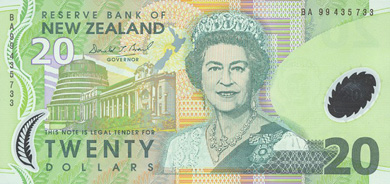
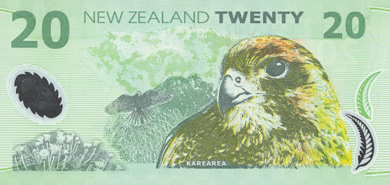
- Currency Name and Code
- New Zealand Dollar (NZD)
- GDP Real Growth Rate
- -0.3%
Banknotes
Budget & Public Finance
- Fiscal Year
- 1 April - 31 March
- External Debt
- $418,000 (USD)
- Economic Aid
- $2,600,000 (USD)
Labor, Industry & Trade
- Labor Force by Occupation
- most work on family plantations; paid work exists only in government service; small industry; and the Niue Development Board
- Industries
- tourism, handicrafts, food processing
- Agriculture Products
- coconuts, passion fruit, honey, limes, taro, yams, cassava (tapioca), sweet potatoes; pigs, poultry, beef cattle
- Export Commodities
- canned coconut cream, copra, honey, vanilla, passion fruit products, pawpaws, root crops, limes, footballs, stamps, handicrafts
- Export Partners
- NZ mainly, Fiji, Cook Islands, Australia
- Import Commodities
- food, live animals, manufactured goods, machinery, fuels, lubricants, chemicals, drugs
- Import Partners
- NZ mainly, Fiji, Japan, Samoa, Australia, US
Energy
- Oil Production
- 0 bbl/day
- Oil Consumption
- 20 bbl/day
- Oil Reserves
- 0 bbl/day
- Natural Gas Production
- 0 cu m
- Natural Gas Consumption
- 0 cu m
- Natural Gas Imports
- 0 cu m
- Natural Gas Exports
- 0 cu m
- Natural Gas Reserves
- 0 cu m
Communications
- Telephone System
- domestic: single-line telephone system connects all villages on island international: country code - 683
- Internet Country Code
- .nu
News & Weather
News & Weather
Current Weather
Latest News
Niue 2023 - National Geographic Society
National Geographic Society · 56d ago
Apply for Santiago Network Community-Led Readiness Program for Loss and Damage Response (Niue) - fundsforNGOs
fundsforNGOs · 16d ago
Pristine South Pacific - Niue - Watch the full documentary | ARTE in English - Arte.tv
Arte.tv · 22d ago
This Island Is One of the Only Places Where You Can Swim With Humpback Whales - AFAR
AFAR · 114d ago
Niue - Health Country Profile - Our World in Data
Our World in Data · 145d ago
How Niue Makes Its Coins - Numismatic News
Numismatic News · 120d ago
Helping Niue Become Disaster-Ready - Asian Development Bank
Asian Development Bank · 30d ago
Niue advances new UNDP–Conservation International Initiative to strengthen Climate Resilience, Biodiversity Protection and Blue Finance - United Nations Development Programme
United Nations Development Programme · 97d ago
News via Google News
Climate Overview
tropical; modified by southeast trade winds
Frequently Asked Questions
Frequently Asked Questions
What is the population of Niue?
What role does family play in Niuean society?
What arts, music, and celebrations are important in Niue?
What should I know before visiting Niue?
What is the capital of Niue?
Where is Niue located?
What ocean surrounds Niue?
What is the predominant religion in Niue?
What currency is used in Niue?
What languages are spoken in Niue?
What is Niue known for?
Last reviewed 2026