
 English
 Español
 中文
中文 हिन्दी
 Français
France
France
Declare Your Relationship to France
CountryReports Community
- Studying147
- From France20
- France heritage37
- Visited29
- Want to visit64
Customs and Culture
Customs and Culture
Cultural Attributes
The French are among the most patriotic people in the world, which is illustrated by their attempts to limit the influence of other cultures in France. While French attitudes have traditionally been dominated by Paris, there seems to be a growing decentralization in administration as well as attitudes.
The French are reserved and polite. Political and social trends have caused the French to re-examine their national identity. Society debates issues related to the central government’s structure, education, immigration, economics, and even language.
A great part of the population, due to a precarious situation and often unemployment, often has difficulties making ends meet. However, in general, people have no problem putting food on the table and can experience leisure opportunities to a certain point (depending on their revenue).
It is also possible for people to send a child on for a higher level of education thanks to France's free education. The only things which hinder some people to go on to higher education are the cost of living, the necessity for students to work, and the fact that some private schools are expensive.
Wealth is defined as cash and ownership of goods (mostly the house). The poorest members of society hope for more financial security, as running water, electricity, and freedom from war are almost certainly guaranteed. They wish for ownership of a car (but this is most of the time the case), home ownership, and money to pay debts. In some suburbs, freedom from violence in one's neighborhood would certainly be very valuable.

The Art of Living
Get More Customs and Culture
6 more cultural topics for members
Social Customs & Etiquette · Diet · Family · Dating Customs · Recreation · Student Life
Every country, every topic, all activities & recipes
✓ Instant access on this device · ✓ No subscription
Holidays
Bastille Day
7/14Other
Birth date - Joan of Arc
1/6Birthday
Birth date -Joan of Arc, French patriot and saint, born in Domrémy, France on Jan 6, 1412.
Birth date - Paul Cezanne
1/19Birthday
Birth date - Paul Cezanne, French artist, was born on Jan 19, 1839.
Birth date - Jules Verne
2/8Birthday
Birth date - Jules Verne, French author, was born Feb. 8, 1828.
Birth date - Pierre Auguste Renoir
2/25Birthday
Birth date - Pierre Auguste Renoir, French artist, was born Feb. 25, 1841.
Birth date - Frédéric-Auguste Bartholdi
4/2Birthday
Birth date - Frédéric-Auguste Bartholdi, French sculptor, creator of the Statue of Liberty, was born in Alsace, France on April 2, 1834.
Birth date - Paul Gauguin
6/7Birthday
Birth date - Paul Gauguin, French artist, was born in Paris, France on June 7, 1848.
Birth date - Louis Braille
1/4Birthday
Birth date - Louis Braille, inventor of the Braille system for the blind, was born on Jan. 4, 1809 in Coupvray, France.
Birth date - Edgar Degas
7/19Birthday
Birth date - Edgar Degas, French artist, was born in Paris, France on July 19, 1834.
Birth date - Pierre Charles L'Enfant
8/2Birthday
Birth date - Pierre Charles L’Enfant, French architect who created the plans for Washington, D.C. was born in Paris, France on Aug. 2, 1754.
Birth date - Pierre Charles L Enfant
8/2Birthday
Birth date - Pierre Charles L’Enfant, French arcitect who created the plans for Washington, D.C. was born in Paris, France on Aug. 2, 1754.
Birth date - Claude-Achille Debussy
8/22Birthday
Birth date - Claude-Achille Debussy, French composer, was born in Yvelines, Saint-germain-en-laye, France on Aug. 22, 1862.
Birth date - Yo Yo Ma
10/7Birthday
Birth date - Yo Yo Ma, cellist, was born in Paris, France on Oct. 7, 1955.
Birth date - François-Auguste-René Rodin
11/12Birthday
Birth date - François-Auguste-René Rodin, French sculptor, was born in Paris, France on Nov. 12, 1840.
Birth date - Claude Oscar Monet
11/14Birthday
Birth date - Claude Oscar Monet, French artist, was born in Paris, France on Nov. 14, 1840.
Birth date - Henri de Toulouse-Lautrec
11/24Birthday
Birth date - Henri de Toulouse-Lautrec, French artist was born on November 24, 1864 in Southern France.
Birth date - Henri de Toulouse-Lautrec
11/24Birthday
Birth date - Henri de Toulouse-Lautrec, French artist was born on November 24, 1864 in Southern France.
Birth date - Georges Pierre Seurat
12/2Birthday
Birth date - Georges Pierre Seurat, French artist, was born Dec. 2, 1859 in Paris, France.
Birth date - Louis Pasteur
12/27Birthday
Birth date - Louis Pasteur, French chemist-bacteriologist whose work led to the process of pasteurization, was born Dec. 27, 1822 in Dôle, France.
Birth date - Henri Matisse
12/31Birthday
Birth date - Henri Matisse , French artist, was born Dec. 31, 1869 in the Picardy region of northern France.
Christmas
12/25Christmas
The holiday season usually begins December 5th, St. Nicholas Eve. Many years ago French nuns began leaving gifts secretly at the homes of poor families with children on St. Nicholas eve. Now French children leave their shoes by the fireplace or radiator hoping to receive gifts.
The Christmas tree is decorated with stars of many colors.
A famous French Christmas carol is “The First Noël”.
For the Christmas day meal fresh goose is a tradition because legends say the Three wise men were meet by geese when they arrived at the manger. Bûche de Noël is a traditional cake eaten during Christmas.
How do people greet each other in France?
Handshakes are standard when meeting someone, while cheek kissing (la bise, without actual mouth contact, more like a hug) is common between women and men and, in some regions, between men. Greetings are combined with the person's name or title and always come before any conversation or request.
Do
- Shake hands when meeting someone
- Say "Bonjour" as a neutral greeting
- Say "Bonjour Monsieur" to someone older or of higher social status
- Use titles unless you are with friends or close colleagues
Don’t
- Give an aggressive handshake
- Use first names except with friends and close colleagues
- Say "Bonne nuit" unless the person is about to go to bed
Good to know
- Use "salut" only with very good friends or in casual settings
- Say "Bonne soirée" at night time
- When non-peers meet, the higher-class person usually offers to shake hands first
What are the dining customs in France?
French cooking is considered an art with strong regional traditions, and table manners are taken seriously. There are usually three meals a day, and the whole family typically eats together at the same time.
Do
- Keep your hands above the table so they are visible
- Try French breads and patisserie such as croissants and baguettes
- Expect the person who invites or suggests the outing to pay when eating out
Don’t
- Place your elbows on the table
- Hide your hands, as this is seen as concealing something
Good to know
- Breakfast and dinner are usually eaten at home; dinner is around 7 or 8 PM
- Supper is at noon or before 1 p.m.
- Children often have a snack at 4 p.m.
- Dinner out is generally associated with great occasions
What etiquette should I know when visiting French homes?
The French are generally formal and reserved when visiting, and people do not often visit unannounced. Guests wait to be invited inside before entering a home.
Do
- Keep about 1 meter of personal space when speaking with someone
- Maintain eye contact, as it shows frankness
- Send a thank you note the day after being a dinner guest
- Wait to be invited inside before entering a home
Don’t
- Visit unannounced
- Stand too close to people you don't know well
Good to know
- Physical contact is limited, mostly slaps on the back, handshakes, kissing, and hugs
- In the South of France, physical contact and gestures tend to be more accentuated
- Going out for a drink, a meal, or to the cinema is a common way to socialize
How should I dress in France?
The French usually make an effort to dress well and fashionably, and professional attire tends to be formal. Men wear pants, a shirt, a jacket, and a pullover depending on the weather, while women wear elegant, feminine clothing including pants, skirts, or dresses.
Good to know
- Traditional peasant clothing survives in regions like Brittany, Alsace, and Provence, but is worn only on traditional occasions and mostly for tourists
Which gestures should I be careful with in France?
Some gestures common elsewhere are considered vulgar or carry different meanings in France. Keep your hands visible and avoid certain hand signs.
Don’t
- Slap an open palm over a closed fist (this is vulgar)
- Speak with your hands in your pockets
- Chew gum in public
- Use the index-finger-and-thumb circle to mean "okay" (in France it means zero or worthless)
Good to know
- To get someone's attention, wave a hand and call them by name
What is family life like in France?
Most families are small with one or two children, and both partners commonly work. The French place a high priority on family time, especially gathering for a Sunday meal.
Good to know
- Sunday family meals are expected
- Families usually spend time together on weekends and holidays
- Many couples cohabit or use a PACS civil partnership, and common-law couples are recognized for government benefits
- The government subsidizes daycares known as crèches
What do people do for recreation and sport in France?
Soccer is the predominant sport among children, alongside tennis, basketball, volleyball, and handball. France is also known for the Tour de France cycling race, pétanque, rugby, and regional games.
Good to know
- The Tour de France cycling race takes place in July, with the leader wearing the yellow jersey (maillot jaune)
- Pétanque (boules) is played by rolling metal balls toward a target ball, usually on a sandy court
- Rugby is especially popular in southern France
- In the Pays Basque, people play pelota, a fast-paced game a little like squash
Last updated: 2026-07-12 · Sources: CountryReports
Photos of France
Photos of France
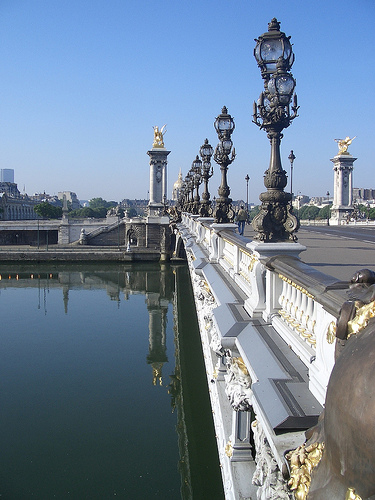
Alexander Bridge, Paris, France
A quiet Paris street, France
Arc de Triomphe
Arc De Triomphe as seen from the Eiffel Tower, Paris, France
Beziers
Chamonix, France
Chamonix, France
Champs Elysees
Chantilly Horse Race Track
Cheese Plate
Christmas decorations - Dieppe, Normandy, France
Christmas market in Strasbourg, France


Travel and Tourism
Travel and Tourism
- Travel Alert Status
- Level 2: Exercise Increased Caution
- Currency
- .885
- Time Difference
- UTC+1 (6 hours ahead of Washington, DC, during Standard Time) time zone note: applies to metropolitan France only; for its overseas regions the time difference is UTC-4 for Guadeloupe and Martinique, UTC-3 for French Guiana, UTC+3 for Mayotte, and UTC+4 for Reunion
- Airports
- 473
Read the full travel guide — health, safety, vaccinations, disease risk, sanitation, and transit details.
View full travel guideRecipes
Recipes
Croissant
Bread
Main Dish
Classic Cassoulet
Main Dish
Bouillabaisse (French Seafood Stew)
Main Dish
Chicken Francaise
Main Dish
Croque Monsieur (Toasted Ham Sandwich)
Side Dish
A Croque-monsieur salad
Side Dish
Stuffed Eggs with Caviar
Side Dish
PremiumFrench-Style Peas
Side Dish
PremiumLégumes Farcis à la Provençale (Stuffed Vegetables)
Soup
PremiumFrench Onion Soup
History
History
Historical Eras
Ancient & Medieval Gaul
600 BCE – 987
Celtic tribes inhabited Gaul before Julius Caesar's conquest (58–51 BCE) incorporated the region into the Roman Empire, bringing Latin culture, Christianity, and urban infrastructure. Following Rome's decline, the Frankish Merovingian dynasty unified much of the territory, succeeded by the Carolingians under Charlemagne, who built a vast Christian empire and was crowned Holy Roman Emperor in 800. The fragmentation of the Carolingian realm by 987 set the stage for the emergence of a distinctly French kingdom.
Medieval Kingdom
987 – 1453
The Capetian dynasty, beginning with Hugh Capet in 987, gradually consolidated royal authority over fractious feudal lords, laying the foundations of the French nation-state. This era encompassed the Crusades, the construction of Gothic cathedrals, and the catastrophic Black Death of the 14th century. The Hundred Years' War against England (1337–1453), punctuated by Joan of Arc's inspirational military campaigns, ended with France expelling English forces and cementing national identity.
Renaissance & Ancien Régime
1453 – 1789
France emerged from the Hundred Years' War as a centralizing monarchy, with the Valois and later Bourbon dynasties expanding royal power through capable ministers such as Richelieu and Colbert. Louis XIV's reign (1643–1715) represented the apex of French absolutism and European dominance, symbolized by the Palace of Versailles, though ruinous wars strained the treasury. Chronic fiscal crisis, Enlightenment philosophy, and deepening resentment of aristocratic privilege created the explosive conditions that culminated in the Revolution of 1789.
Revolution & Napoleon
1789 – 1815
The French Revolution dismantled the monarchy and aristocratic privilege, producing the Declaration of the Rights of Man (1789), the execution of Louis XVI, and the radical Terror under Robespierre before stabilizing under the Directory. Napoleon Bonaparte seized power in 1799, crowning himself Emperor in 1804 and remaking European borders through brilliant military campaigns while codifying French law in the Napoleonic Code. His catastrophic Russian invasion and defeat at Waterloo in 1815 ended the empire and restored the Bourbon monarchy.
Turbulent Republics
1815 – 1958
France oscillated between monarchy, empire, and republic across the 19th century — the Restoration, the July Monarchy of Louis-Philippe, the Second Republic, and Napoleon III's Second Empire — before the Franco-Prussian War (1870–71) established the more durable Third Republic. Two World Wars inflicted staggering losses: the trenches of 1914–18 bled a generation, while the German occupation of 1940–44 and the collaborationist Vichy regime left deep moral wounds. The unstable Fourth Republic (1946–58) struggled with decolonization in Indochina and Algeria until governmental collapse brought de Gaulle to power.
Fifth Republic & Modern France
1958 – present
General Charles de Gaulle's Fifth Republic introduced a strong executive presidency that stabilized French governance after decades of parliamentary fragility, overseeing decolonization and France's emergence as a nuclear power. Successive presidents — Pompidou, Giscard d'Estaing, Mitterrand, Chirac, and their successors — deepened European integration, culminating in the Maastricht Treaty and the adoption of the euro in 1999. France today remains a permanent UN Security Council member, a leading EU power, and one of the world's foremost cultural and economic nations.
Overview
France was one of the earliest countries to progress from feudalism to the nation-state. Its monarchs surrounded themselves with capable ministers, and French armies were among the most innovative, disciplined, and professional of their day.
Every country, every topic, all activities & recipes
✓ Instant access on this device · ✓ No subscription
Timeline of Key Events
481 – 987
Merovingian and Carolingian dynasties
Sweeping invasions from the east. Hugh Capet, elected King of France, founds the Capetian dynasty.
1610 – 1715
Reigns of Louis XIII and Louis XIV.
Reigns of Louis XIII and Louis XIV. Royal power at its peak; France dominates Europe, French culture spreads. Start of large-scale sea trade.
1789 – 1799
French Revolution
French Revolution. Declaration of the Rights of Man and the Citizen (26 August 1789). Abolition of the monarchy (1792). First Republic. Directory. Consulate.
1789
Declaration of the Rights of Man and the Citizen
Declaration of the Rights of Man and the Citizen
1799 – 1815
Rise of Napoleon Bonaparte
Rise of Napoleon Bonaparte, First Consul, then Emperor of the French (1804). Establishment of modern administrative institutions, codification of the law. European wars lead to abdication of the Emperor.
1815 – 1848
Restoration and constitutional monarchy
Restoration and constitutional monarchy (Louis XVIII, Charles X). Revolution of 1830. Reign of Louis-Philippe. Economic prosperity. Rapid development of industrialization. First railways. First colonies established.
1848 – 1852
Revolution. Second Republic
Revolution. Second Republic. First laws on labor, the press and education.
Read the full history profile — narrative overview, defining eras, and the complete timeline in one place.
View expanded historyInteresting Facts
Interesting Facts
When a child loses a tooth they put their tooth under their pillow. A mouse called La Pettie Souris, will come to take it and leave a gift.
France is the top tourist country with over 71.4 million visitors each year.
St. Pierre and Miquelon are the only remaining French territories in North America. These two small islands are located off the south coast of Newfoundland.
The Camargue is a region in southern France at the Rhône River delta, made up of 140,000 hectares of wetlands, pastures, dunes and salt flats. This fragile ecological area includes rare animal species like egrets and ibises and a unique breed of small white horses.
2 more facts for members
Every country, every topic, all activities & recipes
✓ Instant access on this device · ✓ No subscription
Geography and Environment
Geography and Environment
- Terrain
- mostly flat plains or gently rolling hills in north and west; remainder is mountainous, especially Pyrenees in south, Alps in east
- Climate
- The west and north of France experience cool winters and mild summers, while southern France and Corsica have a Mediterranean climate with hot summers and mild winters. Precipitation is frequent all year. The average yearly rainfall in Paris for the last 30 years is 26 inches.
- Natural Hazards
- flooding; avalanches; midwinter windstorms; drought; forest fires in south near the Mediterranean
- Current Environmental Issues
- some forest damage from acid rain; air pollution from industrial and vehicle emissions; water pollution from urban wastes, agricultural runoff
Read the full geography and environment profile — terrain, climate, natural resources, hazards, land use, and international agreements.
View full geographyPeople & Demographics
People & Demographics
Religion
Languages Spoken
French (official) 100%, rapidly declining regional dialects and languages (Provencal, Breton, Alsatian, Corsican, Catalan, Basque, Flemish) overseas departments: French, Creole patois, Mahorian (a Swahili dialect)
- French
Population
- Population
- 68,374,591
- Population: Male/Female
- male: 33,557,094 female: 34,817,497
- Population Distribution
- much of the population is concentrated in the north and southeast; although there are many urban agglomerations throughout the country, Paris is by far the largest city, with Lyon ranked a distant second
- Urban Population
- urban population: 81.8% of total population rate of urbanization: 0.67% annual rate of change
- Population in Major Urban Areas
- 11.208 million PARIS (capital), 1.761 million Lyon, 1.628 million Marseille-Aix-en-Provence, 1.079 million Lille, 1.060 million Toulouse, 1.000 million Bordeaux
- Nationality Noun
- noun: Frenchman(men), Frenchwoman(women) adjective: French
- Ethnic Groups
- Celtic and Latin with Teutonic, Slavic, North African (Algerian, Moroccan, Tunisian), Indochinese, Basque minorities
- Language Note
- French (official) 100%, declining regional dialects and languages (Provencal, Breton, Alsatian, Corsican, Catalan, Basque, Flemish, Occitan, Picard); note - overseas departments: French, Creole patois, Mahorian (a Swahili dialect)
Education
- Literacy Definition
- age 15 and over can read and write
Health Information
- Alcohol consumption per capita
- total: 11.44 liters of pure alcohol beer: 2.52 liters of pure alcohol wine: 6.44 liters of pure alcohol spirits: 2.3 liters of pure alcohol other alcohols: 0.18 liters of pure alcohol
- Tobacco Use
- total: 33.4% male: 34.9% female: 31.9%
Life Expectancy
- Life Expectancy at Birth
- Total population: 83.7 years Male: 81.0 years Female: 86.3 years
- Median Age
- otal: 42.6 years male: 41 years female: 44.2 years
- Age Structure
- 0-14 years: 17.3% (male 6,060,087/female 5,792,805) 15-64 years: 60.7% (male 20,875,861/female 20,615,847) 65 years and over: 22% (male 6,621,146/female 8,408,845)
- Infant Mortality Rate
- total: 3.2 deaths/1,000 live births male: 3.5 deaths/1,000 live births female: 2.9 deaths/1,000 live births
Read the full people and society profile — demographics, health, education, religion, languages, and notable people.
View full people and societyGovernment & Politics
Government & Politics
Country Identity
- Country Name
- France
- Full Country Name
- French Republic
- Local - Long
- Republique Francaise
- Local - Short
- France
Government Structure
- Government Type
- republic
- Legal System
- civil law system with indigenous concepts; review of administrative but not legislative acts
- Executive Branch
- chief of state: President Emmanuel MACRON (since 14 May 2017; reelected for a second five-year term on 24 April 2022) head of government: Prime Minister François BAYROU (since 13 January 2025) cabinet: Council of Ministers appointed by the president on the suggestion of the prime minister elections: president elected by popular vote for a five-year term; election last held 10 April and 24 April 2022 (next to be held in spring 2027); prime minister nominated by the National Assembly majority and appointed by the president election results: Emmanuel MACRON reelected president; percent of vote, second ballot - Emmanuel MACRON (Renaissance) 58.55%, Marine LE PEN (RN) 41.45%
- Legislative Branch
- Bicameral Parliament or Parlement consists of the Senate or Sénat (348 seats; members are indirectly elected by an electoral college composed of local and regional elected officials to serve six-year terms, with one-half of the seats renewed every three years) and the National Assembly or Assemblée Nationale (577 seats; members are elected by popular vote under a two-round single-member majority system to serve five-year terms). Elections: Senate - last held in September 2023 (next to be held in September 2026); National Assembly - last held on 30 June and 7 July 2024 (next to be held no later than July 2029). Election results: Senate - seats by party - Les Républicains (LR) 139, Socialist Party (PS) and allies 64, Rally for the Republic (RDPI/Renaissance and allies) 57, Union Centriste (UC) 56, Rassemblement National (RN) 22, Ecologist and Solidarity Group 17, other and non-attached 13; National Assembly - seats by party - New Popular Front (NFP) coalition 193, Ensemble (centrist alliance) 166, Rassemblement National and allies 143, Les Républicains 39, other and non-attached 36.
- Judicial Branch
- Supreme Court of Appeals or Cour de Cassation (judges are appointed by the president from nominations of the High Council of the Judiciary); Constitutional Council or Conseil Constitutionnel (three members appointed by the president, three appointed by the president of the National Assembly, and three appointed by the president of the Senate); Council of State or Conseil d'Etat
- Suffrage
- 18 years of age; universal
- Constitution
- 28 September 1958, amended concerning election of president in 1962, amended to comply with provisions of 1992 EC Maastricht Treaty, 1996 Amsterdam Treaty, 2000 Treaty of Nice; amended to tighten immigration laws in 1993; amended to change the seven-year presidential term to a five-year term in 2000
- Independence
- 486 (unified by Clovis)
- National Holiday
- Bastille Day, 14 July (1789)
Capital City
- Capital Name
- Paris
- Capital - geographic coordinate
- 48 52 N, 2 20 E
- Capital Time Difference
- UTC+1 (6 hours ahead of Washington, DC, during Standard Time) time zone note: applies to metropolitan France only; for its overseas regions the time difference is UTC-4 for Guadeloupe and Martinique, UTC-3 for French Guiana, UTC+3 for Mayotte, and UTC+4 for Reunion
name derives from the Parisii, a Celtic tribe that inhabited the area from the 3rd century B.C., but who were conquered by the Romans in the 1st century B.C.; the Celtic settlement became the Roman town of Lutetia Parisiorum (Lutetia of the Parisii); over subsequent centuries it became Parisium and then just Paris
Military
Branches: Army (Armee de Terre; includes Marines, Foreign Legion, Army Light Aviation), Navy (Marine Nationale), Air Force (Armee de l'Air (AdlA); includes Air Defense)
Embassy / Diplomatic Mission
U.S. Embassy Paris
2 Avenue Gabriel 75008
Telephone: 33 (1) 43 12 22 22
Fax: 33 (1) 42 66 97 83
Website: http://france.usembassy.gov/index.html
U.S. Consulate General Marseilles
Place Varian Fry
13286 Marseille Cedex 6
Telephone: 33 (0) 4 91 54 92 00
Fax: 04 91 55 09 47
Website: http://marseille.usconsulate.gov/about-us.html
U.S. Consulate General Strasbourg
15, Avenue d'Alsace
67082 Strasbourg Cedex
Telephone: 33 (3) 88 35 31 04
Fax: 33 (3) 88 24 06 95
Website: http://strasbourg.usconsulate.gov/index.html
U.S. Consular Agency Nice
7, Avenue Gustave V
3rd floor
Tel. 33 (4) 93 88 89 55
Fax 33 (4) 93 87 07 38
Website: http://marseille.usconsulate.gov/nice.html
All of our telephone numbers below are written the way you would dial them from the United States. When calling from within France, drop the country code and add a zero. For example: 33 (1) 43 12 22 22 becomes (01) 43 12 22 22.
Read the full government profile — flag symbolism, national anthem, and other national symbols.
View full government detailsEconomy
Economy
France has the world's seventh-largest economy by nominal GDP and the second-largest in the European Union, characterized by a diversified mix of private enterprise and significant state involvement.
Snapshot
- Currency Name and Code
- Euro (EUR)
- GDP — official exchange rate
- $2,055,000,000,000 (USD)
- GDP Real Growth Rate
- 1.1%
- Gini Index
- 32.7
Every country, every topic, all activities & recipes
✓ Instant access on this device · ✓ No subscription
News & Weather
News & Weather
Current Weather
Latest News
What’s Behind the Protests in France and What Happens Next - WSJ
WSJ · 10h ago
A ‘Doom Loop’ Threatens France as Populism Confronts Markets - The New York Times
The New York Times · 7h ago
France’s crisis sounds familiar. Is America next? - CNN
CNN · 12h ago
Bessent Sees No Spillover From France Bond Market’s Turmoil - Bloomberg.com
Bloomberg.com · 7h ago
NFL readies for Steelers-Saints in Paris amid civil unrest, security concerns - ESPN
ESPN · 10h ago
NFL VP says league is 'vigilant' about security for France matchup, remains confident in plans - Fox News
Fox News · 52m ago
NFL gives security update ahead of France debut amid protests - USA Today
USA Today · 1h ago
France riots become Republican midterm boogeyman - Axios
Axios · 5h ago
News via Google News
Videos
Videos
2 curated YouTube videos.
Source: YouTube
Source: YouTube
Frequently Asked Questions
Frequently Asked Questions
What is the population of France?
What is the capital of France?
Where is France located?
What countries border France?
What is the primary religion in France?
What currency does France use?
What language is spoken in France?
What is France known for?
What type of government does France have?
Last reviewed 2026